

Dozens of Crypto ETFs Sit in SEC Queue, Bloomberg’s Seyffart Shows
Bloomberg Intelligence exchange-traded fund (ETF) analyst James Seyffart has compiled a comprehensive roster of dozens of crypto ETF proposals now parked at the U.S. Securities and Exchange Commission (SEC), spanning Nasdaq, NYSE Arca, and Cboe and covering products tied to bitcoin, ethereum, and a wide slate of altcoins.
Issuers Crowd SEC Docket With Crypto ETF Filings: James Seyffart
Seyffart‘s image shared on X opens with multi-asset baskets and dual-coin funds. Hashdex seeks to list two “Nasdaq Crypto Index” products on Nasdaq—both baskets combining bitcoin and ethereum—while Franklin Templeton and Bitwise have parallel bitcoin-and-ethereum baskets aiming to list on NYSE Arca/Cboe as shown in Seyffart’s table. Grayscale’s Digital Large Cap conversion (GDLC) is also queued as a basket conversion. These headline filings signal that plain-vanilla, diversified crypto exposure remains a core part of the pipeline alongside the single-asset wave.
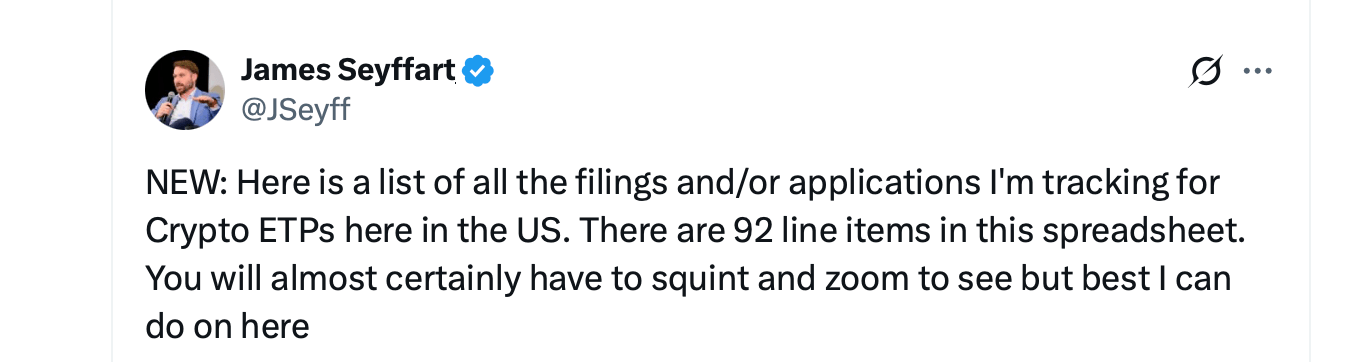
Single-asset conversions and spot proposals dominate the middle of Seyffart’s chart. Grayscale has conversion filings for litecoin, solana, XRP, avalanche, hedera, and polkadot trusts, mirroring its current lineup, with Seyffart’s image showing NYSE Arca or Cboe as the proposed venues. Canary appears repeatedly as a placeholder filer across several single-asset spot concepts (including LTC, SOL, XRP, HBAR, and SUI), illustrating the breadth of “shell” registrations that keep optionality open while sponsors finalize partners and service providers. Coinshares, Franklin Templeton, Fidelity, Invesco and Galaxy, Vaneck, 21shares, and Wisdomtree each appear with their own SOL or XRP spot ETFs slated for Nasdaq, NYSE Arca, or Cboe.
The SOL and XRP tranche is the largest cluster. Vaneck’s Solana Trust, 21shares’ Core Solana ETF, Bitwise’s Solana ETF, Franklin Templeton’s Solana ETF, Fidelity’s Solana ETF, and the Invesco/Galaxy Solana ETF are all present; on the XRP side, the roster includes conversions and spot ETFs from Grayscale, Bitwise, 21shares, Coinshares, Franklin Templeton, and Wisdomtree, plus Canary placeholder entries. Seyffart’s image shows solana and XRP as the most frequently targeted altcoins among the 92 applications.
Beyond those two altcoins, there are also filings tied to cardano, avalanche, polkadot, and hedera. Grayscale’s Cardano Trust conversion appears, and a Vaneck Avalanche product is listed alongside a Grayscale Avalanche conversion; Bitwise has dedicated DOGE and Aptos entries, and the table notes a 21shares Polkadot ETF as well. These single-asset spot filings sit next to “American-made crypto basket” concepts and a Kraneshares “CF Large Cap Crypto” basket, reflecting a mix of index and single-coin approaches.
The list also captures ethereum (ETH)-specific structures. Alongside traditional spot ETH (and previously approved Ether ETFs), the sheet shows an “Ethereum ETF Options (ETHA)” concept and an “ethereum staking” wrapper from 21shares/Cboe and a parallel staking-enabled approach from Grayscale on NYSE Arca, indicating issuers are testing SEC tolerance for yield-bearing constructs within the ETF format. Final-decision dates in the table extend into October, with earlier deadlines delayed, consistent with recent coverage of the SEC’s review cadence.
Several entries on the image relate to conversions of existing over-the-counter (OTC) products. Osprey’s OBTC conversion appears on the sheet, alongside Grayscale’s conversions noted above, positioning those issuers to move long-standing trusts into the 1933/1934 Act ETF chassis pending exchange rule approvals (19b-4s) where required. The chart’s legend reminds readers that 1940 Act funds (derivatives-based) do not need 19b-4 approvals; that’s why many leveraged or inverse products in the lower half show no exchange rule filing.
Newcomer filings tied to Truth/Yorkville appear repeatedly: “Truth Social Bitcoin ETF” and a “Crypto Blue Chip ETF,” plus “Crypto ETP generic listing standards” stubs, all assigned to NYSE Arca or Cboe in the image. Those indicate an attempt to pre-clear templated rules for broader crypto ETP listing—an approach exchanges have used in other asset classes to streamline approvals after the first product clears.
The derivatives and levered cohort is quite extensive and mostly in the 1940 Act lane. Proshares appears with a set of solana ( SOL) and XRP futures-based ETFs including “Short Solana,” “-2X Solana,” “2X Solana,” “-2X XRP” and “2X XRP.” Teucrium adds “2X XRP” and “-2X XRP,” and Tuttle Capital floods the bottom block with “2X” funds tied to XRP, SOL, TRUMP, DOGE, MELANIA, BNB, BONK, ADA, LINK, and DOT. The sheet marks these as 1940 Act filings (no 19b-4), and one green date shows the SEC has already signed off on a 2X SOL product earlier this year.
REX-OSPREY’s shelf covers “ ETH + Staking,” BTC, SOL, XRP, BONK, DOGE and a TRUMP-themed product, all in the derivatives bucket. Separately, Bitwise shows Chainlink and NEAR proposals, a standalone Aptos ETF, and a Polkadot entry, while Vaneck’s column includes BNB and a SOL product (plus Avalanche). 21shares adds SUI and ONDO besides its SOL and XRP filings. The repeated presence of Coinbase-centric or “digital asset” baskets—Kraneshares “Coinbase 50 Index,” Coinshares “Digital Asset ETF,” and Canary’s “AXL” entry—rounds out the breadth.
The right-hand columns of Seyffart’s table track prospectus dates, 19b-4 submission dates, and first/second/third/final decision deadlines. Many entries show red dates denoting delays; a legend notes that green dates reflect approvals and yellow cells denote items in limbo. The overall count—92—has been cited across industry coverage in recent months and reflects a notable expansion from filings filed last year.
Read at face value, the slate suggests three parallel paths: continued maturation of spot products (beyond bitcoin and ethereum), conversion of legacy trusts into ETFs, and a broad, derivatives-based layer designed to give registered access to more niche exposures. Whether many of the single-asset altcoin funds ultimately list will hinge on exchange surveillance-sharing, custody arrangements, and the SEC’s comfort with market quality—issues that have guided recent deferrals and fueled staggered timelines across the table.
If approved in meaningful numbers, these filings would extend the ETF market beyond bitcoin and ethereum into a menu that includes solana, XRP, cardano, avalanche, hedera, polkadot, chainlink, NEAR, aptos, sui, BNB, and more, across Nasdaq, NYSE Arca, and Cboe.


Ayrıca Şunları da Beğenebilirsiniz

Sam Bankman-Fried Drops New Trial Bid, Appeal Still Active

South Korea’s Crucial Crackdown: Crypto and Financial Assets Now Scrutinized in Debt Adjustment Reviews




