Stellar Price Slips as XLM Enters a Make-or-Break Zone: Can Sellers Push It Lower?
The post Stellar Price Slips as XLM Enters a Make-or-Break Zone: Can Sellers Push It Lower? appeared first on Coinpedia Fintech News
Stellar (XLM) remains under pressure as the broader crypto market struggles to regain traction, keeping buyers on the defensive. Stellar price has continued to face bearishness and price action has weakened steadily over recent sessions, pulling XLM back toward a key demand zone that previously acted as a base for rebounds. The token is no longer pricing optimism, yet it has not entered capitulation either. XLM’s next move around current levels will determine whether the move lower evolves into a deeper breakdown or stabilizes into another consolidation phase.
Exchange Netflows Point to Supply Dominance
Recent exchange flow data paints a cautious picture for XLM. After a period of relatively balanced flows, net inflows have turned positive, with millions of XLM tokens moving onto centralized exchanges over a short window. This shift typically reflects increased sell-side readiness rather than accumulation, especially when it coincides with weakening price structure.
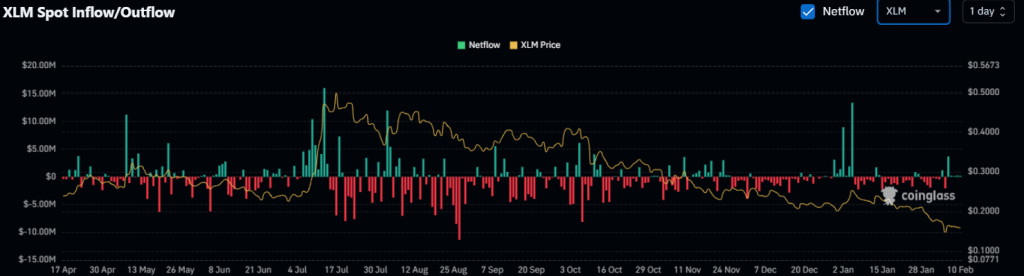
Historically, similar inflow patterns in XLM have preceded periods of downside continuation rather than immediate reversals. The logic is simple: when supply migrates to exchanges during declining momentum, sellers are positioning ahead of potential volatility rather than stepping aside. At the same time, there is little evidence of aggressive exchange outflows that would signal strong dip-buying behavior. Without that counterbalance, price remains exposed to further pressure if market sentiment deteriorates again.
Stellar Price Structure Remains Bearish: Can Bulls Defend $0.1500?
Amidst the broader market headwinds, Stellar price has continued to underperform and slipped below its prior support zone of $0.2000. XLM has traded below its short-term moving averages and displayed lower lows, with each rebound capped below previous resistance levels. As XLM price traded below its short-term moving averages, the momentum tilted to the downside.
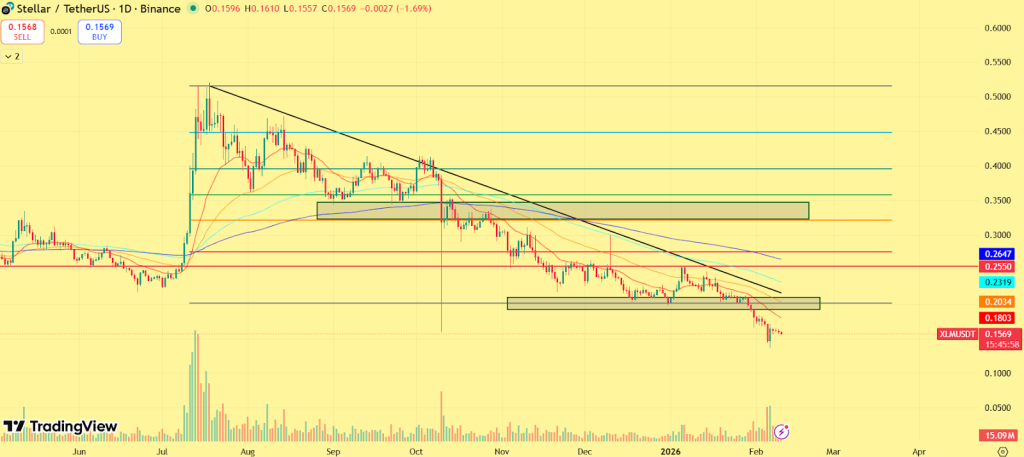
The most notable shift occurred when XLM price flipped its former demand zone into overhead supply. Moreover, momentum indicators also align with this structure, the RSI and MACD indicators display negative crossover, underlying the bearish outlook. The current setup suggests that XLM is not yet in a basing phase. Instead, price appears to be compressing beneath resistance, a condition that often resolves lower if demand does not return decisively. Until XLM price does not reclaim the $0.2000 mark, the downtrend remains intact.
Final Thoughts
Despite slowing downside momentum, Stellar’s market structure does not yet support a bullish thesis. Exchange flows continue to reflect available supply, volume favors sellers, and price remains trapped beneath key hurdles. For now, XLM appears to be consolidating under bearish control, not forming a base. Until on-chain data shifts toward accumulation and price reclaims broken levels with authority, rallies are likely to face selling pressure rather than spark trend reversal.
Ayrıca Şunları da Beğenebilirsiniz

YZi Labs Binance Deposit: A $6.63M Signal That Could Shake the ID Token Market

BitGo wins BaFIN nod to offer regulated crypto trading in Europe
BitGo’s move creates further competition in a burgeoning European crypto market that is expected to generate $26 billion revenue this year, according to one estimate. BitGo, a digital asset infrastructure company with more than $100 billion in assets under custody, has received an extension of its license from Germany’s Federal Financial Supervisory Authority (BaFin), enabling it to offer crypto services to European investors. The company said its local subsidiary, BitGo Europe, can now provide custody, staking, transfer, and trading services. Institutional clients will also have access to an over-the-counter (OTC) trading desk and multiple liquidity venues.The extension builds on BitGo’s previous Markets-in-Crypto-Assets (MiCA) license, also issued by BaFIN, and adds trading to the existing custody, transfer and staking services. BitGo acquired its initial MiCA license in May 2025, which allowed it to offer certain services to traditional institutions and crypto native companies in the European Union.Read more