

Pyth Network (PYTH) Price Prediction 2026-2030: Will PYTH Hit $0.078 Soon?
- Pyth Network’s Robinhood listing causes initial surge, then retraces quickly.
- Retail access expands with Robinhood listing, but price remains volatile.
- Will sustained demand follow Robinhood’s Pyth listing or fade away?
Pyth Network (PYTH) price is currently trading near $0.0614, having spiked 10% earlier this week following the announcement that Robinhood has listed the token for trading. Although the initial surge to $0.068 was short-lived and has since retraced as traders took profits, the listing marks a significant step in expanding retail access to the oracle network token. With Robinhood’s large user base now able to trade PYTH, the token has garnered increased attention. However, the question remains: will this listing lead to sustained demand and a breakout toward higher levels?
Robinhood Listing Expands Retail Access
Robinhood announced that PYTH is now available for trading on its crypto platform, including for users in New York, a state with some of the strictest cryptocurrency regulations. This listing provides exposure to Pyth Network for Robinhood’s extensive retail user base, many of whom may not have had access to the token through other exchanges. The New York availability is particularly significant as many tokens are unavailable to residents of the state due to regulatory restrictions. This makes the Robinhood listing a key distribution channel for Pyth.
Also Read: Jupiter (JUP) Price Prediction 2026-2030: Will JUP Hit $0.70 Soon?
Following the announcement, PYTH experienced a sharp spike from $0.058 to $0.068 within hours. However, as is often the case with exchange listing news, the price has since retraced, with traders taking profits. The key question is whether the listing will generate sustained demand from Robinhood users, particularly if they view Pyth’s oracle infrastructure as an attractive investment opportunity. PYTH powers price feeds across decentralized finance (DeFi), providing data for protocols that require reliable off-chain information.
Price Fades Initial Spike
PYTH Price Dynamics
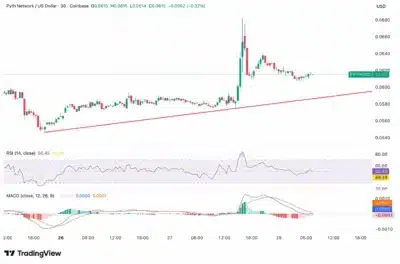
The intraday chart illustrates the dynamics surrounding the Robinhood listing. On the 30-minute timeframe, PYTH had been forming an ascending trendline from the January 26 low near $0.054 before the Robinhood news triggered the vertical spike. Price reached $0.068 before sellers emerged, pushing it back toward pre-announcement levels. The Relative Strength Index (RSI) has returned to 50.45, indicating neutral territory following the volatility spike, while the MACD remains flat near zero, reflecting consolidation after the failed breakout.
Source: Tradingview
The $0.062 level now acts as a pivot. If PYTH holds above this zone, it would suggest that the Robinhood listing has generated some lasting demand. However, if the price drops below $0.060, it would indicate that the initial pump has faded, and the token could be heading lower.
Descending Triangle Dominates Daily Structure
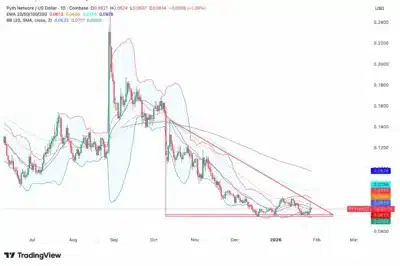
On the daily chart, Pyth Network (PYTH) continues to trade within a descending triangle pattern, a technical structure that has constrained price action since October. This pattern features lower highs that are compressing against horizontal support at the $0.053 level. The lower Bollinger Band has now converged at this support zone, suggesting the price is in a consolidation phase. Currently, the price is positioned near the 20-day exponential moving average (EMA) at $0.0613, as well as the middle line of the Bollinger Bands at $0.0625, which further indicates that the market is waiting for a decisive move.
The key resistance levels to watch for PYTH include the immediate resistance at $0.0658, represented by the 50 EMA. If the price pushes higher, the next significant resistance is found at $0.0717, near the upper Bollinger Band. Above that, trend resistance at $0.0784, represented by the 100 EMA, will come into play, and further upward movement would need to break through long-term resistance at $0.0978, indicated by the 200 EMA.
Support for PYTH lies at the $0.053 level, where the descending triangle forms a strong base. Additionally, the lower Bollinger Band provides further support at $0.0533. If the price fails to hold these levels and breaks below $0.053, it could open the door for a further decline toward the $0.040 target.
Typically, descending triangles resolve with a breakdown, but strong support at these levels, combined with fundamental catalysts like the Robinhood listing, could potentially trigger an upside breakout instead. The upcoming price action will depend on whether buyers continue to step in and defend these critical levels.
Outlook: Will The Listing Drive Sustained Demand?
The technical setup is currently facing a bearish structure with the descending triangle, but the Robinhood listing provides a potential bullish catalyst. Although the initial price spike has faded, the expanded retail access could lead to gradual accumulation over time. Whether this results in a sustained uptrend depends on whether Robinhood users continue to show interest in Pyth’s oracle infrastructure.
If the price holds above $0.060 and the Robinhood listing generates steady retail inflows, a close above $0.065 would break the descending trendline. This would open up the possibility of targeting resistance at $0.072 and potentially $0.078. A strong breakout could then push PYTH toward its 100 EMA resistance near $0.0784.
If the price fails to maintain above $0.060 and drops below the $0.053 triangle support, it would confirm that the listing pump has faded. In this case, the price could retest the $0.053 support level and potentially decline to the $0.040 target if selling pressure increases.
Source: Tradingview
Pyth Network Price Predictions (2026–2030)
| Year | Minimum Price | Average Price | Maximum Price |
|---|---|---|---|
| 2026 | $0.053 | $0.061 | $0.078 |
| 2027 | $0.075 | $0.10 | $0.15 |
| 2028 | $0.12 | $0.18 | $0.25 |
| 2029 | $0.18 | $0.30 | $0.40 |
| 2030 | $0.25 | $0.40 | $0.50 |
Year-by-Year Insights
2026
In 2026, PYTH is likely to remain in a consolidation phase following the Robinhood listing. Price action is expected to fluctuate between $0.053 and $0.078 as the token absorbs the effects of the listing. The expanded retail access could slowly drive accumulation, but broader market conditions will heavily influence price movement.
2027
By 2027, the increased visibility from the Robinhood listing should help push PYTH toward higher levels. If retail interest continues to grow, PYTH could break past the $0.078 resistance and reach the $0.10-$0.15 range, especially as the token gains further adoption within the DeFi ecosystem.
2028
In 2028, as Pyth continues to expand its reach and infrastructure, the price could see a significant surge. The token may benefit from increased demand for decentralized oracle services in DeFi, pushing the price to the $0.18-$0.25 range.
2029
By 2029, PYTH could see more stability and higher adoption as the demand for decentralized oracles grows. If Pyth’s infrastructure becomes more widely used in the DeFi space, the price could range from $0.30 to $0.40.
2030
In the long term, PYTH has strong potential if it continues to solidify its position as a leading decentralized oracle network. By 2030, the token could reach prices of $0.40-$0.50, supported by sustained adoption and integration into DeFi protocols.
Conclusion
The Robinhood listing of PYTH represents a major step toward increasing retail access to the oracle network token. Although the initial price spike has faded, the listing could lead to gradual accumulation over time if sustained demand develops. The token remains in a consolidation phase, with technical indicators suggesting a key decision point at the $0.060 level. Whether PYTH breaks out to $0.078 or faces further downside will depend on the continued interest from Robinhood users and the broader market environment.
FAQs
1.What is the current market situation for PYTH in 2026?
PYTH is currently consolidating near $0.0614, having spiked following the Robinhood listing but retraced as traders took profits. The token is testing support levels and facing resistance at $0.078.
2. What is the significance of Robinhood listing PYTH?
The Robinhood listing expands PYTH’s retail access, particularly for users in New York, who previously had limited access to the token due to regulatory restrictions.
3. What is the current price trend for PYTH?
The price is in a consolidation phase, with support around $0.053 and resistance near $0.078. The token is currently trading near the 20-day EMA at $0.0613.
4. What is the bullish case for PYTH?
A close above $0.065 would signal that retail demand from Robinhood users is driving the price higher, with the next target at $0.078.
5. What is the long-term outlook for PYTH?
By 2030, PYTH could reach prices of $0.40-$0.50, supported by broader adoption and sustained growth in the decentralized oracle space.
Also Read: World Mobile Token (WMTX) Price Prediction 2026–2030: Can WMTX Hit $1.85 Soon?
The post Pyth Network (PYTH) Price Prediction 2026-2030: Will PYTH Hit $0.078 Soon? appeared first on 36Crypto.
Ayrıca Şunları da Beğenebilirsiniz

ETH Exit Queue Gridlocks As Validators Pile Up

TheWell Bioscience Launches VitroPrime™ 3D Culture and Imaging Plate for Organoid and 3D Cell Culture Workflows
