A recent November 2025 report from ApeX Protocol offers a fresh snapshot of the global geography of crypto…A recent November 2025 report from ApeX Protocol offers a fresh snapshot of the global geography of crypto…

China leads global crypto mining ranking as US dominance grows- report

2025/12/10 21:51

A recent November 2025 report from ApeX Protocol offers a fresh snapshot of the global geography of crypto mining. According to the study, the world’s top ten mining nations continue to shape the bulk of global production, with surprising findings about energy efficiency, mining pressure on power grids and potential room for growth.

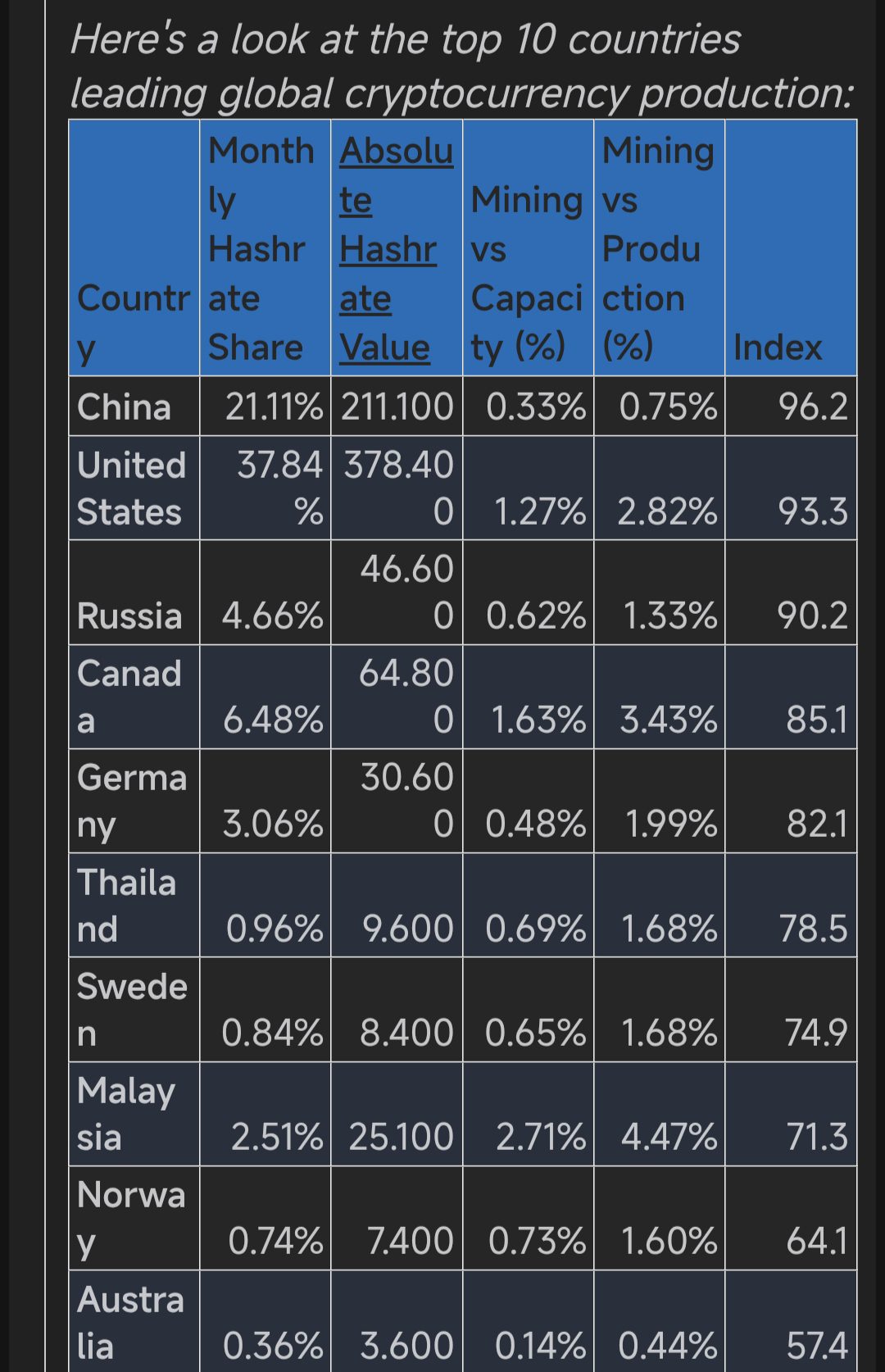
At the top of the ranking is China, producing 21.11 per cent of the global monthly hashrate. What stands out is the country’s efficiency. China reportedly uses just 0.33 per cent of its total electricity capacity for mining operations.

Even compared to overall national electricity production, crypto mining consumes a paltry 0.75 per cent, despite China having the highest total electricity generation in the study. With a final “ApeX index” score of 96.2, China remains the world’s leading crypto producer and, according to the report, has room to expand further without overtaxing its grid.
Africa is missing out on a key pillar of the global digital economy – crypto miningTop ten crypto-producing countries

Closely behind is the United States, responsible for 37.84 per cent of the global monthly hashrate share, more than a third of all global crypto mining activity. That makes the US the biggest crypto-mining nation in absolute terms.

However, this comes with a heavier impact on electricity systems: mining in the US accounts for 1.27 per cent of electricity capacity and 2.82 per cent of total power production. With a final index score of 93.3, the US remains a powerhouse, but the strain on infrastructure is clearly higher than China’s.

Also read: Crypto mining: Africa is missing out on a key pillar of the global digital economy

Other players: Russia, Canada, Germany and more

Russia takes third place with 4.66 per cent of global crypto mining output. Russian operations consume only 0.62 per cent of total electricity capacity, or 1.33 per cent of production, yielding an index score of 90.2.

Canada ranks fourth, contributing 6.48 per cent of the global hashrate while using 1.63 per cent of its electrical capacity, equal to 3.43 per cent of its total power production. That produced a score of 85.1.

In Europe, Germany leads with a 3.06 per cent share of global mining. German miners use just 0.48 per cent of the country’s electricity capacity, representing 1.99 per cent of national production. The country attained an index score of 82.1, cementing its place as the continent’s most efficient mining hub.

China still leads global crypto mining, but US dominance grows — a new report shows shifting patterns

Beyond the top five, the report highlights several emerging or efficient mining nations. Malaysia, for instance, devotes nearly 5 per cent of its electricity production to mining, among the highest rates globally.

With 2.51 per cent of the global hashrate, Malaysia earned a 71.3 index score, showing how smaller economies can attract mining activity through heavy energy dedication. Other countries in the top ten include Sweden, Thailand, Norway and Australia, each with modest hashrate shares but varying energy-use patterns and grid impact.

What the data reveal, and why it matters

The study by ApeX Protocol evaluated countries across four metrics: share of global mining activity; total computing (hash) power; electricity-use efficiency; and stress on national power grids.

The final index reflects each country’s ability to balance large-scale production with grid stability. Under that lens, China’s mining machine stands out. Producing over a fifth of global crypto while using only a fraction of its power capacity gives it a clear edge.

The United States, while the largest in absolute mining terms, seems to carry a greater energy and infrastructure burden. Russia and Canada offer mixed models, combining decent output with moderate energy consumption.

Meanwhile, smaller or emerging mining nations such as Malaysia show how mining can take root in unexpected places, though their high proportion of energy production dedicated to mining raises questions about sustainability and grid stress.

China still leads global crypto mining, but US dominance grows — a new report shows shifting patternsCrypto mining by location

Apex Protocol’s spokesperson noted that crypto mining “has become a serious economic sector that governments can’t ignore anymore.” The study underscores how even relatively small countries can influence the global mining landscape if they channel sizeable portions of their energy grids toward mining operations.

Yet that kind of energy dedication inevitably pushes up pressure on national power infrastructures, making it imperative for regulators to keep systems of checks and balances in place.

At a moment when energy policy, climate concerns and geopolitics increasingly shape the future of crypto, this report offers a clear barometer. It reveals where large-scale mining thrives, where it risks overburdening systems, and where there may still be room for growth, setting the stage for fresh competition among mining hubs and fresh scrutiny by regulators.

Sorumluluk Reddi: Bu sitede yeniden yayınlanan makaleler, halka açık platformlardan alınmıştır ve yalnızca bilgilendirme amaçlıdır. MEXC'nin görüşlerini yansıtmayabilir. Tüm hakları telif sahiplerine aittir. Herhangi bir içeriğin üçüncü taraf haklarını ihlal ettiğini düşünüyorsanız, kaldırılması için lütfen service@support.mexc.com ile iletişime geçin. MEXC, içeriğin doğruluğu, eksiksizliği veya güncelliği konusunda hiçbir garanti vermez ve sağlanan bilgilere dayalı olarak alınan herhangi bir eylemden sorumlu değildir. İçerik, finansal, yasal veya diğer profesyonel tavsiye niteliğinde değildir ve MEXC tarafından bir tavsiye veya onay olarak değerlendirilmemelidir.

Ayrıca Şunları da Beğenebilirsiniz

Luxembourg adds Bitcoin to its wealth fund, but what does that mean for Europe?

Luxembourg adds Bitcoin to its wealth fund, but what does that mean for Europe?

The post Luxembourg adds Bitcoin to its wealth fund, but what does that mean for Europe? appeared on BitcoinEthereumNews.com. Key Takeaways Why does Luxembourg’s move matter? It’s the first Eurozone nation to include Bitcoin in a sovereign wealth fund. How does it fit into Europe’s bigger picture? The UK is opening crypto ETNs to retail investors, and the EU’s ESMA is expanding its oversight. Luxembourg has become the first Eurozone country to invest part of its sovereign wealth fund in Bitcoin. During the presentation of the 2026 Budget at the Chambre des Deputes, Finance Minister Gilles Roth confirmed that the Fonds Souverain Intergenerationnel du Luxembourg (FSIL) — the nation’s sovereign wealth fund — has allocated 1% of its portfolio to Bitcoin. Luxembourg’s Bitcoin play According to Bob Kieffer, Director of the Treasury, the decision reflects “the growing maturity of this new asset class” and “leadership in digital finance.” Under the FSIL’s revised investment policy, up to 15% of total assets can now be placed in alternative investments. This includes investments in private equity, real estate, and crypto assets. The Bitcoin exposure, roughly €8.5 million [around $9 million USD], is being made through ETFs to avoid custody and operational risks. Kieffer also acknowledged differing opinions about the move. He said,  “Some might argue that we’re committing too little too late; others will point out the volatility and speculative nature of the investment. Yet, given the FSIL’s mission, a 1% allocation strikes the right balance while sending a clear message about Bitcoin’s long-term potential.” A cautious, but symbolic shift The FSIL, created in 2014 to preserve wealth across generations, now manages roughly €850 million. The announcement also comes on the back of Luxembourg tightening its digital asset regulatory framework, while preparing to implement DAC8. This new move will expand tax and reporting standards for crypto service providers in 2026. If Bitcoin continues to gain acceptance among sovereign investors, Luxembourg’s decision could…
Paylaş
BitcoinEthereumNews2025/10/10 02:02
XRP Fractal Signals $6–$7 Surge by November Amid DLT Disruption

XRP Fractal Signals $6–$7 Surge by November Amid DLT Disruption

The post XRP Fractal Signals $6–$7 Surge by November Amid DLT Disruption appeared on BitcoinEthereumNews.com. XRP Fractal Analysis Hints at $6–$7 Breakout by Mid-November According to renowned market analyst EGRAG CRYPTO, XRP may be on the verge of a significant price movement. In his latest analysis, he points to a fractal formation pattern that suggests XRP could reach the $6–$7 range by mid-November.  Source: EGRAG CRYPTO This projection has quickly caught the attention of traders and long-term investors, as XRP’s current price remains well below this target. Fractals, often used in technical analysis, are recurring chart patterns that can help predict future price action by identifying historical similarities in market behavior.  Therefore, EGRAG CRYPTO argues that XRP is currently mirroring a previous structure that led to a notable rally. If this fractal setup plays out as expected, it could mark one of the most significant price surges for the digital asset in recent years. If XRP reaches $6–$7 by mid-November, it would mark a major win for investors and a symbolic breakthrough for a token that has endured regulatory battles and market volatility, validating its resilience and cementing its relevance in the evolving digital finance ecosystem. Meanwhile, a recent cup-and-handle pattern signalled that XRP had the potential of soaring to $15 by year-end with the altcoin presently trading at $3.04 per CoinGecko data.  DLT-Based Solutions: How Ripple and Stellar are Redefining Cross-Border Banking According to crypto observer SMQKE, distributed ledger technology (DLT)-based solutions are increasingly challenging the traditional correspondent banking model.  For decades, cross-border payments have relied on a chain of intermediaries, often resulting in slow settlements, high costs, and limited transparency. But with the rise of blockchain networks such as Ripple and Stellar, the industry is experiencing a seismic shift. The correspondent banking model depends on trust and pre-funded accounts, locking up liquidity and exposing banks to counterparty risk.  Transactions often take days to…
Paylaş
BitcoinEthereumNews2025/09/19 16:12