SpaceX Drops to $153 on Nasdaq-100 Entry: The Mechanics Behind the 30% Correction
A classic market paradox played out on Wall Street today. On July 7, 2026, Space Exploration Technologies Corp. (NASDAQ: SPCX) officially became a constituent of the prestigious Nasdaq-100 Index, completing the fastest-ever inclusion process (just 15 trading days post-IPO) for a mega-cap asset.
Yet, instead of a liquidity-driven rally fueled by billions of dollars in mandatory passive index buying, SpaceX stock gap-downed and slumped 4.75% to $153.31 during morning trading in New York.
With this latest decline, the newly listed aerospace and AI giant has now corrected roughly 30% from its post-IPO lifetime high of $225.64 printed mid-June. This aggressive cooling-off phase has shifted institutional focus away from initial listing euphoria toward the stark realities of market structure and upcoming structural supply unlocks.
Macro & Market Structure Profile
| Operational & Index Metric | SpaceX (NASDAQ: SPCX) Standing | Market Impact Mapping |
|---|---|---|
| Current Stock Price | $153.31 (Down 4.75% intraday) | Testing the key $149 to $155 triple-bottom support zone |
| Market Capitalization | ~$2.02 Trillion | Sustaining its multi-trillion valuation anchor |
| 52-Week Range | $147.11 (Post-IPO low) to $225.64 (Peak) | Trading near the initial June 12 debut close |
| Index Inclusion Date | July 7, 2026 (Pre-Market Effective) | Passive fund rebalancing flows legally finalized |
| Next Critical Catalyst | Early August 2026 (Q2 Earnings Release) | Triggers the first fractional internal insider lock-up expiry |
The Catalysts: Why a Massive $4.3B Forced Buy Generated a Slide
For broad-market retail observers, watching a stock drop on the exact day passive giant Invesco QQQ (and other index trackers) deployed an estimated $4.3 billion in non-discretionary capital into SPCX seems impossible. However, specialized trading desks look at three structural reasons behind the rotation:
1. Technical Exhaustion of the Front-Running Trade
Index inclusion is a notorious "buy the rumor, sell the news" mechanism. Active institutional funds, hedge funds, and market makers had already aggressively accumulated SPCX over the past two weeks, notably spiking the price when Nasdaq formally announced the inclusion parameters and following Starlink's landmark mobile connectivity partnership with Charter. Today, as passive index managers were legally forced to buy the stock at the market open, active desks used that massive pool of predictable liquidity to dump their positions and lock in early profits, completely overwhelming the passive bidding gate.
2. The Staggered Lock-Up Overhang
While SpaceX went public with a restrictive 3% to 5% public float, the structural scarcity premium that propped up the initial $225 run is fast approaching its expiration date. Unlike traditional IPOs that use a rigid 180-day cliff lock-up, SpaceX engineered a customized, multi-tranche unlock schedule.
The first significant release, representing nearly 20% of previously locked insider, employee, and early-backer shares, will hit the market immediately following the company's Q2 financial reporting sequence in early August. Active portfolios are pricing in this impending wall of secondary supply a month in advance.
3. Fundamental Valuation Gravity
Even after a steep 30% haircut from its local peak, SpaceX's valuation remains exceptionally rich. Trading at an implied multiple of over 100 times trailing sales, the company's $2.02 trillion capitalization requires massive forward execution. While long-term institutional coverage initiated today remains highly bullish (with Deutsche Bank setting a $255 target and Goldman Sachs starting at $205, citing the Starship transportation moat and Starlink surpassing 10 million global subscribers), short-term momentum traders are unwilling to carry premium multiples during a broader macroeconomic tech consolidation.
Structural Trajectories: Mapping the Next Support Horizons
For active trading accounts monitoring capital deployment or derivative positioning on MEXC RealStocks, SPCX's immediate trajectory depends on a pivotal technical boundary.
$153.31 Current Spot ──> [$149 - $155 Triple Bottom Support] ──> Breakdown opens path to $135 IPO Base
The Accumulation Floor ($149 to $155 Zone): SpaceX is currently retesting its post-listing structural support range. If long-term institutional buyers step in to defend this boundary over the weekly close, the technical damage will be contained, forming a stable consolidation base ahead of August operations.
The Valuation Reset (Breakdown below $149): If macro selling pressure forces a clean break below $149, the stock loses its primary local floor. This opens a clear technical path toward a full mean-reversion test of its initial $135.00 IPO base price, a common historical trajectory for mega-caps entering their secondary post-listing correction phase.
What Traders Usually Miss
The Single-Stock Volatility Trap: Historical precedents show that large-scale index inclusions frequently mark local structural tops. Notable mega-caps added to the Nasdaq-100 over the past 24 months routinely experienced 25% to 40% retracements immediately following their inclusion dates as mechanical index demand cleared out, leaving the stock temporarily exposed to raw fundamental valuation reviews.
The "Brake-Mechanism" Unlock Trigger: Part of SpaceX's insider unlock design states that a specific 10% tranche of internal shares automatically frees up if the stock maintains a trading premium 30% above the IPO price ($175.50). By keeping the stock pinned below $160 today, short-sellers and institutional accumulators are effectively blocking that extra supply from accelerating onto the tape early, keeping the market containerized.
The AI Compute Revenue Valuation Insulation: Amid the rocket launch volatility, Wall Street is increasingly evaluating SpaceX through an infrastructure lens. The company's expanding, multi-billion dollar satellite-delivered low-cost cloud compute leasing pipelines provide a recurring revenue profile that traditional aerospace entities cannot replicate, setting a firm fundamental long-term floor beneath the cyclical hardware dips.
Bottom Line
This looks more like a healthy, structural clearing of short-term speculative leverage than a fundamental breakdown of the SpaceX long-term thesis. The fast-track index inclusion narrative has run its course, and the stock is transitioning into a fundamental price-discovery phase. For active traders, trying to aggressively chase the asset directly during a technical index-rebalancing selloff carries high near-term friction. Waiting for the price action to cleanly validate the $149 to $155 triple-bottom support during the weekly close offers a vastly superior risk-to-reward setup before positioning for the August earnings print.
Risk Warning
Trading newly listed mega-cap technology and aerospace equities involves high capital exposure, extreme price volatility, and unique market structure mechanics. Forced index fund flows can temporarily decouple stock prices from baseline enterprise value. Strict risk management boundaries, appropriate position sizes, and continuous monitoring of the upcoming August earnings disclosures and internal employee share unlocks are strongly advised before executing any market orders.
Popular Articles
View More
RKLB Stock Price Prediction 2026–2030: Neutron, Iridium, Defense and RKLBON Outlook
Summary Predicting Rocket Lab (NASDAQ: RKLB) through 2030 requires more than extrapolating its current revenue growth. Rocket Lab is simultaneously developing Neutron, expanding defense programs,

Rocket Lab Stock Analysis: Electron, Neutron, Space Systems, Defense Contracts and Backlog
Summary Rocket Lab's investment case in 2026 has moved beyond the simple question: “How many Electron rockets can it launch?” The company now spans: Launch; Hypersonic testing; Spacecraft; Satellite

How to DCA Into RKLBON on MEXC: A Step-by-Step Spot DCA Guide
Summary Dollar-cost averaging (DCA) divides an intended investment into multiple recurring purchases instead of committing the full amount at one entry price. For users interested in RKLBON, MEXC

What Is Rocket Lab (NASDAQ: RKLB) Stock? Electron, Neutron, Space Systems, Iridium and Growth Opportunities
Summary Rocket Lab Corporation (NASDAQ: RKLB) is an end-to-end space company providing launch services, spacecraft, satellite components, mission software, payload technologies and on-orbit solutions
Hot Crypto Updates
View More
Bitcoin Fee Tracker & Guide: Understanding Mempool, sat/vB, and Real Transaction Costs
Overview As of roughly 07:00 UTC on October 13, with the chain at block 971,119, moving bitcoin on-chain costs almost nothing. The recommended fee endpoint at mempool.space puts the next-block tier

Accenture FY2027 Earnings Preview: Will AI Demand Supercharge Growth?
Overview Accenture reports fourth-quarter and full-year fiscal 2026 results before the U.S. market opens on October 1, with a conference call at 8:00 a.m. Eastern, a schedule the company confirmed in

Accelevation IPO: AI Data Center Infrastructure Firm Eyes $5.4B Valuation
Overview The next entry ticket to the AI capital-expenditure cycle is moving from compute itself toward the infrastructure that sits between the grid and the rack. On September 22, Accelevation, a

Dogecoin Goes to the Moon as Corporate Treasuries Bail: DOGE-1 Launches While CleanCore's 463 Million DOGE Exit Exposes the Meme Coin Treasury Trap
Key Takeaways DOGE-1, the first space mission ever paid for entirely in Dogecoin (DOGE), was scheduled to lift off on Monday, September 14, 2026 aboard a SpaceX Falcon 9 rideshare from Kennedy Space
Trending News
View More
SpaceX Sonic Boom: Why SpaceX Launches and Dragon Reentries Cause Loud Booms
SpaceX sonic booms often surprise residents in California and other launch or reentry regions, especially around Vandenberg Space Force Base and Southern California splashdown paths. The loud sound is
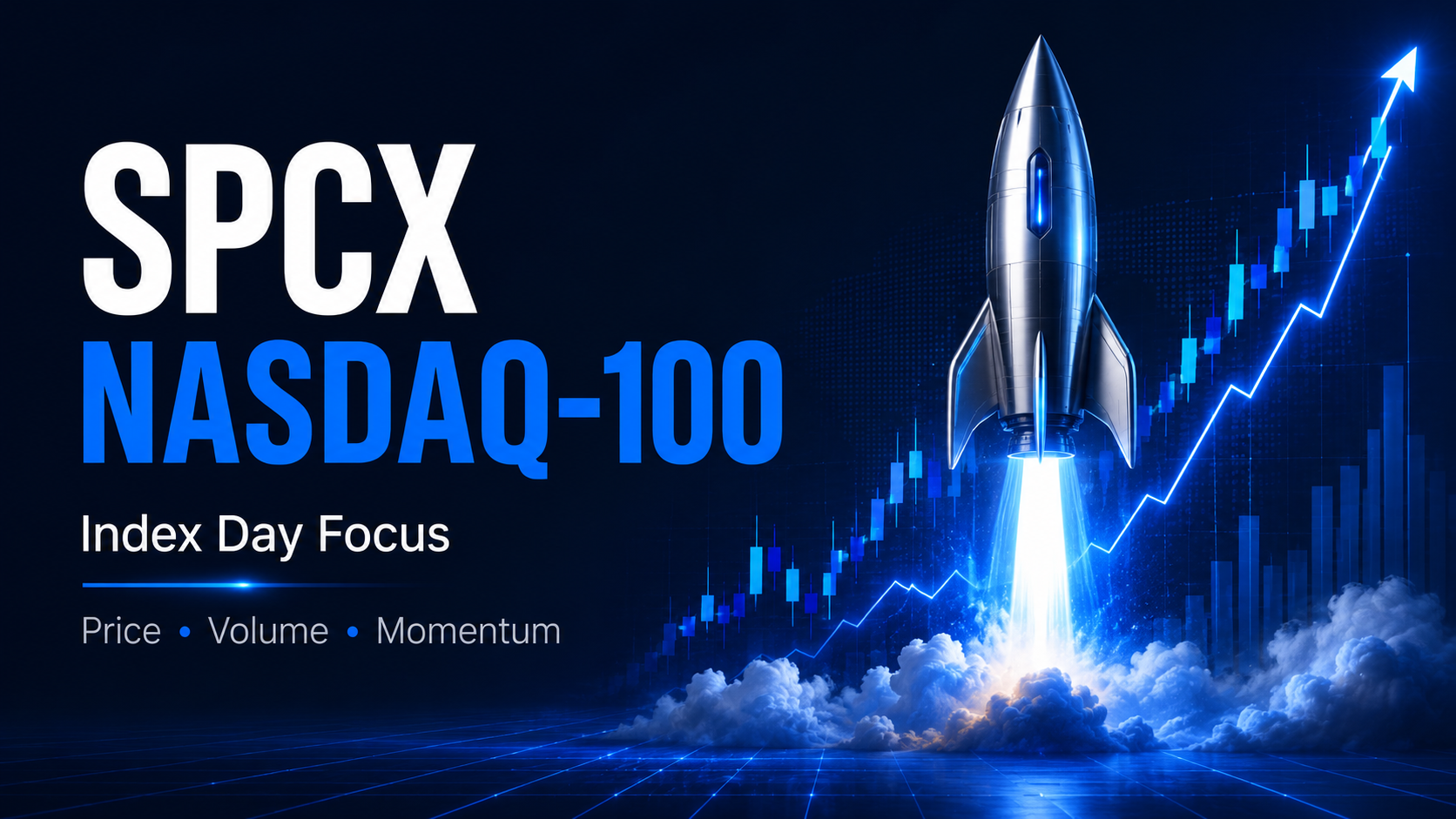
SPCX Nasdaq-100 Inclusion: Why Price, Volume and Momentum Matter on Index Day
SPCX is set to enter the Nasdaq-100 Index effective at the U.S. market open on July 7, 2026. The inclusion marks a major visibility event for Space Exploration Technologies Corp., but the short-term m


Related Articles
View More
Nominal vs. Real Interest Rates: What Really Moves Stocks, Gold, and Bitcoin?
Financial headlines regularly tell us that interest rates have reached 5%, that a central bank is preparing to cut rates, or that borrowing costs will remain higher for longer. Yet the number in the h
Why Can Stocks Rise After a Rate Hike and Fall After a Rate Cut?
“Rate hikes are bearish, while rate cuts are bullish” is a useful starting point, but a poor prediction rule. Higher rates can reduce stock valuations and increase borrowing costs, while lower rates c
Can Bitcoin Diversify a Traditional Investment Portfolio?
Stocks are largely driven by corporate earnings, economic growth, and valuation. Bonds respond to interest rates, inflation expectations, and credit risk. Gold is influenced by real yields, the US dol