GOOG and GOOGL are two share classes of Alphabet, the parent company of Google. GOOGL, the Class A shares, carries one vote per share, while GOOG, the Class C shares, carries no votes. Both representGOOG and GOOGL are two share classes of Alphabet, the parent company of Google. GOOGL, the Class A shares, carries one vote per share, while GOOG, the Class C shares, carries no votes. Both represent
Learn/Trading Guide/US Stocks/GOOG vs GOO...re Classes?

GOOG vs GOOGL Stock: What Is the Difference Between Alphabet Share Classes?

Beginner
Sep 9, 2026Emma Williams
0m
ShareX
SHARE$0.4652-0.25%
Polytrade
TRADE$0.04349+1.89%
Shiba Inu Treat
TREAT$0.0001639+11.42%
GOOG and GOOGL are two share classes of Alphabet, the parent company of Google. GOOGL, the Class A shares, carries one vote per share, while GOOG, the Class C shares, carries no votes. Both represent the same economic ownership in Alphabet and trade at nearly the same price, so for most investors the difference between them is small.


What Are Alphabet's Share Classes?


Alphabet has three classes of stock, though only two of them trade publicly. Class A shares trade under the ticker GOOGL and come with one vote each. Class C shares trade under the ticker GOOG and come with no votes. There is also a third class, Class B, which is not sold on the open market and is held mainly by Alphabet's founders and insiders.

This structure exists by design. When Google created the non-voting Class C shares in 2014, the goal was to let the company issue equity for uses such as acquisitions and employee compensation without proportionally diluting founder voting control. The result is that public investors can hold similar economic exposure through two tickers while voting power remains concentrated through Class B shares. For the wider business, see MEXC's published Alphabet guide

Ticker
Share class
Voting rights
Traded publicly
GOOGL
Class A
One vote per share
Yes
GOOG
Class C
No voting rights
Yes
Class B
Class B
Ten votes per share
No, held by insiders

What Is GOOGL?


GOOGL is Alphabet's Class A common stock, listed on the Nasdaq. It gives shareholders economic ownership in Alphabet along with one vote per share, which can be used on matters like electing board members and approving major corporate proposals. The distinguishing feature of GOOGL is therefore governance rather than a different economic claim on Alphabet's operating business.

For a company with Alphabet's voting structure, a single public shareholder has limited influence because Class B shares carry super-voting rights. That does not make Class A voting rights meaningless, but it means the practical governance difference between GOOG and GOOGL is smaller than the one-vote-versus-zero-votes headline may suggest.

What Is GOOG?


GOOG is Alphabet's Class C capital stock, also listed on the Nasdaq. It gives shareholders the exact same economic ownership as GOOGL, including the same dividends and the same share of profits, but it carries no voting rights at all. In every financial sense that matters to a typical investor, a GOOG share and a GOOGL share represent the same claim on Alphabet's business.

GOOG was created in 2014 as a non-voting share that Alphabet could hand out to existing shareholders and use as a kind of currency. It let the company pay for acquisitions and reward employees with stock without handing over any additional control. That is why GOOG is sometimes described as Alphabet's growth currency: it delivers economic exposure without touching the founders' voting power.

What Is the Voting Difference?


Voting rights are the single real difference between the two public classes. GOOGL gives one vote per share, while GOOG gives none. Sitting above both is the privately held Class B stock, which carries ten votes per share and is held by Alphabet's founders and insiders, according to Alphabet's annual report. That is the class that truly controls the company.

The practical effect is important to understand. Because the founders hold super-voting Class B shares, they can keep majority control of Alphabet even while owning a minority of its total economic value. This means that even if you own thousands of GOOGL shares, your voting influence remains tiny next to the insiders. So the main Google stock difference between the two classes is real on paper but, for most individual investors, has little practical impact on how the company is run.

How Do Indexes Treat GOOG and GOOGL?


A common misconception is that only one Alphabet share class belongs to major indexes. As of August 31, 2026, S&P Dow Jones Indices lists both Alphabet Class A (GOOGL) and Alphabet Class C (GOOG) as S&P 500 constituents. Index treatment therefore does not create a simple 'GOOGL is in, GOOG is out' distinction from Current constituent data.

Both tickers are highly liquid, but their trading volumes and small price differences can vary over time. Those differences are better understood as market-structure effects rather than evidence that one class represents a superior claim on Alphabet's business.

Do GOOG and GOOGL Trade at Different Prices?


The two classes usually trade at very similar prices because they represent closely aligned economic claims on Alphabet. Small gaps can still appear because of differences in order flow, liquidity, and the value some market participants place on voting rights. That spread is not fixed and can narrow, disappear, or reverse over time.


Two points are worth remembering. First, both classes receive the same dividend per share. Second, because their economics are closely aligned, meaningful price gaps can attract arbitrage and relative-value trading that tends to keep the two classes near one another over time.

What Actually Differs in Practice?


Because the two public classes have closely aligned economics, the practical comparison is about governance, liquidity, and any temporary price gap rather than a different underlying business. Both participate in Alphabet's earnings and receive the same per-share dividend.

GOOGL carries one vote per share; GOOG carries none. Either class can trade at a small premium or discount to the other, and that relationship is not fixed. The more durable analytical point is that the share-class decision changes governance rights at the margin, while the operating thesis still depends on Alphabet's Search, YouTube, Cloud, AI investment, margins, and regulatory exposure.

Alphabet and Real U.S. Stocks on MEXC

GOOG and GOOGL are two public share classes of Alphabet. Current Real U.S. Stock availability on MEXC can be checked at Stock. Product access varies by region, so the live market page should be treated as the source of truth.


FAQ

What is the difference between GOOG and GOOGL?

Both are share classes of Alphabet with identical economic ownership, but GOOGL (Class A) carries one vote per share while GOOG (Class C) carries nvoting rights. They trade at nearly the same price and pay the same dividend.

Do GOOG and GOOGL pay the same dividend?

Yes. Both classes receive exactly the same dividend per share, so there is no difference in income between them. Dividend treatment is identical for GOOG and GOOGL shareholders.

What is the practical difference between GOOG and GOOGL?

GOOGL carries one vote per share while GOOG carries none. Both have closely aligned economic exposure and both are S&P 500 constituents, so the practical differences are governance rights, liquidity, and any temporary price gap between the classes.

Why did Alphabet create two share classes?

Alphabet created the non-voting Class C shares (GOOG) in 2014 so it could issue stock for acquisitions and employee pay without diluting the founders' control. The founders keep control through their super-voting Class B shares.

Are GOOG and GOOGL both in the S&P 500?

Yes. S&P Dow Jones Indices currently lists both Alphabet Class A (GOOGL) and Alphabet Class C (GOOG) as constituents of the S&P 500.
Market Opportunity
ShareX Logo
ShareX Price(SHARE)
$0.4653
$0.4653$0.4653
-0.02%
USD
ShareX (SHARE) Live Price Chart

Popular Articles

View More
Meta Stock Split: Has Meta Ever Split Its Stock and What Could Trigger One?

Meta Stock Split: Has Meta Ever Split Its Stock and What Could Trigger One?

Meta Platforms has never split its stock. Since its May 2012 IPO at $38 per share, first as Facebook under the ticker FB and now as META, the company has completed zero forward splits and zero
SK Hynix ADR Guide: SKHY Listing, HBM Exposure and U.S. Market Access Explained

SK Hynix ADR Guide: SKHY Listing, HBM Exposure and U.S. Market Access Explained

SKHY is the Nasdaq-listed American Depositary Share for SK Hynix, the South Korean memory company and a leading supplier of high-bandwidth memory for AI systems. U.S. trading began in July 2026. Each
Kraken Crypto Exchange Review 2026: 3.7 Out of 5, a 0.80% Entry Taker Fee, Four Licences, and the First Mark on a Clean Custody Record

Kraken Crypto Exchange Review 2026: 3.7 Out of 5, a 0.80% Entry Taker Fee, Four Licences, and the First Mark on a Clean Custody Record

Kraken, the crypto exchange rather than the headset, water-cooler or rum brands that share the name, scores 3.7 out of 5 on our six-dimension scorecard as of September 2026, leading on deposits and
Where Is Anthropic's S-1? Inside the Anthropic IPO Filing June 2026

Where Is Anthropic's S-1? Inside the Anthropic IPO Filing June 2026

Anthropic began its IPO process on June 1, 2026, and more than three months later you still cannot read a single page of the paperwork. That gap is not a delay and not a secret. It is how the SEC's

Hot Crypto Updates

View More
Why Is CoreWeave Stock Tumbling? The $3B Debt and Share Sale Explained

Why Is CoreWeave Stock Tumbling? The $3B Debt and Share Sale Explained

Overview As the broader artificial intelligence infrastructure investment thesis transitions from initial hype to rigorous return on invested capital scrutiny, the market valuation of specialized

Dangote Refinery IPO Goes On-Chain: How Solana and Base Opened Africa's Biggest Listing

Dangote Refinery IPO Goes On-Chain: How Solana and Base Opened Africa's Biggest Listing

Key takeaways Dangote Petroleum Refinery and Petrochemicals FZE opened its initial public offering on September 14, 2026 at ₦525 per share, selling 4.1 billion new ordinary shares for roughly 3.3% of

Apple Stock Outlook After iPhone Duo Launch: Can AAPL Keep Rising?

Apple Stock Outlook After iPhone Duo Launch: Can AAPL Keep Rising?

Overview Global equity markets are reassessing valuation thresholds across megacap technology bellwethers as consumer hardware enters an era centered on edge intelligence. Following the formal

Why Is CooperCompanies Stock Down 15%? COO Earnings and Guidance

Why Is CooperCompanies Stock Down 15%? COO Earnings and Guidance

CooperCompanies stock dropped 15% as Q3 revenue of $1.07 billion missed expectations and Q4 EPS guidance of $1.05 to $1.09 fell short of analyst forecasts. Key Takeaways CooperCompanies equity

Trending News

View More
MEXC On-chain Daily Report: SpaceX IPO Priced at $135 Per Share

MEXC On-chain Daily Report: SpaceX IPO Priced at $135 Per Share

The crypto market continues to be driven by the convergence of traditional finance, AI, and blockchain infrastructure. Digital Asset secured a major $355 million funding round led by a16z crypto, rein
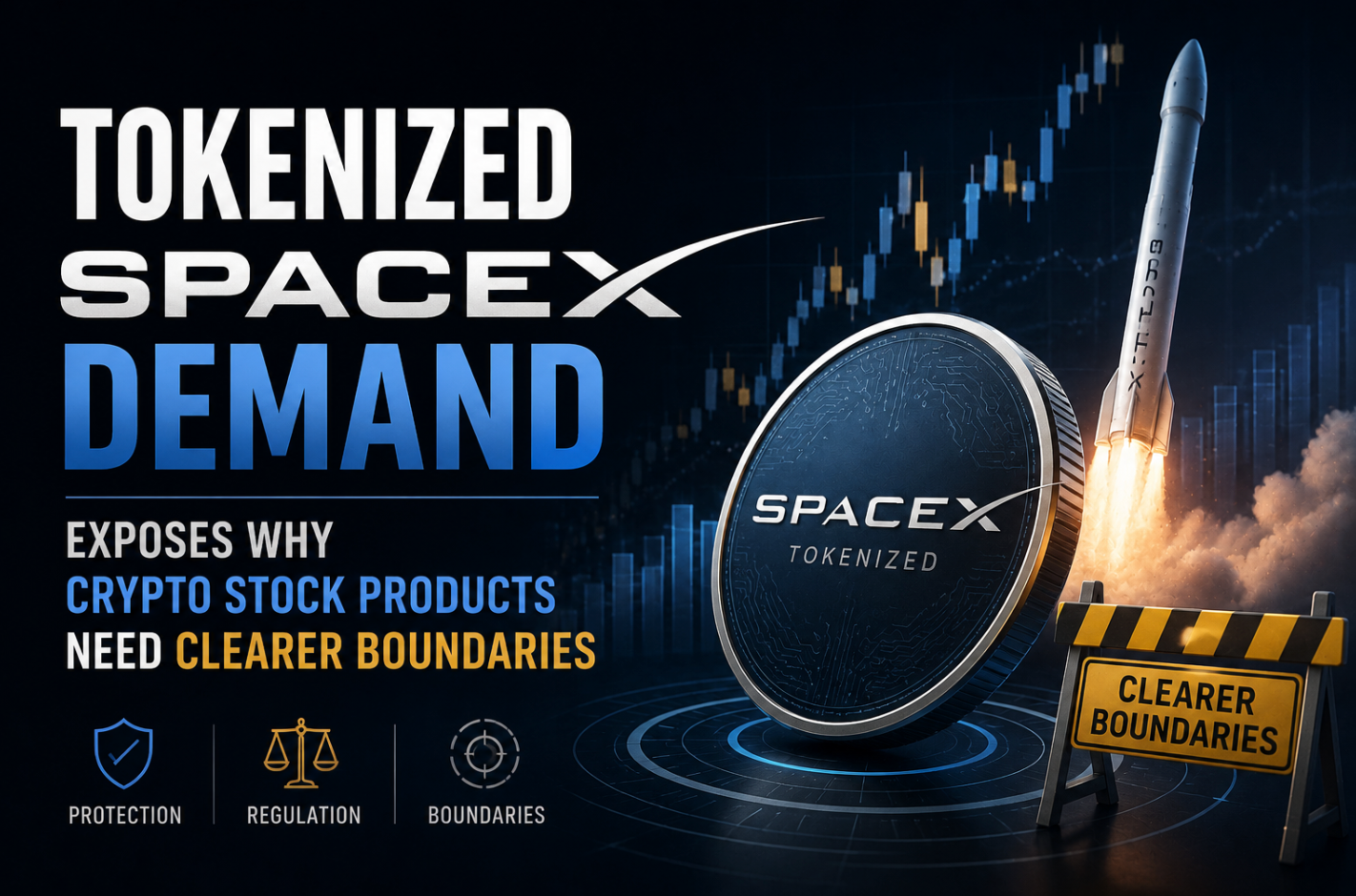
Tokenized SpaceX Demand Exposes Why Crypto Stock Products Need Clearer Boundaries

Tokenized SpaceX Demand Exposes Why Crypto Stock Products Need Clearer Boundaries

Tokenized SpaceX share products drew over $1 billion in crypto demand around its historic IPO, but platforms failed to complete allocations due to severe supply shortages from provider xStocks. While


Why 98.9% of Zcash Voters Kept Bitcoin-Style Halvings

Why 98.9% of Zcash Voters Kept Bitcoin-Style Halvings

Zcash holders have overwhelmingly voted to preserve the network’s Bitcoin-style halving schedule as part of the upcoming NU7 upgrade. Nearly 2.4 million ZEC participated in the privacy-preserving vote

SEC Innovation Exemption: How Tokenized Stocks Can Trade Onchain

SEC Innovation Exemption: How Tokenized Stocks Can Trade Onchain

The U.S. Securities and Exchange Commission introduced a five-year Innovation Exemption on September 17, 2026, creating a temporary regulatory pathway for certain tokenized U.S. stocks to trade onchai

Related Articles

View More
Meta Stock Split: Has Meta Ever Split Its Stock and What Could Trigger One?

Meta Stock Split: Has Meta Ever Split Its Stock and What Could Trigger One?

Meta Platforms has never split its stock. Since its May 2012 IPO at $38 per share, first as Facebook under the ticker FB and now as META, the company has completed zero forward splits and zero reverse
Tesla Stock Split History: When Did TSLA Split and Could It Happen Again?

Tesla Stock Split History: When Did TSLA Split and Could It Happen Again?

Tesla has split its stock twice: a 5-for-1 split with split-adjusted trading starting August 31, 2020, and a 3-for-1 split starting August 25, 2022. Together they produced a cumulative 15-for-1 adjust
Tesla Stock Guide: Deliveries, Margins, Robotaxi and EV Demand Explained

Tesla Stock Guide: Deliveries, Margins, Robotaxi and EV Demand Explained

Tesla trades as TSLA on the Nasdaq. Most of its revenue comes from selling electric vehicles, so quarterly deliveries and automotive gross margin drive its results — Tesla delivered 480,126 vehicles i


SK Hynix ADR Guide: SKHY Listing, HBM Exposure and U.S. Market Access Explained

SK Hynix ADR Guide: SKHY Listing, HBM Exposure and U.S. Market Access Explained

SKHY is the Nasdaq-listed American Depositary Share for SK Hynix, the South Korean memory company and a leading supplier of high-bandwidth memory for AI systems. U.S. trading began in July 2026. Each

Sign Up on MEXC
Sign Up & Receive Up to 10,000 USDT Bonus
Is Your Stablecoin Truly Safe?
Is Your Stablecoin Truly Safe?Is Your Stablecoin Truly Safe?
Know the risks of USDT, USDC, OpenUSD & USD1