

Robinhood and dYdX Labs have unveiled Arcus, a new decentralized exchange (DEX) built on Robinhood Chain, a Layer 2 blockchain powered by Arbitrum technology. The platform enables perpetual trading anRobinhood and dYdX Labs have unveiled Arcus, a new decentralized exchange (DEX) built on Robinhood Chain, a Layer 2 blockchain powered by Arbitrum technology. The platform enables perpetual trading an
Robinhood and dYdX Launch Arcus: The Race for Tokenized Stocks and 24/7 Trading Is Heating Up

Robinhood and dYdX Labs have unveiled Arcus, a new decentralized exchange (DEX) built on Robinhood Chain, a Layer 2 blockchain powered by Arbitrum technology. The platform enables perpetual trading and access to 95 tokenized stocks with zero trading fees, aiming to bring the U.S. equity market to global investors through a 24/7 trading model.
Arcus not only represents Robinhood's latest step toward blockchain-based capital markets, but also highlights the growing convergence between traditional finance, DeFi, and tokenized real-world assets (RWAs). At the same time, it is widely viewed as a direct competitive response to Hyperliquid, the rapidly expanding decentralized perpetual trading platform.
Key Takeaways
Robinhood and dYdX Labs have launched the Arcus DEX on Robinhood Chain.
Arcus supports 95 tokenized stocks available for trading around the clock.
Global users can access U.S. equity markets without traditional trading-hour restrictions.
The platform aims to combine tokenized equities, perpetual contracts, and digital assets within a single ecosystem.
Arcus represents a new front in the competition against Hyperliquid and other decentralized perpetual exchanges.
Asset tokenization is becoming a strategic trend across global financial markets.
What Is Arcus?
Arcus is a next-generation decentralized exchange developed by dYdX Labs in collaboration with Robinhood Crypto.
The platform operates on Robinhood Chain, an EVM-compatible Layer 2 blockchain built using Arbitrum technology.
Unlike traditional DEXs that primarily focus on cryptocurrencies, Arcus seeks to integrate multiple asset classes within one trading infrastructure, including:
Perpetual contracts
Tokenized real-world assets
Cryptocurrency markets
Potential access to private market assets in the future
According to initial announcements, Arcus currently offers spot trading for 95 tokenized stocks and plans to expand into perpetual markets over time.
Why Is Robinhood Building Robinhood Chain?
For years, Robinhood has primarily been recognized as a retail stock trading platform.
However, the rapid rise of blockchain technology has encouraged the company to expand aggressively into digital assets.
Robinhood Chain reflects the firm's long-term vision.
Building Onchain Financial Infrastructure
Rather than simply offering a trading interface, Robinhood aims to own the underlying blockchain infrastructure supporting:
Tokenized stocks
Stablecoins
Digitized real-world assets
Onchain lending
DeFi products
Enabling 24/7 Trading
One of the biggest limitations of traditional stock markets is limited operating hours.
For example:
U.S. markets trade for roughly 6.5 hours per day.
Markets close during weekends.
Trading pauses for public holidays.
Blockchain networks, by contrast, operate continuously.
This enables investors in:
Asia
Europe
The Middle East
Latin America
to access financial assets at any time.
Expanding International Access
Tokenization helps Robinhood overcome geographical barriers.
Investors outside the United States may gain easier access to U.S. financial assets without needing brokerage accounts at traditional institutions.
How Could Tokenized Stocks Transform Financial Markets?
Arcus arrives at a time when asset tokenization is becoming one of Wall Street's most significant trends.
At its core, stock tokenization converts the economic rights associated with equities into blockchain-based tokens.
This offers several advantages.
Continuous 24/7 Trading
Investors no longer need to wait for markets to open.
Trading activity can occur at any time.
Reduced Intermediary Costs
Blockchain infrastructure can eliminate several traditional layers, including:
Central securities depositories
Clearing houses
Intermediary brokerage firms
Greater Global Accessibility
International investors may gain easier access to U.S. capital markets.
Programmable Assets
Tokenized securities can potentially:
Participate in DeFi protocols
Serve as collateral
Move across multiple blockchain networks
Integrate with stablecoins
This is one reason why major financial institutions are increasingly investing in tokenization initiatives.
Is Arcus Competing Directly With Hyperliquid?
The answer is yes.
Over the past two years, Hyperliquid has emerged as one of the fastest-growing decentralized perpetual exchanges in crypto.
Its strengths include:
High trading volumes
Centralized exchange-like user experience
Fast execution speeds
Deep liquidity
However, Hyperliquid remains largely focused on crypto-native assets.
Arcus is pursuing a broader strategy.
Rather than concentrating solely on digital currencies, the platform seeks to integrate:
Equities
Perpetual products
Real-world assets
Traditional capital markets
If successful, Arcus could potentially expand beyond the current boundaries of DeFi.
dYdX Is Entering a New Phase
The launch of Arcus also suggests that dYdX Labs is entering a new stage of development.
For years, dYdX has been among the largest derivatives protocols in DeFi.
Yet the crypto perpetual market is becoming increasingly competitive with the rise of:
Hyperliquid
Vertex
Drift
Aevo
Expanding into tokenized equities may allow dYdX to reach an entirely new customer segment.
It could also reduce the protocol's dependence on crypto market cycles.
Tokenization Is Becoming Wall Street's Biggest Theme
Arcus is not an isolated case.
Numerous financial institutions are currently participating in the tokenization race.
Areas attracting significant attention include:
Equities
Bonds
Investment funds
Bank deposits
Real estate
Commodities
Many industry experts believe that in the future, a large share of financial assets could exist as blockchain-based tokens.
Such a system would enable markets that are:
Open 24/7
Settled instantly
Globally interoperable
Significantly more cost-efficient
Arcus may represent one of the clearest examples of this evolving trend.
Implications for Robinhood and DeFi
Robinhood's deeper involvement in blockchain infrastructure illustrates how the distinction between traditional fintech and DeFi is becoming increasingly blurred.
If Arcus achieves meaningful scale, the market could see:
Greater adoption of onchain stock trading
New capital inflows from traditional investors
Rising demand for stablecoins
Accelerated growth in tokenized real-world assets
Intensifying competition among next-generation DEXs
This could mark the early stages of a financial system that operates entirely on blockchain infrastructure.
Conclusion
Arcus represents an important milestone in the blockchainization of global capital markets. By combining tokenized stocks, 24/7 trading, and perpetual products within a decentralized platform, Robinhood and dYdX are betting on a future in which every asset class can be traded onchain.
Although regulatory challenges and scalability concerns remain, Arcus demonstrates that tokenization is no longer merely an experimental concept but is increasingly becoming part of next-generation financial infrastructure.
FAQ
What is Arcus?
Arcus is a decentralized exchange developed by dYdX Labs and Robinhood Crypto on Robinhood Chain.
What assets does Arcus support?
The platform currently supports 95 tokenized stocks and plans to expand into perpetual trading.
What is Robinhood Chain?
Robinhood Chain is Robinhood's Layer 2 blockchain built using Arbitrum technology to support tokenized assets and onchain financial applications.
Does Arcus compete with Hyperliquid?
Yes. Arcus is widely viewed as a potential competitor to Hyperliquid in the decentralized perpetual trading sector.
Why are tokenized stocks important?
Tokenization enables stocks to trade 24/7, reduces intermediary costs, and broadens access for global investors.
Disclaimer: The information provided here is for informational purposes only and should not be considered financial, investment, legal, or professional advice. Always conduct your own research, consider your financial situation, and, if necessary, consult with a licensed professional before making any decisions.
市場機遇
4實時價格 (4)
--
----
USD
4 (4) 實時價格圖表
本頁面分享的文章均源自公開平台,僅供參考。該內容不代表 MEXC 的立場或觀點。所有版權歸 Nguyen Rin Hoang 所有。如果您認為任何內容侵犯了第三方的權益,請聯絡 service@support.mexc.com 以便及時刪除。 MEXC 不保證任何內容的準確性、完整性或及時性,且不對基於所提供信息而採取的任何行動負責。本內容不構成財務、法律或其他專業建議,亦不應被解釋為 MEXC 的推薦或認可。如需專家見解和深入分析,請造訪 MEXC 學院。
學習更多 4 知識
查看更多
美股週報 9月4日–9月11日 | AAPL 摺疊機首秀、油價破$100,資金大舉換邊的這一週你站對邊了嗎?
上週就業走軟,加息預期退燒,風險資產全線反攻。這周劇本被完整倒放了一遍。 推手是能源。8月 PPI 同比上漲5.4%,高於市場預期0.1個百分點,其中能源分項單月上漲4.2%,柴油更是暴漲24.1%;布倫特原油突破$100,創下本輪新高。這類成本會沿着運輸與製造一路往下游傳導,不是一兩個月能消化的。加息預期因此快速回升——9月15至16日 FOMC 會議上加息25個基點的概率升至七成以上,三大指數
2026/09/15
LITEON價格的驅動因素是什麼?AI數據中心、光纖網路與Lumentum股價解析
摘要 LITEON 的價格從根本上與 Lumentum Holdings 股票 LITE 掛鉤。 這意味著分析 LITEON 最有用的方式不是透過傳統的幣種代幣經濟學,而是透過驅動 Lumentum 的經濟鏈: AI 資本支出 → 更多加速器 → 更多頻寬 → 更多光纖連接 → Lumentum 營收與利潤率 → LITE 估值 → LITEON 目前最重要的變數包括 1.6T 採用、光電路交換、
2026/09/14
光寶科技風險解析:AI資本支出、估值、客戶集中度與光學技術風險
摘要 LITEON 結合了 Lumentum 的基礎權益風險與額外的代幣化市場層面。 最大的公司層級風險包括: AI 資本支出放緩; 極高的成長預期; 客戶集中度; 製造產能; 依賴光學技術轉型的成功; 競爭; 利潤壓力; LITE 估值。 LITEON 另外增加: 追蹤風險; 流動性風險; 市場交易時間錯配; 託管與營運風險; 區塊鏈風險; 司法管轄限制。 一個有用的分析框架是: AI 基礎設施
2026/09/14
4 最新動態
查看更多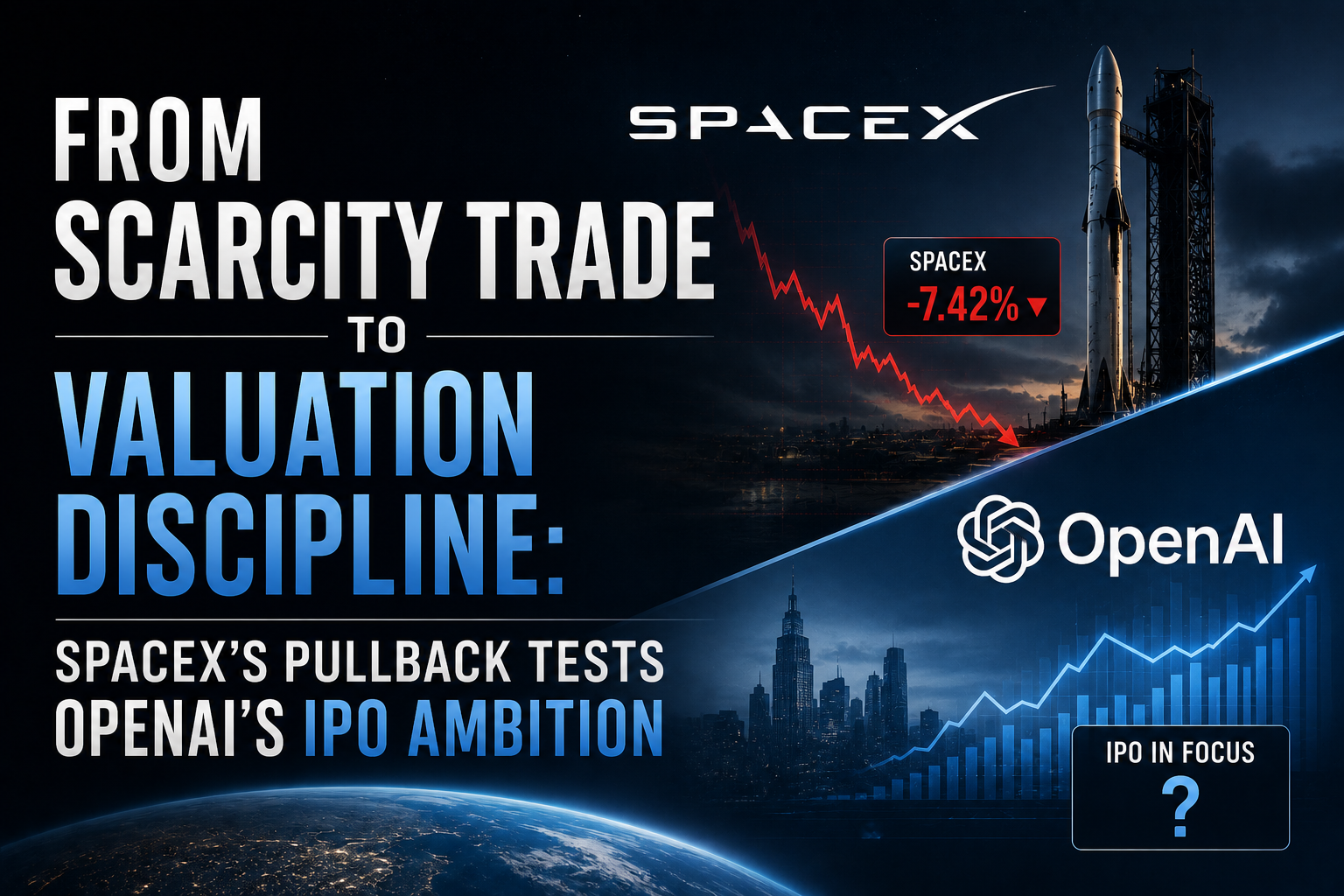
從稀缺交易到估值紀律:SpaceX的回調考驗OpenAI的IPO野心
據報導,OpenAI 傾向將其 IPO 推遲至 2027 年,但更強烈的市場訊號來自 SpaceX。SpaceX 於 6 月 22 日收盤下跌了 16.4%,收於 154.60 美元,較盤中高點 225.64 美元降低了 31.5%,但仍較其 135 美元的 IPO 價格高出 14.5%。這一走勢使 SpaceX 從一個由稀缺性驅動的 IPO 成功案例,轉變為 AI 相關超大型上市週期中首個重大公開市場壓力測試。
OpenAI 的問題不在於需求,而在於估值。路透社引用《紐約時報》的報導指出,OpenAI 正考慮等待至 2027 年,以維持高達 1 兆美元的估值目標,而顧問將此選擇定調為:要麼等待達到該估值,要麼以較低目標提前上市。
預測市場已開始反映這種謹慎態度。Polymarket 的 OpenAI IPO 市場近期顯示,OpenAI 在 2026 年 12 月 31 日前完成 IPO 的機率約為四分之一,這表明交易者不再將近期上市視為明確的基本情境。對於加密貨幣交易者而言,這使得 AI 上市前的曝險從單向的稀缺性交易,轉變為與公開市場基準掛鉤的估值紀律交易。
2026/06/29

Coldcard Mk3 警告隨 $38M Bitcoin 掃蕩而來,但原因仍未確認
比特幣硬體錢包製造商 Coinkite 已警告用戶,Coldcard 裝置存在種子生成問題,影響範圍涵蓋所有 4.0.1 及更高版本的 Mk3 韌體。此警告是在安全研究人員調查一宗涉及 594.48 BTC(價值約 3,800 萬美元)的協調性盜取事件時出現的。然而,目前尚無公開的技術證據證實 Coldcard 的問題導致了這些轉帳。
2026/07/31

Mastercard 完成對 BVNK 的收購,金額高達 18 億美元——穩定幣進入全球支付核心
Mastercard 於三月宣布該交易後,已於 2026 年 8 月 3 日(UTC +8)完成對穩定幣基礎設施供應商 BVNK 的收購。
2026/08/04


熱門
目前熱門備受市場關注的加密貨幣
加密貨幣價格
按交易量計算交易量最大的加密貨幣