Ethereum is beginning to formalize its post-quantum security push in public. ETH Foundation researcher Will Corcoran used a presentation at the Institutional EthereumEthereum is beginning to formalize its post-quantum security push in public. ETH Foundation researcher Will Corcoran used a presentation at the Institutional Ethereum

Ethereum Unveils Post-Quantum Security Roadmap For Institutions

2026/03/24 19:30
4 min read
For feedback or concerns regarding this content, please contact us at crypto.news@mexc.com

Ethereum is beginning to formalize its post-quantum security push in public. ETH Foundation researcher Will Corcoran used a presentation at the Institutional Ethereum Forum in New York to lay out both the threat model and the protocol work already underway. The effort matters well beyond ETH, he argued, because the core bottleneck is not unique to one chain: every proof-of-stake network built on today’s cryptographic assumptions will eventually face the same scaling problem.

Alongside the talk, the Ethereum Foundation launched pq.ethereum.org, a new portal that packages the project’s roadmap, technical resources, FAQs for institutions, and a registration form for a post-quantum retreat in Cambridge in October 2026. Corcoran framed the site as a way to consolidate years of research and answer what he described as growing inbound interest from institutions asking how Ethereum plans to prepare for a future in which quantum computers can break elliptic-curve cryptography.

Ethereum Eyes Post-Quantum Industry Standard

That future is still projected to be years away, but Corcoran said Ethereum is already working against a tight window. He pointed to current estimates for “Q-Day”: the arrival of a cryptographically relevant quantum computer, clustering around 2032, while the current roadmap targets key post-quantum components for the protocol’s “L” or “M” fork, roughly around 2029.

The presentation’s core argument was that post-quantum security cannot be reduced to a simple signature swap. Ethereum today relies on elliptic-curve cryptography across the stack: validator attestations at the consensus layer, blob proof data at the data layer, and transaction and wallet signatures at the execution layer. If that cryptography is broken, large parts of the network’s security model break with it.

But replacing it introduces a second-order problem. Ethereum’s current BLS signatures are compact and aggregate extremely efficiently: 10,000 signatures still compress to 96 bytes. The proposed post-quantum replacement, a hash-based scheme Corcoran called Lean Sig, is around 3,000 bytes per signature, and naively aggregating them would produce roughly 30 megabytes of data per slot.

That tradeoff is not merely an engineering inconvenience. Corcoran repeatedly tied it back to Ethereum’s decentralization constraint, arguing that bigger signatures would raise bandwidth requirements, reduce the number of viable home validators, and weaken the chain’s security properties. In his telling, the entire design challenge is downstream from that point.

“So making Ethereum post quantum secure isn’t just as simple as swapping out the signature schemes because that one change cascades through everything else,” he said. “Bigger signatures would result in more bandwidth that would result in fewer home validators, less decentralization, and weaker security guarantees. So that one change cascades through everything.”

Ethereum’s proposed answer is a pairing of LeanSig with a proving system called Lean Multisig, which Corcoran described as a STARK-based aggregation engine. Instead of forwarding all of the signatures directly, the system aims to prove that they were verified correctly and compress the output to around 125 kilobytes. He called that roughly 250x compression “the moon math” that makes post-quantum consensus viable on Ethereum.

Corcoran also used the talk to stress that this is no longer a purely theoretical research thread. He said Ethereum is already running devnets with 10 client teams, has shipped four devnets so far, and is building around three-slot finality and four-second slots as a design basis. The broader effort, he added, spans more than eight years of research, about $25 million in funding, and roughly 1,500 contributors across more than 250 organizations and teams.

For Ethereum, the immediate message is that post-quantum readiness is becoming a visible part of its long-range protocol agenda. For the rest of crypto, Corcoran’s claim was broader.

“Really, every proof of stake blockchain faces the same challenge, and that challenge is the ability to aggregate at scale hash based signatures. It’s nonnegotiable,” he said. “When we succeed in shipping LeanSig and LeanMultisig and Lean consensus, we think that this could really become the de facto industry standard.”

At press time, ETH traded at $2,154.
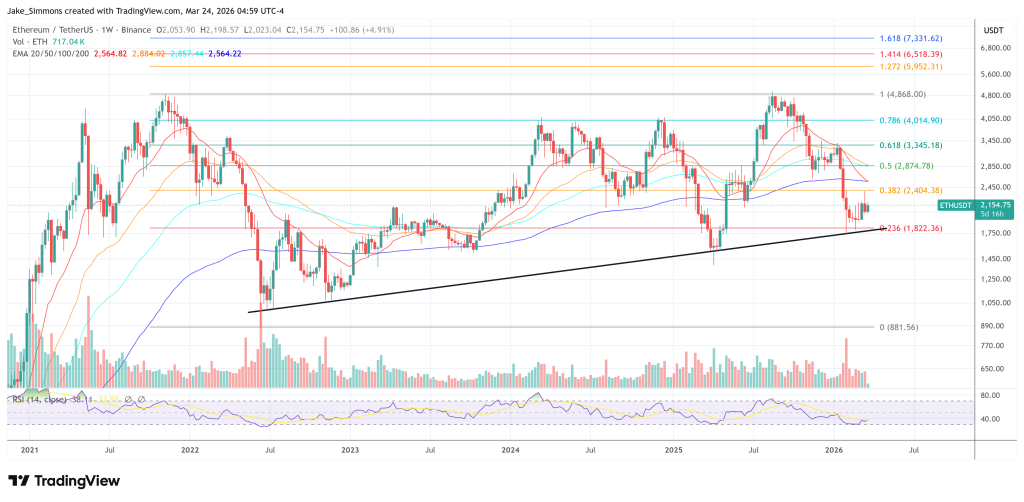
Ethereum price chart
Market Opportunity
QUANTUM Logo
QUANTUM Price(QUANTUM)
$0.0027
$0.0027$0.0027
+0.25%
USD
QUANTUM (QUANTUM) Live Price Chart
Disclaimer: The articles reposted on this site are sourced from public platforms and are provided for informational purposes only. They do not necessarily reflect the views of MEXC. All rights remain with the original authors. If you believe any content infringes on third-party rights, please contact crypto.news@mexc.com for removal. MEXC makes no guarantees regarding the accuracy, completeness, or timeliness of the content and is not responsible for any actions taken based on the information provided. The content does not constitute financial, legal, or other professional advice, nor should it be considered a recommendation or endorsement by MEXC.
Tags:

You May Also Like

Coinbase Slams ‘Patchwork’ State Crypto Laws, Calls for Federal Preemption

Coinbase Slams ‘Patchwork’ State Crypto Laws, Calls for Federal Preemption

The post Coinbase Slams ‘Patchwork’ State Crypto Laws, Calls for Federal Preemption appeared on BitcoinEthereumNews.com. In brief Coinbase has filed a letter with the DOJ urging federal preemption of state crypto laws, citing Oregon’s securities suit, New York’s ETH stance, and staking bans. Chief Legal Officer Paul Grewal called state actions “government run amok,” warning that patchwork enforcement “slows innovation and harms consumers.” A legal expert told Decrypt that states risk violating interstate commerce rules and due process, and DOJ support for preemption may mark a potential turning point. Coinbase has gone on the offensive against state regulators, petitioning the Department of Justice that a patchwork of lawsuits and licensing schemes is tearing America’s crypto market apart. “When Oregon can sue us for services that are legal under federal law, something’s broken,” Chief Legal Officer Paul Grewal tweeted on Tuesday. “This isn’t federalism—this is government run amok.” When Oregon can sue us for services that are legal under federal law, something’s broken. This isn’t federalism–this is government run amok. We just sent a letter to @TheJusticeDept urging federal action on crypto market structure to remedy this. 1/3 — paulgrewal.eth (@iampaulgrewal) September 16, 2025 Coinbase’s filing says that states are “expansively interpreting their securities laws in ways that undermine federal law” and violate the dormant Commerce Clause by projecting regulatory preferences beyond state borders. “The current patchwork of state laws isn’t just inefficient – it slows innovation and harms consumers” and demands “federal action on crypto market structure,” Grewal said.  States vs. Coinbase It pointed to Oregon’s securities lawsuit against the exchange, New York’s bid to classify Ethereum as a security, and cease-and-desist orders on staking as proof that rogue states are trying to resurrect the SEC’s discredited “regulation by enforcement” playbook. Oregon Attorney General Dan Rayfield sued Coinbase in April for promoting unregistered securities, and in July asked a federal judge to return the…
Share
BitcoinEthereumNews2025/09/18 11:52
Time Management For Entrepreneurs

Time Management For Entrepreneurs

When you’re managing everything on your own, time is your biggest asset. Yet while most entrepreneurs focus on leadership, growth and networking, they often overlook
Share
Techbullion2026/03/24 20:21
UK Looks to US to Adopt More Crypto-Friendly Approach

UK Looks to US to Adopt More Crypto-Friendly Approach

The post UK Looks to US to Adopt More Crypto-Friendly Approach appeared on BitcoinEthereumNews.com. The UK and US are reportedly preparing to deepen cooperation on digital assets, with Britain looking to copy the Trump administration’s crypto-friendly stance in a bid to boost innovation.  UK Chancellor Rachel Reeves and US Treasury Secretary Scott Bessent discussed on Tuesday how the two nations could strengthen their coordination on crypto, the Financial Times reported on Tuesday, citing people familiar with the matter.  The discussions also involved representatives from crypto companies, including Coinbase, Circle Internet Group and Ripple, with executives from the Bank of America, Barclays and Citi also attending, according to the report. The agreement was made “last-minute” after crypto advocacy groups urged the UK government on Thursday to adopt a more open stance toward the industry, claiming its cautious approach to the sector has left the country lagging in innovation and policy.  Source: Rachel Reeves Deal to include stablecoins, look to unlock adoption Any deal between the countries is likely to include stablecoins, the Financial Times reported, an area of crypto that US President Donald Trump made a policy priority and in which his family has significant business interests. The Financial Times reported on Monday that UK crypto advocacy groups also slammed the Bank of England’s proposal to limit individual stablecoin holdings to between 10,000 British pounds ($13,650) and 20,000 pounds ($27,300), claiming it would be difficult and expensive to implement. UK banks appear to have slowed adoption too, with around 40% of 2,000 recently surveyed crypto investors saying that their banks had either blocked or delayed a payment to a crypto provider.  Many of these actions have been linked to concerns over volatility, fraud and scams. The UK has made some progress on crypto regulation recently, proposing a framework in May that would see crypto exchanges, dealers, and agents treated similarly to traditional finance firms, with…
Share
BitcoinEthereumNews2025/09/18 02:21
