The Grass network captures more than 100TB of data every day. Grass nodes are now spread across 190 countries and regions, with more than 2.5 million nodes.The Grass network captures more than 100TB of data every day. Grass nodes are now spread across 190 countries and regions, with more than 2.5 million nodes.

After the airdrop, the price fluctuated upward. What are the characteristics of Grass, a web crawler project that combines AI and DePIN?

2024/11/05 08:30
3 min read

Author: Research institution ASXN

Compiled by: Felix, PANews

Recently, Grass, a web crawler project combining AI and DePIN, has once again launched an airdrop "feast". On October 28, the Grass Foundation announced that the first round of GRASS token airdrops were open for collection. Due to too many people claiming, the Phantom wallet was once down. As of November 4, Dune data showed that 82.75% of the GRASS airdrop tokens (about 64,781,717 tokens) had been claimed by users, involving 1,830,287 addresses for airdrop claims.

The airdrop craze also once "boosted" the GRASS token. Since the announcement of the airdrop, GRASS has shown a soaring trend, from around $0.65 to $1.86, and is now trading at $1.63. This article aims to analyze the technical characteristics of the Grass project from a technical perspective.

Grass is a decentralized data layer and network focused on web scraping, real-time contextual retrieval, and AI data collection. Its main goal is to decentralize and democratize web data collection through incentive mechanisms while compensating users for contributing resources.
After the airdrop, the price fluctuated upward. What are the characteristics of Grass, a web crawler project that combines AI and DePIN?

The Grass network currently captures more than 100TB of data every day. As of now, Grass nodes are spread across 190 countries and have more than 2.5 million nodes.

It manages all processes from initial data collection to processing and validation, while compensating and incentivizing participants.

The Grass Agreement consists of the following parts:

  • Grass Node
  • Sovereign Data Rollup

After the airdrop, the price fluctuated upward. What are the characteristics of Grass, a web crawler project that combines AI and DePIN?

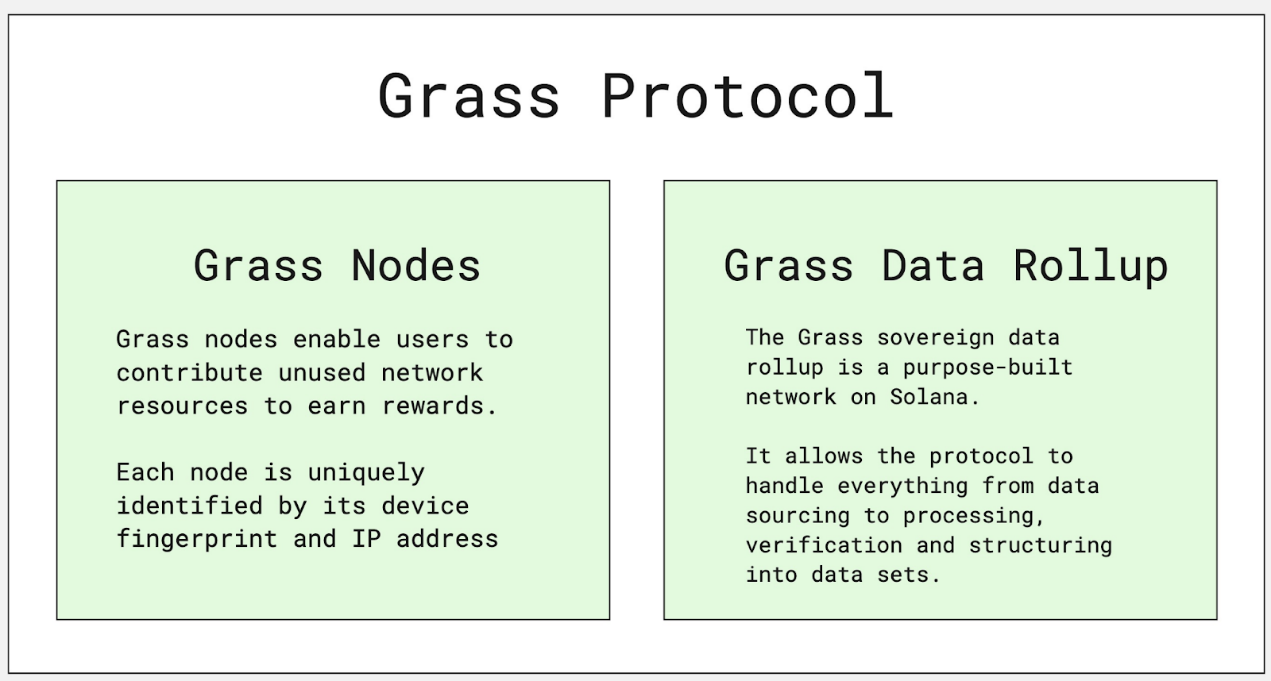
Grass nodes allow users to contribute idle network resources to earn rewards. Each node is uniquely identified by its device fingerprint and IP address.

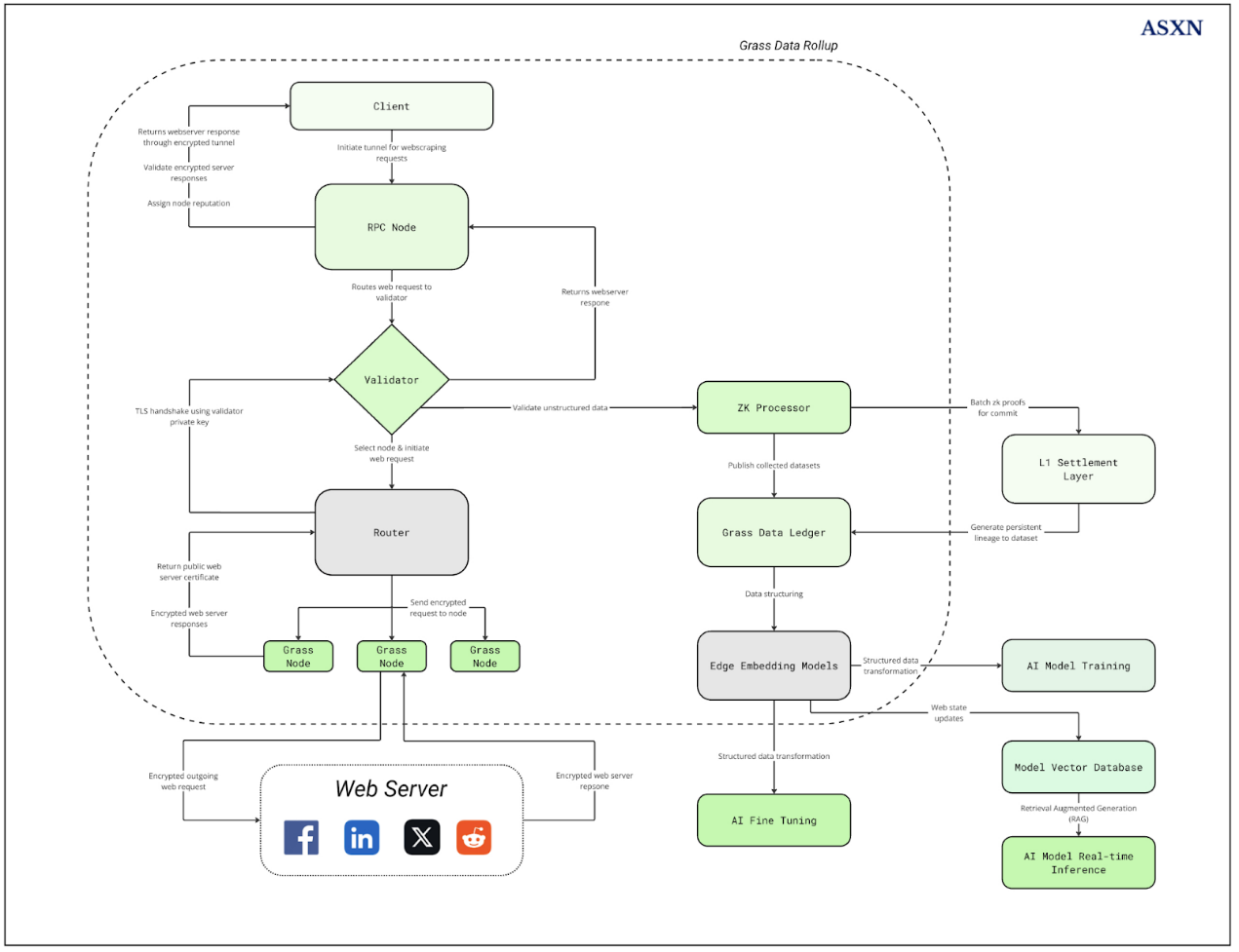
The GRASS Sovereign Data Rollup is a purpose-built network on Solana that enables the protocol to handle all transactions from data source to processing, validating, and structuring datasets.

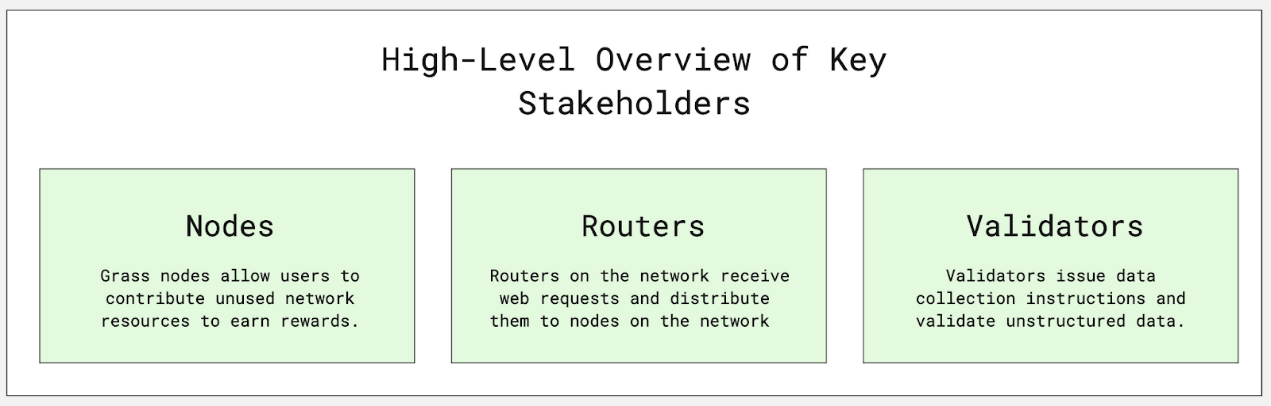
The network is built around validators that issue data collection instructions, routers that manage the distribution of web requests, and nodes that users use to contribute their idle network resources.

GRASS uses a data ledger for hash storage, a Merkle tree bundling system, and on-chain root data publishing.
After the airdrop, the price fluctuated upward. What are the characteristics of Grass, a web crawler project that combines AI and DePIN?

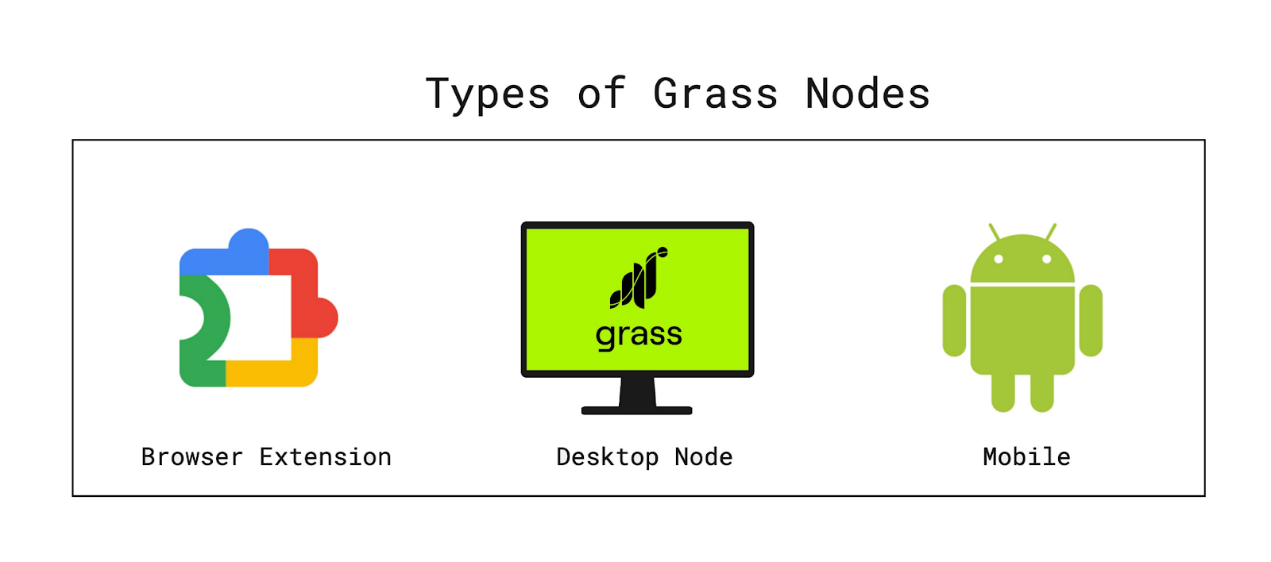
GRASS nodes can be deployed via a browser extension, desktop application, or Android-based mobile application.
After the airdrop, the price fluctuated upward. What are the characteristics of Grass, a web crawler project that combines AI and DePIN?

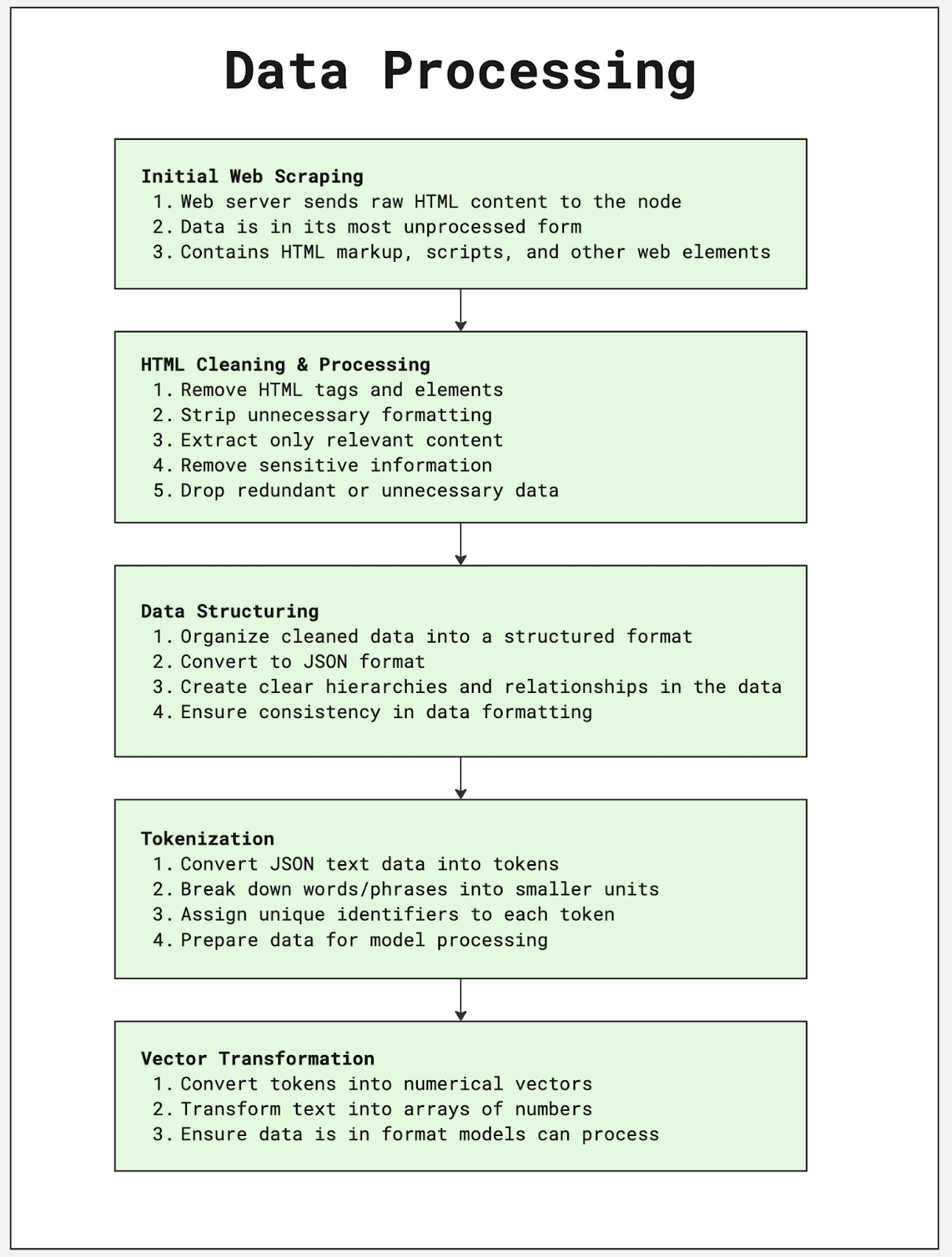
For data processing, the protocol uses an HTML to JSON conversion system, custom Python cleanup scripts, data structure tools, and vectorization processes, while developing embedded models for edge processing.
After the airdrop, the price fluctuated upward. What are the characteristics of Grass, a web crawler project that combines AI and DePIN?

Security and authentication are maintained through Zero-Knowledge Transport Layer Security (ZK TLS), proof generation for web requests, web session logging, a decentralized database for hash storage, and anti-data poisoning measures.

GRASS also ensures the integrity and quality of the data through various means, including a contributor ranking system, a consensus mechanism for quality control, a distributed work system, and a reputation scoring system.

Data management is handled through multiple storage solutions, including Hugging Face (which supports up to 10TB/day of free storage), self-hosted MongoDB for proprietary datasets, and partnerships with decentralized data providers.

Recently, the team opened up their dataset UpVoteWeb, which contains 600 million Reddit posts and comments on HuggingFace: https://huggingface.co/datasets/OpenCo7/UpVoteWeb

Related reading: Decentralized Data Layer: New Infrastructure for the AI Era

Market Opportunity
Moonveil Logo
Moonveil Price(MORE)
$0.0007947
$0.0007947$0.0007947
-0.06%
USD
Moonveil (MORE) Live Price Chart
Disclaimer: The articles reposted on this site are sourced from public platforms and are provided for informational purposes only. They do not necessarily reflect the views of MEXC. All rights remain with the original authors. If you believe any content infringes on third-party rights, please contact service@support.mexc.com for removal. MEXC makes no guarantees regarding the accuracy, completeness, or timeliness of the content and is not responsible for any actions taken based on the information provided. The content does not constitute financial, legal, or other professional advice, nor should it be considered a recommendation or endorsement by MEXC.

You May Also Like

Vitalik Buterin Challenges Ethereum’s Layer 2 Paradigm

Vitalik Buterin Challenges Ethereum’s Layer 2 Paradigm

Vitalik Buterin challenges the role of layer 2 solutions in Ethereum's ecosystem. Layer 2's slow progress and Ethereum’s L1 scaling impact future strategies.
Share
Coinstats2026/02/04 04:08
USAA Names Dan Griffiths Chief Information Officer to Drive Secure, Simplified Digital Member Experiences

USAA Names Dan Griffiths Chief Information Officer to Drive Secure, Simplified Digital Member Experiences

SAN ANTONIO–(BUSINESS WIRE)–USAA today announced the appointment of Dan Griffiths as Chief Information Officer, effective February 5, 2026. A proven financial‑services
Share
AI Journal2026/02/04 04:15
One Of Frank Sinatra’s Most Famous Albums Is Back In The Spotlight

One Of Frank Sinatra’s Most Famous Albums Is Back In The Spotlight

The post One Of Frank Sinatra’s Most Famous Albums Is Back In The Spotlight appeared on BitcoinEthereumNews.com. Frank Sinatra’s The World We Knew returns to the Jazz Albums and Traditional Jazz Albums charts, showing continued demand for his timeless music. Frank Sinatra performs on his TV special Frank Sinatra: A Man and his Music Bettmann Archive These days on the Billboard charts, Frank Sinatra’s music can always be found on the jazz-specific rankings. While the art he created when he was still working was pop at the time, and later classified as traditional pop, there is no such list for the latter format in America, and so his throwback projects and cuts appear on jazz lists instead. It’s on those charts where Sinatra rebounds this week, and one of his popular projects returns not to one, but two tallies at the same time, helping him increase the total amount of real estate he owns at the moment. Frank Sinatra’s The World We Knew Returns Sinatra’s The World We Knew is a top performer again, if only on the jazz lists. That set rebounds to No. 15 on the Traditional Jazz Albums chart and comes in at No. 20 on the all-encompassing Jazz Albums ranking after not appearing on either roster just last frame. The World We Knew’s All-Time Highs The World We Knew returns close to its all-time peak on both of those rosters. Sinatra’s classic has peaked at No. 11 on the Traditional Jazz Albums chart, just missing out on becoming another top 10 for the crooner. The set climbed all the way to No. 15 on the Jazz Albums tally and has now spent just under two months on the rosters. Frank Sinatra’s Album With Classic Hits Sinatra released The World We Knew in the summer of 1967. The title track, which on the album is actually known as “The World We Knew (Over and…
Share
BitcoinEthereumNews2025/09/18 00:02