Ethereum is more than digital money—it’s a decentralized platform designed for smart contracts and applications. Unlike Bitcoin’s UTXO model, Ethereum uses accounts, enabling faster transactions, programmable contracts, and gas fees to manage computation. With its Turing-complete language and Ethereum Virtual Machine, it functions like a global computer that minimizes censorship and third-party risks, laying the foundation for DeFi, NFTs, and the broader Web3 ecosystem.Ethereum is more than digital money—it’s a decentralized platform designed for smart contracts and applications. Unlike Bitcoin’s UTXO model, Ethereum uses accounts, enabling faster transactions, programmable contracts, and gas fees to manage computation. With its Turing-complete language and Ethereum Virtual Machine, it functions like a global computer that minimizes censorship and third-party risks, laying the foundation for DeFi, NFTs, and the broader Web3 ecosystem.

Ethereum Is More Than Just “Crypto”

6 min read

Abstract and 1. Introduction

  1. Bitcoin and the Blockchain

    2.1 The Origins

    2.2 Bitcoin in a nutshell

    2.3 Basic Concepts

  2. Crypto Exchanges

  3. Source of Value of crypto assets and Bootstrapping

  4. Initial Coin Offerings

  5. Airdrops

  6. Ethereum

    7.1 Proof-of-Stake based consensus in Ethereum

    7.2 Smart Contracts

    7.3 Tokens

    7.4 Non-Fungible Tokens

  7. Decentralized Finance and 8.1 MakerDAO

    8.2 Uniswap

    8.3 Taxable events in DeFi ecosystem

    8.4 Maximal Extractable Value (MEV) on Ethereum

  8. Decentralized Autonomous Organizations - DAOs

    9.1 Legal Entity Status of DAOs

    9.2 Taxation issues of DAOs

  9. International Cooperation and Exchange of Information

    10.1 FATF Standards on VAs and VASPs

    10.2 Crypto-Asset Reporting Framework

    10.3 Need for Global Public Digital Infrastructure

    10.4 The Challenge of Anonymity Enhancing Crypto Assets

  10. Conclusion and References

7. Ethereum

Bitcoin is mainly used to transfer value from one address to another in a secure and efficient manner. However, it does not offer many opportunities to build applications on top of the Bitcoin Blockchain as the Bitcoin script is not Turing complete[69] and does not allow user defined logic and customized functions to execute in transactions. As seen earlier, Bitcoin transactions also require the entire UTXO amount to be spent and do not provide control over the amount that can be withdrawn from a UTXO. Ethereum is different from Bitcoin as it provides above and beyond the capacity to transfer value from one address to another. Ethereum is mistakenly considered a crypto asset whereas it is a decentralized platform that is designed to run smart contracts, with Ether as its native asset which gives basis to its value.

\ As Ethereum’s language is Turing complete, it can act like a giant decentralized general-purpose computer which is censorship resistant and minimizes third party risks in transactions. To understand Ethereum it is important to imagine a blockchain as a state-machine where transactions change the state of the blockchain. A blockchain is essentially a "cryptographically secure transactional singleton machine with shared-state."[70]. This is depicted pictorially in Fig.28 [71]. The consensus mechanism essentially aims to make all the nodes/validators of the Ethereum network agree on the current state of the blockchain.

\ Fig. 28 Blockchain as a State Machine[72]

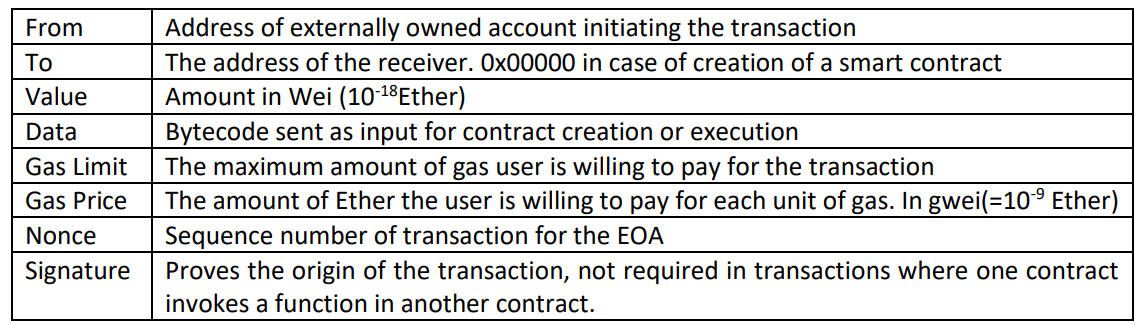
\ Ethereum is an account based blockchain unlike Bitcoin which is UTXO based. For a Bitcoin user the ‘Balance’ of his/her account is the sum of all the UTXOs for which he/she owns the private keys. In Ethereum, the accounts keep a track of the balance automatically. There are two types of accounts in Ethereum a) Externally Owned Accounts which have private keys and no code associated with them and b) Contract Accounts which do not have private keys and have code associated with them. Both these types of accounts have a Balance field associated with them, which shows the amount of Ether owned by these accounts. The state of the Ethereum Blockchain consists of the balance, data, code, and all other fields of all the accounts. The fields in a transaction on the Ethereum Blockchain are given in Table 4.

\ A contract account contains the code of the smart contract and it is controlled by the smart contract code. In an Ethereum transaction when the destination address is a contract address, the smart contract code is executed on the Ethereum Virtual Machine. The smart contract function specified in the data payload is called, if no function is specified, a fallback function is called.

\ Table. 4 fields in a transaction on the Ethereum Blockchain
\ An Ethereum block consists of transactions which i) change the balance associated with EOA and smart contract accounts ii) change data stored in a smart contract or iii) create, destroy(deprecated) or change the code of a smart contract. Each transaction affects the data stored in contracts in every single full node on the Ethereum network. Thus, Ethereum can be imagined as a giant decentralized computer where users can run their code and store data after paying the fee for the transaction. However, these computations are mainly used for basic functions like changing the balance and ownership of tokens held by the smart contract and validating signatures instead of storing large files or executing complex programs.

\ Ethereum also has a much smaller block time of 12 seconds as opposed to ~10 Minutes in Bitcoin. It also has much lower fees as compared to the Bitcoin Blockchain. The fee to be paid for any transaction in Ethereum is called gas. To complete a transaction, the user needs to provide appropriate amount of gas depending on the size and nature of the transaction. Simple transactions to transfer Ether from one account to another do not cost as much gas as breeding CryptoKitties[73] using a smart contract. The user must provide adequate gas for the entire transaction to go through, if the entire gas is not used for the transaction, the excess gas is refunded. However, if the gas amount is not enough for the entire transaction to take place, the entire gas amount is consumed and forfeited.

\ Gas also protects the Ethereum Blockchain from infinite loops as even if a malicious user tries to execute an infinite loop on the Ethereum EVM it would stop after the transaction runs out of gas. Any contract execution in Ethereum must be triggered by an externally owned account. The triggered transaction can in-turn trigger further transactions on other contract accounts. The triggered transactions are executed atomically, i.e., either the full transaction involving all the intended smart contracts is executed or all the changes made by the incomplete transaction are reversed. Ethereum also uses digital signature and hash functions like Bitcoin. However, Ethereum uses the KECCAK-256 algorithm and an Ethereum address is a 42-character hexadecimal address derived from the last 20 bytes of the public key. The signed transactions are sent to a mempool, thereafter the nodes verify and propagate the transactions using flooding.

\

:::info Author:

(1) Arindam Misra.

:::


:::info This paper is available on arxiv under CC BY 4.0 DEED license.

:::

  1. In Computer Science a Turing Complete system is one that can mimic a Turing Machine. A Turing Machine is a theoretical machine with a memory tape of infinite length which can calculate or compute anything for which an algorithm exists.

    \

  2. https://docs.ethhub.io/ethereum-roadmap/ethereum-2.0/stateless-clients/

    \

  3. https://www.preethikasireddy.com/post/how-does-ethereum-work-anyway

    \

  4. Source: https://uploads-ssl.webflow.com/5ddd80927946cdaa0e71d607/5ddd80927946cdd1dd71d6f1_howdoes-ethereum-work-anyway-2.png

    \

  5. https://www.cryptokitties.co/about

\

Market Opportunity
Moonveil Logo
Moonveil Price(MORE)
$0.0006664
$0.0006664$0.0006664
-8.88%
USD
Moonveil (MORE) Live Price Chart
Disclaimer: The articles reposted on this site are sourced from public platforms and are provided for informational purposes only. They do not necessarily reflect the views of MEXC. All rights remain with the original authors. If you believe any content infringes on third-party rights, please contact service@support.mexc.com for removal. MEXC makes no guarantees regarding the accuracy, completeness, or timeliness of the content and is not responsible for any actions taken based on the information provided. The content does not constitute financial, legal, or other professional advice, nor should it be considered a recommendation or endorsement by MEXC.

You May Also Like

Top NYC Book Publishing Companies

Top NYC Book Publishing Companies

New York City has been the epicenter of American publishing for generations, but “NYC publishing” isn’t just one lane. Today’s landscape includes two very different
Share
Techbullion2026/02/06 14:02
Sensorion Announces its Participation in the Association for Research in Otolaryngology ARO 49th Annual Midwinter Meeting

Sensorion Announces its Participation in the Association for Research in Otolaryngology ARO 49th Annual Midwinter Meeting

MONTPELLIER, France–(BUSINESS WIRE)–Regulatory News: Sensorion (FR0012596468 – ALSEN) a pioneering clinical-stage biotechnology company which specializes in the
Share
AI Journal2026/02/06 14:45
AI Crypto Trading Secrets: What They Won’t Tell You About Profits and Pitfalls|9-Figure Media

AI Crypto Trading Secrets: What They Won’t Tell You About Profits and Pitfalls|9-Figure Media

AI crypto trading is everywhere, and every YouTube guru claims their bot mints money while they sleep. Sounds dreamy, right? However, most don’t discuss the full story, the wild profits possible, and the lurking pitfalls. As someone obsessed with the intersection of artificial intelligence and digital assets, let me pull back the curtain on the realities of algorithmic trading in the crypto jungle. Here’s what nobody tells you: 87% of retail traders using automated systems lose money within their first year. The marketing materials show cherry-picked results. The testimonials come from paid affiliates. But here’s the twist. The remaining 13% who succeed aren’t just lucky. They understand something the majority misses entirely. The Reality Behind the Hype The crypto world loves success stories. You’ve probably seen them. “I made $50,000 in three months using this bot.” What they don’t mention? The $200,000 they lost by testing seventeen other systems first. Real talk: most trading algorithms fail because they’re built for perfect market conditions. Crypto markets are anything but perfect. Think about it like this. Would you trust a Formula 1 car to handle rush hour traffic? That’s essentially what most people do with their trading bots. Why Smart Money Uses Crypto AI Tools Differently Professional traders approach crypto AI tools with surgical precision. They don’t expect miracles. They expect consistent, measured results. The difference lies in understanding what these tools actually do well: • Risk management automation • Pattern recognition at scale • Emotional bias elimination • 24/7 market monitoring • Portfolio rebalancing Notice what’s missing from that list? Get-rich-quick schemes. The smartest crypto AI tools focus on protecting capital first. Profits come second. This mindset separates winners from losers. Here’s something interesting. 9-figure media companies track these patterns religiously. They know which crypto AI tools produce sustainable results versus flashy short-term gains. Professional traders using crypto AI tools typically target 15–25% annual returns. Not 500% monthly moonshots. The Startup Connection Most People Ignore AI for startups isn’t just about building the next ChatGPT. Many successful companies use AI to optimize their crypto treasury management. Smart startups integrate crypto AI tools into their financial operations early. They automate routine decisions. They reduce human error. They scale their trading operations without hiring armies of analysts. But here’s where it gets interesting. The best AI for startup applications in crypto aren’t the obvious ones. Consider automated tax reporting. Or real-time compliance monitoring. Or treasury optimization across multiple blockchains. These unsexy applications generate more consistent profits than flashy trading algorithms. AI for startups in the crypto space succeeds when it solves boring problems efficiently. Not when it promises unrealistic returns. The most successful AI for startups implementations focus on operational efficiency. They reduce costs. They minimize risks. They free up human resources for strategic decisions. Learning from Top AI Start-Ups Top AI start-ups in the crypto space share common characteristics. They prioritize transparency over marketing hype. Look at successful top AI start-ups like Chainalysis or Elliptic. They don’t promise easy money. They provide essential infrastructure. The best top AI start-ups focus on solving real problems: • Market data analysis • Security monitoring • Regulatory compliance • Portfolio analytics • Risk assessment These top AI start-ups understand something crucial. Sustainable businesses solve actual problems. They don’t just ride hype cycles. 9-figure media outlets consistently highlight these fundamental companies. They ignore the noise. They focus on substance. Many top AI start-ups actually discourage retail trading. They know the odds. They’ve seen the casualties. Instead, successful top AI start-ups build tools for institutions. Banks. Hedge funds. Companies with proper risk management systems. The Hidden Costs Nobody Discusses Using crypto AI tools costs more than subscription fees. Much more. First, there’s the learning curve. Most people spend months figuring out proper settings. During this time, they’re paying tuition to the market. Second, there’s infrastructure. Reliable crypto AI tools require stable internet, backup systems, and proper security measures. Third, there’s opportunity cost. Time spent tweaking algorithms could be spent learning fundamental analysis. The real cost? Most people using crypto AI tools trade more frequently. Increased trading usually means increased losses. Think about 9-figure media companies again. They understand that technology amplifies existing skills. It doesn’t replace them. Smart Implementation Strategies Successful crypto AI tools users follow specific patterns: • Start with paper trading • Use position sizing rules • Set strict stop losses • Monitor performance weekly • Adjust strategies quarterly They treat crypto AI tools like any other business tool. With respect. With caution. With realistic expectations, startup applications work similarly. They augment human decision-making. They don’t replace it. The most successful AI for startups implementations in crypto involve human oversight at every level. Algorithms suggest. Humans decide. What Actually Works Here’s what separates successful crypto AI tools users from everyone else: They focus on consistency over home runs. They understand that small, regular gains compound better than occasional big wins followed by devastating losses. They apply AI principles to their approach for startups. They iterate quickly. They fail fast. They learn constantly. They study top AI start-ups for inspiration. But they don’t try to replicate their exact strategies. Most importantly, they never risk money they can’t afford to lose. The crypto market will humble anyone. AI doesn’t change this fundamental truth. Your success with crypto AI tools depends more on your discipline than the sophistication of your algorithms. Remember: the house always has an edge. Your job is to find where that edge doesn’t apply. That’s the secret they won’t tell you. AI Crypto Trading Secrets: What They Won’t Tell You About Profits and Pitfalls|9-Figure Media was originally published in Coinmonks on Medium, where people are continuing the conversation by highlighting and responding to this story
Share
Medium2025/09/18 23:20