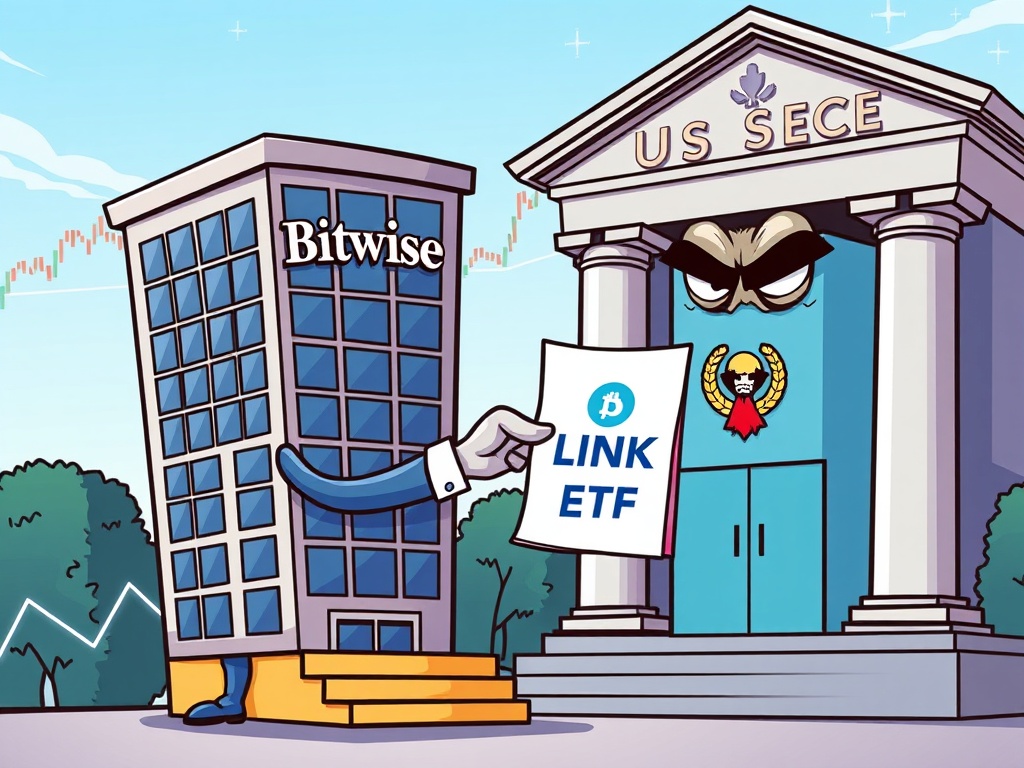
BitcoinWorld Chainlink ETF: Bitwise Files Crucial S-1 Application with SEC The cryptocurrency world is buzzing with significant news as Bitwise, a prominent crypto asset manager, has officially filed an S-1 application for a Chainlink ETF with the U.S. Securities and Exchange Commission (SEC). This pivotal development, initially reported by BWE News, marks a crucial step in the ongoing mainstream integration of digital assets. For many in the crypto community, this move signifies growing institutional interest and potential new avenues for investors to gain exposure to the Chainlink network. What Does This Chainlink ETF Filing Mean? When Bitwise filed its S-1 application, it signaled a formal intent to launch a Chainlink ETF. An S-1 is essentially a registration statement required by the SEC for U.S. companies planning to offer securities to the public. In this context, it details the structure, investment objectives, risks, and operational procedures of the proposed exchange-traded fund. Bitwise’s Role: As a well-respected crypto asset manager, Bitwise has a history of pioneering digital asset investment products. Their move to introduce a Chainlink ETF highlights their belief in Chainlink’s long-term potential. Chainlink (LINK): Chainlink is a decentralized oracle network that connects smart contracts with real-world data and off-chain computations. Its LINK token is vital for paying for these oracle services. ETF Structure: A Chainlink ETF would allow traditional investors to gain exposure to LINK’s price movements without directly buying and holding the cryptocurrency. This simplifies access and often provides a regulated investment vehicle. Why is a Chainlink ETF So Significant? The potential approval of a Chainlink ETF carries immense significance for the broader crypto market and Chainlink specifically. It represents a bridge between traditional finance and the decentralized world, opening doors for a new wave of capital. Here’s why this development is attracting so much attention: Increased Institutional Access: ETFs are familiar investment vehicles for institutional investors, pension funds, and wealth managers. A Chainlink ETF would provide a regulated, liquid, and easily accessible way for these entities to invest in LINK. Market Legitimacy and Trust: SEC approval would lend significant credibility to Chainlink as an asset class. It suggests that regulators are becoming more comfortable with digital assets, potentially paving the way for further crypto product approvals. Potential Price Impact: Increased demand from institutional investors could positively impact LINK’s price. As more capital flows into the market through an ETF, the underlying asset often sees appreciation. Simplified Investment: Retail investors who might be hesitant to navigate crypto exchanges can invest in a Chainlink ETF through their traditional brokerage accounts, making participation much simpler. Navigating the Regulatory Path for a Chainlink ETF While the filing is a positive step, the path to a fully approved Chainlink ETF is not without its challenges. The SEC has historically been cautious regarding cryptocurrency-related investment products, citing concerns about market manipulation, investor protection, and custody. The SEC’s review process is rigorous and involves several stages: Initial Review: The SEC staff examines the S-1 application for completeness and compliance with securities laws. Public Comment Period: The public, including industry experts and concerned citizens, can submit comments on the proposed ETF. Amendments and Resubmissions: Bitwise may need to amend its S-1 multiple times based on SEC feedback and market developments. Final Decision: The SEC will ultimately approve, disapprove, or delay the application. Previous Bitcoin spot ETF applications faced numerous rejections before recent approvals, indicating the SEC’s meticulous approach. This history underscores the importance of a well-structured application and ongoing dialogue with regulators for a Chainlink ETF. What Happens After a Chainlink ETF Filing? The filing of the S-1 application is just the beginning of a potentially lengthy process. Investors and market observers will now closely watch the SEC’s response and any subsequent updates from Bitwise. Key things to look out for include: SEC Communications: The SEC will issue notices regarding the application’s status, including requests for public comments or amendments. Market Reaction: The crypto market, particularly LINK holders, will likely react to each stage of the approval process. Competitive Landscape: Other asset managers might also consider filing for a Chainlink ETF or similar products, intensifying the race for first-mover advantage. Broader Crypto Sentiment: The outcome could influence the regulatory landscape for other altcoin ETFs, setting a precedent for future digital asset products. Bitwise’s S-1 filing for a Chainlink ETF represents a significant milestone in the evolution of cryptocurrency investment. While the journey to approval is complex and subject to regulatory scrutiny, this move highlights the increasing maturity and institutional acceptance of digital assets. It offers a tantalizing glimpse into a future where accessing innovative blockchain projects like Chainlink becomes as straightforward as investing in traditional stocks, potentially unlocking massive capital flows and solidifying crypto’s place in mainstream finance. The coming months will be crucial in determining the fate of this groundbreaking proposal. Frequently Asked Questions (FAQs) 1. What is an S-1 application in the context of a Chainlink ETF? An S-1 application is a registration statement required by the U.S. SEC for new securities offerings. For a Chainlink ETF, it details the fund’s structure, investment strategy, risks, and operational aspects, providing transparency for potential investors. 2. What is Chainlink (LINK) and why is it important? Chainlink is a decentralized oracle network that securely connects smart contracts on various blockchains with real-world data, events, and off-chain computations. Its importance lies in enabling smart contracts to interact with external data, making them more powerful and useful for real-world applications. 3. How does a Chainlink ETF benefit investors? A Chainlink ETF offers investors exposure to LINK’s price movements without the complexities of direct cryptocurrency ownership, such as setting up wallets or managing private keys. It provides a regulated and accessible investment vehicle through traditional brokerage accounts. 4. What are the next steps after Bitwise files for a Chainlink ETF? After filing, the SEC will review the S-1 application. This process involves staff evaluations, potential public comment periods, and requests for amendments from Bitwise. The SEC will eventually issue a decision to approve, deny, or delay the Chainlink ETF. 5. Has the SEC approved other crypto ETFs? Yes, the SEC has approved several Bitcoin futures ETFs and, more recently, a spot Bitcoin ETF. These approvals set precedents and indicate a potential shift in the SEC’s approach to cryptocurrency-related investment products, which could bode well for a Chainlink ETF. 6. What are the main challenges for a Chainlink ETF to get approved? Key challenges include addressing SEC concerns about market manipulation, ensuring adequate investor protection, and establishing robust custody solutions for the underlying LINK assets. The SEC’s historical caution with crypto products means thorough scrutiny is expected. If you found this article insightful, please share it with your network! Your support helps us bring more crucial crypto news and analysis to a wider audience. Join the conversation and spread the word about this significant development for the Chainlink ETF. To learn more about the latest crypto market trends, explore our article on key developments shaping Chainlink institutional adoption. This post Chainlink ETF: Bitwise Files Crucial S-1 Application with SEC first appeared on BitcoinWorld and is written by Editorial TeamBitcoinWorld Chainlink ETF: Bitwise Files Crucial S-1 Application with SEC The cryptocurrency world is buzzing with significant news as Bitwise, a prominent crypto asset manager, has officially filed an S-1 application for a Chainlink ETF with the U.S. Securities and Exchange Commission (SEC). This pivotal development, initially reported by BWE News, marks a crucial step in the ongoing mainstream integration of digital assets. For many in the crypto community, this move signifies growing institutional interest and potential new avenues for investors to gain exposure to the Chainlink network. What Does This Chainlink ETF Filing Mean? When Bitwise filed its S-1 application, it signaled a formal intent to launch a Chainlink ETF. An S-1 is essentially a registration statement required by the SEC for U.S. companies planning to offer securities to the public. In this context, it details the structure, investment objectives, risks, and operational procedures of the proposed exchange-traded fund. Bitwise’s Role: As a well-respected crypto asset manager, Bitwise has a history of pioneering digital asset investment products. Their move to introduce a Chainlink ETF highlights their belief in Chainlink’s long-term potential. Chainlink (LINK): Chainlink is a decentralized oracle network that connects smart contracts with real-world data and off-chain computations. Its LINK token is vital for paying for these oracle services. ETF Structure: A Chainlink ETF would allow traditional investors to gain exposure to LINK’s price movements without directly buying and holding the cryptocurrency. This simplifies access and often provides a regulated investment vehicle. Why is a Chainlink ETF So Significant? The potential approval of a Chainlink ETF carries immense significance for the broader crypto market and Chainlink specifically. It represents a bridge between traditional finance and the decentralized world, opening doors for a new wave of capital. Here’s why this development is attracting so much attention: Increased Institutional Access: ETFs are familiar investment vehicles for institutional investors, pension funds, and wealth managers. A Chainlink ETF would provide a regulated, liquid, and easily accessible way for these entities to invest in LINK. Market Legitimacy and Trust: SEC approval would lend significant credibility to Chainlink as an asset class. It suggests that regulators are becoming more comfortable with digital assets, potentially paving the way for further crypto product approvals. Potential Price Impact: Increased demand from institutional investors could positively impact LINK’s price. As more capital flows into the market through an ETF, the underlying asset often sees appreciation. Simplified Investment: Retail investors who might be hesitant to navigate crypto exchanges can invest in a Chainlink ETF through their traditional brokerage accounts, making participation much simpler. Navigating the Regulatory Path for a Chainlink ETF While the filing is a positive step, the path to a fully approved Chainlink ETF is not without its challenges. The SEC has historically been cautious regarding cryptocurrency-related investment products, citing concerns about market manipulation, investor protection, and custody. The SEC’s review process is rigorous and involves several stages: Initial Review: The SEC staff examines the S-1 application for completeness and compliance with securities laws. Public Comment Period: The public, including industry experts and concerned citizens, can submit comments on the proposed ETF. Amendments and Resubmissions: Bitwise may need to amend its S-1 multiple times based on SEC feedback and market developments. Final Decision: The SEC will ultimately approve, disapprove, or delay the application. Previous Bitcoin spot ETF applications faced numerous rejections before recent approvals, indicating the SEC’s meticulous approach. This history underscores the importance of a well-structured application and ongoing dialogue with regulators for a Chainlink ETF. What Happens After a Chainlink ETF Filing? The filing of the S-1 application is just the beginning of a potentially lengthy process. Investors and market observers will now closely watch the SEC’s response and any subsequent updates from Bitwise. Key things to look out for include: SEC Communications: The SEC will issue notices regarding the application’s status, including requests for public comments or amendments. Market Reaction: The crypto market, particularly LINK holders, will likely react to each stage of the approval process. Competitive Landscape: Other asset managers might also consider filing for a Chainlink ETF or similar products, intensifying the race for first-mover advantage. Broader Crypto Sentiment: The outcome could influence the regulatory landscape for other altcoin ETFs, setting a precedent for future digital asset products. Bitwise’s S-1 filing for a Chainlink ETF represents a significant milestone in the evolution of cryptocurrency investment. While the journey to approval is complex and subject to regulatory scrutiny, this move highlights the increasing maturity and institutional acceptance of digital assets. It offers a tantalizing glimpse into a future where accessing innovative blockchain projects like Chainlink becomes as straightforward as investing in traditional stocks, potentially unlocking massive capital flows and solidifying crypto’s place in mainstream finance. The coming months will be crucial in determining the fate of this groundbreaking proposal. Frequently Asked Questions (FAQs) 1. What is an S-1 application in the context of a Chainlink ETF? An S-1 application is a registration statement required by the U.S. SEC for new securities offerings. For a Chainlink ETF, it details the fund’s structure, investment strategy, risks, and operational aspects, providing transparency for potential investors. 2. What is Chainlink (LINK) and why is it important? Chainlink is a decentralized oracle network that securely connects smart contracts on various blockchains with real-world data, events, and off-chain computations. Its importance lies in enabling smart contracts to interact with external data, making them more powerful and useful for real-world applications. 3. How does a Chainlink ETF benefit investors? A Chainlink ETF offers investors exposure to LINK’s price movements without the complexities of direct cryptocurrency ownership, such as setting up wallets or managing private keys. It provides a regulated and accessible investment vehicle through traditional brokerage accounts. 4. What are the next steps after Bitwise files for a Chainlink ETF? After filing, the SEC will review the S-1 application. This process involves staff evaluations, potential public comment periods, and requests for amendments from Bitwise. The SEC will eventually issue a decision to approve, deny, or delay the Chainlink ETF. 5. Has the SEC approved other crypto ETFs? Yes, the SEC has approved several Bitcoin futures ETFs and, more recently, a spot Bitcoin ETF. These approvals set precedents and indicate a potential shift in the SEC’s approach to cryptocurrency-related investment products, which could bode well for a Chainlink ETF. 6. What are the main challenges for a Chainlink ETF to get approved? Key challenges include addressing SEC concerns about market manipulation, ensuring adequate investor protection, and establishing robust custody solutions for the underlying LINK assets. The SEC’s historical caution with crypto products means thorough scrutiny is expected. If you found this article insightful, please share it with your network! Your support helps us bring more crucial crypto news and analysis to a wider audience. Join the conversation and spread the word about this significant development for the Chainlink ETF. To learn more about the latest crypto market trends, explore our article on key developments shaping Chainlink institutional adoption. This post Chainlink ETF: Bitwise Files Crucial S-1 Application with SEC first appeared on BitcoinWorld and is written by Editorial Team

Chainlink ETF: Bitwise Files Crucial S-1 Application with SEC

6 min read

BitcoinWorld

Chainlink ETF: Bitwise Files Crucial S-1 Application with SEC

The cryptocurrency world is buzzing with significant news as Bitwise, a prominent crypto asset manager, has officially filed an S-1 application for a Chainlink ETF with the U.S. Securities and Exchange Commission (SEC). This pivotal development, initially reported by BWE News, marks a crucial step in the ongoing mainstream integration of digital assets. For many in the crypto community, this move signifies growing institutional interest and potential new avenues for investors to gain exposure to the Chainlink network.

When Bitwise filed its S-1 application, it signaled a formal intent to launch a Chainlink ETF. An S-1 is essentially a registration statement required by the SEC for U.S. companies planning to offer securities to the public. In this context, it details the structure, investment objectives, risks, and operational procedures of the proposed exchange-traded fund.

  • Bitwise’s Role: As a well-respected crypto asset manager, Bitwise has a history of pioneering digital asset investment products. Their move to introduce a Chainlink ETF highlights their belief in Chainlink’s long-term potential.
  • Chainlink (LINK): Chainlink is a decentralized oracle network that connects smart contracts with real-world data and off-chain computations. Its LINK token is vital for paying for these oracle services.
  • ETF Structure: A Chainlink ETF would allow traditional investors to gain exposure to LINK’s price movements without directly buying and holding the cryptocurrency. This simplifies access and often provides a regulated investment vehicle.

The potential approval of a Chainlink ETF carries immense significance for the broader crypto market and Chainlink specifically. It represents a bridge between traditional finance and the decentralized world, opening doors for a new wave of capital.

Here’s why this development is attracting so much attention:

  • Increased Institutional Access: ETFs are familiar investment vehicles for institutional investors, pension funds, and wealth managers. A Chainlink ETF would provide a regulated, liquid, and easily accessible way for these entities to invest in LINK.
  • Market Legitimacy and Trust: SEC approval would lend significant credibility to Chainlink as an asset class. It suggests that regulators are becoming more comfortable with digital assets, potentially paving the way for further crypto product approvals.
  • Potential Price Impact: Increased demand from institutional investors could positively impact LINK’s price. As more capital flows into the market through an ETF, the underlying asset often sees appreciation.
  • Simplified Investment: Retail investors who might be hesitant to navigate crypto exchanges can invest in a Chainlink ETF through their traditional brokerage accounts, making participation much simpler.

While the filing is a positive step, the path to a fully approved Chainlink ETF is not without its challenges. The SEC has historically been cautious regarding cryptocurrency-related investment products, citing concerns about market manipulation, investor protection, and custody.

The SEC’s review process is rigorous and involves several stages:

  1. Initial Review: The SEC staff examines the S-1 application for completeness and compliance with securities laws.
  2. Public Comment Period: The public, including industry experts and concerned citizens, can submit comments on the proposed ETF.
  3. Amendments and Resubmissions: Bitwise may need to amend its S-1 multiple times based on SEC feedback and market developments.
  4. Final Decision: The SEC will ultimately approve, disapprove, or delay the application.

Previous Bitcoin spot ETF applications faced numerous rejections before recent approvals, indicating the SEC’s meticulous approach. This history underscores the importance of a well-structured application and ongoing dialogue with regulators for a Chainlink ETF.

The filing of the S-1 application is just the beginning of a potentially lengthy process. Investors and market observers will now closely watch the SEC’s response and any subsequent updates from Bitwise.

Key things to look out for include:

  • SEC Communications: The SEC will issue notices regarding the application’s status, including requests for public comments or amendments.
  • Market Reaction: The crypto market, particularly LINK holders, will likely react to each stage of the approval process.
  • Competitive Landscape: Other asset managers might also consider filing for a Chainlink ETF or similar products, intensifying the race for first-mover advantage.
  • Broader Crypto Sentiment: The outcome could influence the regulatory landscape for other altcoin ETFs, setting a precedent for future digital asset products.

Bitwise’s S-1 filing for a Chainlink ETF represents a significant milestone in the evolution of cryptocurrency investment. While the journey to approval is complex and subject to regulatory scrutiny, this move highlights the increasing maturity and institutional acceptance of digital assets. It offers a tantalizing glimpse into a future where accessing innovative blockchain projects like Chainlink becomes as straightforward as investing in traditional stocks, potentially unlocking massive capital flows and solidifying crypto’s place in mainstream finance. The coming months will be crucial in determining the fate of this groundbreaking proposal.

Frequently Asked Questions (FAQs)

An S-1 application is a registration statement required by the U.S. SEC for new securities offerings. For a Chainlink ETF, it details the fund’s structure, investment strategy, risks, and operational aspects, providing transparency for potential investors.

Chainlink is a decentralized oracle network that securely connects smart contracts on various blockchains with real-world data, events, and off-chain computations. Its importance lies in enabling smart contracts to interact with external data, making them more powerful and useful for real-world applications.

A Chainlink ETF offers investors exposure to LINK’s price movements without the complexities of direct cryptocurrency ownership, such as setting up wallets or managing private keys. It provides a regulated and accessible investment vehicle through traditional brokerage accounts.

After filing, the SEC will review the S-1 application. This process involves staff evaluations, potential public comment periods, and requests for amendments from Bitwise. The SEC will eventually issue a decision to approve, deny, or delay the Chainlink ETF.

5. Has the SEC approved other crypto ETFs?

Yes, the SEC has approved several Bitcoin futures ETFs and, more recently, a spot Bitcoin ETF. These approvals set precedents and indicate a potential shift in the SEC’s approach to cryptocurrency-related investment products, which could bode well for a Chainlink ETF.

Key challenges include addressing SEC concerns about market manipulation, ensuring adequate investor protection, and establishing robust custody solutions for the underlying LINK assets. The SEC’s historical caution with crypto products means thorough scrutiny is expected.

If you found this article insightful, please share it with your network! Your support helps us bring more crucial crypto news and analysis to a wider audience. Join the conversation and spread the word about this significant development for the Chainlink ETF.

To learn more about the latest crypto market trends, explore our article on key developments shaping Chainlink institutional adoption.

This post Chainlink ETF: Bitwise Files Crucial S-1 Application with SEC first appeared on BitcoinWorld and is written by Editorial Team

Market Opportunity
RealLink Logo
RealLink Price(REAL)
$0.05846
$0.05846$0.05846
-2.82%
USD
RealLink (REAL) Live Price Chart
Disclaimer: The articles reposted on this site are sourced from public platforms and are provided for informational purposes only. They do not necessarily reflect the views of MEXC. All rights remain with the original authors. If you believe any content infringes on third-party rights, please contact service@support.mexc.com for removal. MEXC makes no guarantees regarding the accuracy, completeness, or timeliness of the content and is not responsible for any actions taken based on the information provided. The content does not constitute financial, legal, or other professional advice, nor should it be considered a recommendation or endorsement by MEXC.

You May Also Like

Solana Hits $4B in Corporate Treasuries as Companies Boost Reserves

Solana Hits $4B in Corporate Treasuries as Companies Boost Reserves

TLDR Solana-based corporate treasuries have surpassed $4 billion in value. These reserves account for nearly 3% of Solana’s total circulating supply. Forward Industries is the largest holder with over 6.8 million SOL tokens. Helius Medical Technologies launched a $500 million Solana treasury reserve. Pantera Capital has a $1.1 billion position in Solana, emphasizing its potential. [...] The post Solana Hits $4B in Corporate Treasuries as Companies Boost Reserves appeared first on CoinCentral.
Share
Coincentral2025/09/18 04:08
SHIB Price Prediction: Mixed Signals Point to $0.0000085 Target by February End

SHIB Price Prediction: Mixed Signals Point to $0.0000085 Target by February End

Technical analysis reveals SHIB trading near oversold levels with RSI at 35.06. Despite bearish MACD momentum, support levels suggest potential recovery toward $
Share
BlockChain News2026/02/04 16:04
CEO Sandeep Nailwal Shared Highlights About RWA on Polygon

CEO Sandeep Nailwal Shared Highlights About RWA on Polygon

The post CEO Sandeep Nailwal Shared Highlights About RWA on Polygon appeared on BitcoinEthereumNews.com. Polygon CEO Sandeep Nailwal highlighted Polygon’s lead in global bonds, Spiko US T-Bill, and Spiko Euro T-Bill. Polygon published an X post to share that its roadmap to GigaGas was still scaling. Sentiments around POL price were last seen to be bearish. Polygon CEO Sandeep Nailwal shared key pointers from the Dune and RWA.xyz report. These pertain to highlights about RWA on Polygon. Simultaneously, Polygon underlined its roadmap towards GigaGas. Sentiments around POL price were last seen fumbling under bearish emotions. Polygon CEO Sandeep Nailwal on Polygon RWA CEO Sandeep Nailwal highlighted three key points from the Dune and RWA.xyz report. The Chief Executive of Polygon maintained that Polygon PoS was hosting RWA TVL worth $1.13 billion across 269 assets plus 2,900 holders. Nailwal confirmed from the report that RWA was happening on Polygon. The Dune and https://t.co/W6WSFlHoQF report on RWA is out and it shows that RWA is happening on Polygon. Here are a few highlights: – Leading in Global Bonds: Polygon holds 62% share of tokenized global bonds (driven by Spiko’s euro MMF and Cashlink euro issues) – Spiko U.S.… — Sandeep | CEO, Polygon Foundation (※,※) (@sandeepnailwal) September 17, 2025 The X post published by Polygon CEO Sandeep Nailwal underlined that the ecosystem was leading in global bonds by holding a 62% share of tokenized global bonds. He further highlighted that Polygon was leading with Spiko US T-Bill at approximately 29% share of TVL along with Ethereum, adding that the ecosystem had more than 50% share in the number of holders. Finally, Sandeep highlighted from the report that there was a strong adoption for Spiko Euro T-Bill with 38% share of TVL. He added that 68% of returns were on Polygon across all the chains. Polygon Roadmap to GigaGas In a different update from Polygon, the community…
Share
BitcoinEthereumNews2025/09/18 01:10