European banks are moving beyond pilot programs and positioning stablecoins as core financial infrastructure, according to a new analysis released on Feb. 3, 2026European banks are moving beyond pilot programs and positioning stablecoins as core financial infrastructure, according to a new analysis released on Feb. 3, 2026

European Banks Embrace Euro Stablecoins as Core Financial Infrastructure
6 min read
European Banks Embrace Euro Stablecoins As Core Financial Infrastructure

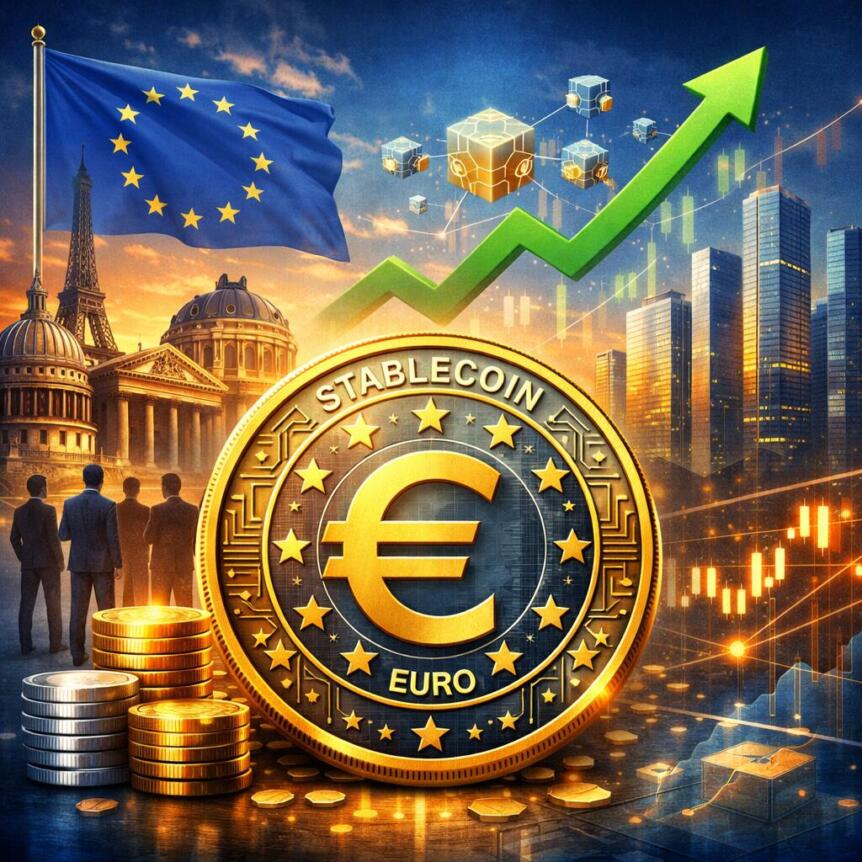
European banks are moving beyond pilot programs and positioning stablecoins as core financial infrastructure, according to a new analysis released on Feb. 3, 2026. The report outlines how euro-pegged stablecoins are increasingly viewed as tools for faster settlement, lower transaction costs, and improved traceability across payments and tokenized finance. With regulatory clarity in place under the EU’s Markets in Crypto-Assets Regulation, banks are preparing to issue their own instruments and integrate them into day-to-day operations. The assessment projects a sharp expansion of the euro stablecoin market by the end of the decade, driven primarily by tokenized investments and, to a lesser extent, retail and corporate payments.

Key takeaways

  • European banks are shifting from experimentation to infrastructure-level adoption of euro-pegged stablecoins.
  • The euro stablecoin market is projected to grow from about €650 million at end-2025 to between €25 billion and €1.1 trillion by 2030.
  • Regulatory clarity under MiCAR is accelerating institutional interest and bank issuance plans.
  • A consortium of 11 European banks is targeting a euro-denominated stablecoin launch by 2026.
  • While stablecoins offer efficiency gains, deeper bank–issuer linkages could introduce new financial stability risks.

Tickers mentioned: $SPGI

Sentiment: Neutral

Market context: The push by European banks comes as regulated crypto frameworks mature globally, with tokenization and blockchain-based settlement gaining traction amid demand for faster, more transparent financial rails.

Why it matters

The entry of established banks into stablecoin issuance signals a structural shift in how digital money may be integrated into mainstream finance. Rather than ceding ground to non-bank platforms, incumbents are aiming to embed programmable money into existing payment and settlement systems.

For investors and market participants, the scale of projected growth suggests stablecoins could become a meaningful component of eurozone liquidity. At the same time, tighter links between banks and token issuers raise questions about interconnected risks that supervisors will need to monitor closely.

For builders and corporates, bank-backed euro stablecoins could lower barriers to adopting tokenized assets and onchain settlement, potentially accelerating real-world use cases beyond crypto-native markets.

What to watch next

  • Progress toward the planned 2026 launch of a bank-led euro stablecoin consortium.
  • Implementation milestones and supervisory guidance under MiCAR.
  • Early adoption metrics for euro stablecoins in payments versus tokenized investments.
  • Risk management frameworks addressing bank–stablecoin issuer interconnectedness.

Sources & verification

  • S&P Global Ratings report titled “European Banks Are Embracing Stablecoins With An Eye On The Future.”
  • Public statements from S&P Global Ratings analysts on market size projections.
  • EU Markets in Crypto-Assets Regulation documentation referenced in the report.

How European banks are integrating stablecoins into future finance

European banks and their affiliated entities are expected to move into active stablecoin issuance as early as 2026, reflecting a broader reassessment of how digital assets fit within regulated finance. According to the latest analysis from S&P Global Ratings, euro-pegged stablecoins are no longer viewed as peripheral experiments but as building blocks for faster settlement, lower costs, and enhanced transparency across financial markets.

The report argues that two structural trends are converging to support this shift. First is the tokenization of real-world assets, particularly for investment products that benefit from onchain settlement and fractional ownership. Second is the gradual normalization of stablecoins as a payment instrument for both retail and corporate users, especially in cross-border contexts where legacy systems remain slow and expensive.

Under this framework, the euro stablecoin market is projected to expand dramatically over the next five years. From an estimated €650 million in circulation at the end of 2025, the market could reach anywhere between €25 billion and €1.1 trillion by 2030. Even at the lower end of that range, stablecoins would represent a non-trivial share of eurozone bank deposits. At the upper end, they could account for more than 4% of overnight deposits, a scale that would be impossible for banks and regulators to ignore.

Regulation is a central factor in this outlook. The EU’s Markets in Crypto-Assets Regulation has provided a harmonized legal framework that reduces uncertainty for institutional players. By setting clear requirements around issuance, reserves, and supervision, MiCAR has lowered the barrier for banks to explore tokenized products without stepping outside their compliance obligations. The report notes that this assurance has already increased institutional adoption of tokenized investments and sharpened banks’ interest in issuing their own stablecoins to support settlement.

Rather than relying on third-party issuers, many large banks are preparing to compete directly. A consortium of 11 European banks is currently planning the launch of a euro-denominated stablecoin by 2026, signaling a coordinated effort to retain control over customer relationships and payment rails. This approach reflects a broader strategic calculation: if banks do not participate, they risk being disintermediated by non-bank platforms that can capture transaction flows and data.

The business implications are mixed. On one hand, stablecoins open potential revenue streams tied to custody, settlement, and tokenized asset services. On the other, they challenge traditional intermediation models by enabling near-instant peer-to-peer transfers that bypass some existing fee structures. Larger banks, with the balance sheet capacity and technical resources to adapt, appear more inclined to embrace the shift, while smaller institutions may face tougher choices.

Efficiency gains are a recurring theme in the analysis. Stablecoins can reduce reconciliation costs, improve traceability, and operate continuously, unlike batch-based legacy systems. For corporates managing liquidity across borders or investors settling tokenized securities, these features translate into tangible operational benefits. The report emphasizes that payments are likely to be a secondary driver of growth compared with tokenized investments, but still an important component of overall demand.

At the same time, the expansion of bank-linked stablecoins introduces new forms of interconnectedness within the financial system. As banks, issuers, custodians, and blockchain infrastructures become more tightly coupled, shocks in one segment could propagate more quickly to others. The analysis associates significant adoption of euro-pegged stablecoins with higher financial stability risks, particularly if governance, reserve management, or operational resilience fall short.

Supervisors are therefore expected to scrutinize not only individual issuers but also the network effects created by widespread use. Stress scenarios, redemption dynamics, and operational dependencies will likely become standard components of prudential oversight. The report stops short of predicting systemic disruption, but it underscores the need for risk frameworks that evolve alongside adoption.

From a market perspective, the findings position Europe as a testing ground for regulated, bank-issued stablecoins at scale. If successful, these initiatives could set precedents for other jurisdictions grappling with how to integrate programmable money into existing financial systems. For now, the trajectory remains conditional on execution, regulatory follow-through, and user uptake across payments and tokenized assets.

S&P Global Ratings, a division of S&P Global (NYSE: SPGI), frames the development as a forward-looking adaptation rather than a break from traditional banking. In this view, stablecoins are not replacing banks but reshaping the infrastructure they rely on, with long-term implications for how value moves across the eurozone’s financial system.

This article was originally published as European Banks Embrace Euro Stablecoins as Core Financial Infrastructure on Crypto Breaking News – your trusted source for crypto news, Bitcoin news, and blockchain updates.

Disclaimer: The articles reposted on this site are sourced from public platforms and are provided for informational purposes only. They do not necessarily reflect the views of MEXC. All rights remain with the original authors. If you believe any content infringes on third-party rights, please contact service@support.mexc.com for removal. MEXC makes no guarantees regarding the accuracy, completeness, or timeliness of the content and is not responsible for any actions taken based on the information provided. The content does not constitute financial, legal, or other professional advice, nor should it be considered a recommendation or endorsement by MEXC.

You May Also Like

Is Doge Losing Steam As Traders Choose Pepeto For The Best Crypto Investment?

Is Doge Losing Steam As Traders Choose Pepeto For The Best Crypto Investment?

The post Is Doge Losing Steam As Traders Choose Pepeto For The Best Crypto Investment? appeared on BitcoinEthereumNews.com. Crypto News 17 September 2025 | 17:39 Is dogecoin really fading? As traders hunt the best crypto to buy now and weigh 2025 picks, Dogecoin (DOGE) still owns the meme coin spotlight, yet upside looks capped, today’s Dogecoin price prediction says as much. Attention is shifting to projects that blend culture with real on-chain tools. Buyers searching “best crypto to buy now” want shipped products, audits, and transparent tokenomics. That frames the true matchup: dogecoin vs. Pepeto. Enter Pepeto (PEPETO), an Ethereum-based memecoin with working rails: PepetoSwap, a zero-fee DEX, plus Pepeto Bridge for smooth cross-chain moves. By fusing story with tools people can use now, and speaking directly to crypto presale 2025 demand, Pepeto puts utility, clarity, and distribution in front. In a market where legacy meme coin leaders risk drifting on sentiment, Pepeto’s execution gives it a real seat in the “best crypto to buy now” debate. First, a quick look at why dogecoin may be losing altitude. Dogecoin Price Prediction: Is Doge Really Fading? Remember when dogecoin made crypto feel simple? In 2013, DOGE turned a meme into money and a loose forum into a movement. A decade on, the nonstop momentum has cooled; the backdrop is different, and the market is far more selective. With DOGE circling ~$0.268, the tape reads bearish-to-neutral for the next few weeks: hold the $0.26 shelf on daily closes and expect choppy range-trading toward $0.29–$0.30 where rallies keep stalling; lose $0.26 decisively and momentum often bleeds into $0.245 with risk of a deeper probe toward $0.22–$0.21; reclaim $0.30 on a clean daily close and the downside bias is likely neutralized, opening room for a squeeze into the low-$0.30s. Source: CoinMarketcap / TradingView Beyond the dogecoin price prediction, DOGE still centers on payments and lacks native smart contracts; ZK-proof verification is proposed,…
Share
BitcoinEthereumNews2025/09/18 00:14
Crucial Fed Rate Cut: October Probability Surges to 94%

Crucial Fed Rate Cut: October Probability Surges to 94%

BitcoinWorld Crucial Fed Rate Cut: October Probability Surges to 94% The financial world is buzzing with a significant development: the probability of a Fed rate cut in October has just seen a dramatic increase. This isn’t just a minor shift; it’s a monumental change that could ripple through global markets, including the dynamic cryptocurrency space. For anyone tracking economic indicators and their impact on investments, this update from the U.S. interest rate futures market is absolutely crucial. What Just Happened? Unpacking the FOMC Statement’s Impact Following the latest Federal Open Market Committee (FOMC) statement, market sentiment has decisively shifted. Before the announcement, the U.S. interest rate futures market had priced in a 71.6% chance of an October rate cut. However, after the statement, this figure surged to an astounding 94%. This jump indicates that traders and analysts are now overwhelmingly confident that the Federal Reserve will lower interest rates next month. Such a high probability suggests a strong consensus emerging from the Fed’s latest communications and economic outlook. A Fed rate cut typically means cheaper borrowing costs for businesses and consumers, which can stimulate economic activity. But what does this really signify for investors, especially those in the digital asset realm? Why is a Fed Rate Cut So Significant for Markets? When the Federal Reserve adjusts interest rates, it sends powerful signals across the entire financial ecosystem. A rate cut generally implies a more accommodative monetary policy, often enacted to boost economic growth or combat deflationary pressures. Impact on Traditional Markets: Stocks: Lower interest rates can make borrowing cheaper for companies, potentially boosting earnings and making stocks more attractive compared to bonds. Bonds: Existing bonds with higher yields might become more valuable, but new bonds will likely offer lower returns. Dollar Strength: A rate cut can weaken the U.S. dollar, making exports cheaper and potentially benefiting multinational corporations. Potential for Cryptocurrency Markets: The cryptocurrency market, while often seen as uncorrelated, can still react significantly to macro-economic shifts. A Fed rate cut could be interpreted as: Increased Risk Appetite: With traditional investments offering lower returns, investors might seek higher-yielding or more volatile assets like cryptocurrencies. Inflation Hedge Narrative: If rate cuts are perceived as a precursor to inflation, assets like Bitcoin, often dubbed “digital gold,” could gain traction as an inflation hedge. Liquidity Influx: A more accommodative monetary environment generally means more liquidity in the financial system, some of which could flow into digital assets. Looking Ahead: What Could This Mean for Your Portfolio? While the 94% probability for a Fed rate cut in October is compelling, it’s essential to consider the nuances. Market probabilities can shift, and the Fed’s ultimate decision will depend on incoming economic data. Actionable Insights: Stay Informed: Continue to monitor economic reports, inflation data, and future Fed statements. Diversify: A diversified portfolio can help mitigate risks associated with sudden market shifts. Assess Risk Tolerance: Understand how a potential rate cut might affect your specific investments and adjust your strategy accordingly. This increased likelihood of a Fed rate cut presents both opportunities and challenges. It underscores the interconnectedness of traditional finance and the emerging digital asset space. Investors should remain vigilant and prepared for potential volatility. The financial landscape is always evolving, and the significant surge in the probability of an October Fed rate cut is a clear signal of impending change. From stimulating economic growth to potentially fueling interest in digital assets, the implications are vast. Staying informed and strategically positioned will be key as we approach this crucial decision point. The market is now almost certain of a rate cut, and understanding its potential ripple effects is paramount for every investor. Frequently Asked Questions (FAQs) Q1: What is the Federal Open Market Committee (FOMC)? A1: The FOMC is the monetary policymaking body of the Federal Reserve System. It sets the federal funds rate, which influences other interest rates and economic conditions. Q2: How does a Fed rate cut impact the U.S. dollar? A2: A rate cut typically makes the U.S. dollar less attractive to foreign investors seeking higher returns, potentially leading to a weakening of the dollar against other currencies. Q3: Why might a Fed rate cut be good for cryptocurrency? A3: Lower interest rates can reduce the appeal of traditional investments, encouraging investors to seek higher returns in alternative assets like cryptocurrencies. It can also be seen as a sign of increased liquidity or potential inflation, benefiting assets like Bitcoin. Q4: Is a 94% probability a guarantee of a rate cut? A4: While a 94% probability is very high, it is not a guarantee. Market probabilities reflect current sentiment and data, but the Federal Reserve’s final decision will depend on all available economic information leading up to their meeting. Q5: What should investors do in response to this news? A5: Investors should stay informed about economic developments, review their portfolio diversification, and assess their risk tolerance. Consider how potential changes in interest rates might affect different asset classes and adjust strategies as needed. Did you find this analysis helpful? Share this article with your network to keep others informed about the potential impact of the upcoming Fed rate cut and its implications for the financial markets! To learn more about the latest crypto market trends, explore our article on key developments shaping Bitcoin price action. This post Crucial Fed Rate Cut: October Probability Surges to 94% first appeared on BitcoinWorld.
Share
Coinstats2025/09/18 02:25
MOEX to Launch $XRP Indices/Futures: $MAXI Adoption Grows

MOEX to Launch $XRP Indices/Futures: $MAXI Adoption Grows

The post MOEX to Launch $XRP Indices/Futures: $MAXI Adoption Grows appeared on BitcoinEthereumNews.com. MOEX to Launch $XRP Indices/Futures: $MAXI Adoption
Share
BitcoinEthereumNews2026/02/04 06:00