

Bitcoin enters reserve conversation, but gold still rules as dollar grows weak
BlackRock’s latest report frames de-dollarization as a genuine trend, with gold rising and Bitcoin now entering conversations at the sovereign level.
- BlackRock’s July report calls de-dollarization a reality, driven by geopolitical stress, inflation, and weakening confidence in U.S. debt.
- Central banks are accumulating gold at a record pace, with official holdings nearing levels last seen over 50 years ago.
- Bitcoin has entered reserve-level discussions, with mentions in formal reviews and proposals by central banks and sovereign entities.
- Governments, including the U.S., Pakistan, and Texas, have established strategic Bitcoin reserves outside traditional central bank frameworks.
- Bitcoin’s institutional inflows, ETF growth, and clearer regulation are positioning it as a possible long-term hedge under observation.
De-dollarization gets real
BlackRock, which manages nearly $12.5 trillion in assets, stated in a July 2025 report that de-dollarization has moved from theory to reality.
Central banks are gradually reducing their reliance on the U.S. dollar and moving toward a more diversified mix of reserve assets.
The report attributes this transition to rising geopolitical tensions, persistent inflation and renewed concerns over U.S. credit stability.
President Donald Trump addressed the topic on Friday, explaining that while he liked a strong dollar, “you make a hell of a lot more money” with a weaker one.
Indeed, the U.S. dollar has fallen over 10% in six months—a steep drop not seen since 1973’s post-gold standard shift. Such a scenario can also boost cryptocurrency by driving demand for alternative stores of value like Bitcoin. That makes dollar-priced crypto assets cheaper for foreign buyers and can erode confidence in fiat currencies, pushing more investors (Trump being one) toward decentralized options.
Rethinking the reserve playbook
In 2024, central banks purchased over 1,000 metric tons of gold, more than twice the average annual total of the previous decade. Total official holdings are now approaching 36,000 metric tons, a level not seen in more than 50 years.
Gold currently accounts for roughly 20% of global reserves. The dollar’s share has declined to about 46%, while other currencies and the euro make up 18% and 16% respectively, according to data cited by Business Insider.
Although gold remains the core hedge, the report notes an increasing number of references to Bitcoin (BTC) in discussions about sovereign reserves.
BlackRock characterizes it as a decentralized, non-sovereign asset with a fixed supply, features that may hold strategic value over time.
Central banks have not yet added Bitcoin to their holdings in confirmed quantities, but its appearance in official analyses marks the beginning of a new chapter.
Central banks load up on bullion
Central banks continued adding to their gold reserves in early 2025, with first-quarter acquisitions surpassing 244 metric tons. Exchange-traded funds linked to gold also saw renewed demand, drawing nearly $30 billion in inflows, a level not recorded since 2020.
The World Gold Council’s May update reported net monthly purchases of 20 metric tons, led by Kazakhstan with 7 tons, followed by Turkey and Poland at 6 tons each.
Its 2025 survey of reserve managers found that 95% expect global official gold holdings to rise further in the coming year.
Nearly half of the respondents plan to increase their own gold reserves, while over 70% anticipate reducing U.S. dollar exposure within five years in favor of gold, the euro, and China’s renminbi.
Emerging markets remain active in this transition. Countries such as Azerbaijan, China, and Iran have been among the most consistent buyers, often driven by the need to protect their reserves from sanctions or currency-related volatility.
In April, gold prices peaked at nearly $3,500 per troy ounce. Metals Focus estimates place the value of official gold purchases this year at approximately $80 billion, with further growth possible in 2026 depending on geopolitical and monetary conditions.
China’s central bank has played a major role in this accumulation. Its reported gold reserves rose from about 2,000 metric tons in late 2022 to 2,299 metric tons by mid-2025.
Some analysts believe that China’s actual figure could be higher, based on import activity and off-balance-sheet storage.
The current trend marks a sharp reversal from the era of net selling that began in the late 1990s. Since 2023, central banks have accounted for nearly 25% of total global gold demand, acquiring bullion at a rate more than five times that of ETF inflows.
Over the past five years, one out of every eight ounces of newly mined gold has been absorbed directly into sovereign vaults.
Bitcoin sparks interest in policy circles
The reserve conversation is expanding beyond physical metals and fiat currencies. While full-scale adoption remains unlikely in the near term, Bitcoin has begun to appear in official-level discussions.
In January 2025, the Czech National Bank became the first major Western monetary authority to initiate a formal internal review on Bitcoin’s potential as part of its reserves. The governor suggested that up to 5% of the bank’s €140 billion portfolio might be considered.
In Switzerland, citizen-led campaigns have urged the Swiss National Bank to consider a modest Bitcoin allocation of 1 to 2% of its holdings.
Despite its growing visibility in policy circles, actual adoption among central banks remains extremely limited.
A 2025 survey by Central Banking Publications, covering over 91 central banks managing $7 trillion in reserves, found that none held Bitcoin. Only 2% expressed any intent to invest in crypto assets within the next five to ten years, down sharply from nearly 16% the year before.
A separate assessment by OMFIF’s Global Public Investor 2025 report echoed these findings, with 93% of central banks stating they had no plans to include digital assets in their portfolios.
The reluctance stems from Bitcoin’s high price volatility, uncertain liquidity under stress, and unresolved challenges in custody and cybersecurity.
Many central banks also face structural limitations, including legal barriers and conservative investment frameworks that favor assets with long histories, stable returns, and mature oversight mechanisms.
Bitcoin, though over a decade old, still falls short of those standards in the view of most public institutions.
Even as central banks remain hesitant, some governments and sub-sovereign entities have begun taking measured steps.
In March 2025, the U.S. government formalized a Strategic Bitcoin Reserve, placing approximately 200,000 seized Bitcoins into a Treasury-managed, non-trading account.
Future additions are required to be budget-neutral, turning the reserve into a passive store of previously acquired assets.
Texas followed with legislation allocating $10 million to its own Bitcoin reserve, positioning it as a long-term hedge. Pakistan also announced plans to establish a sovereign Bitcoin reserve under its finance ministry.
Among the more advanced examples, El Salvador now holds over 6,000 BTC, although usage has declined amid loan negotiations with the IMF.
Bhutan’s reserve reportedly represents nearly 28% of its GDP, showing how smaller nations with favorable energy conditions can use Bitcoin as a strategic asset in unconventional ways.
Bitcoin price and growing legitimacy
Bitcoin’s sharp climb in 2025 has brought renewed attention to its role in the shifting global reserve discussions.
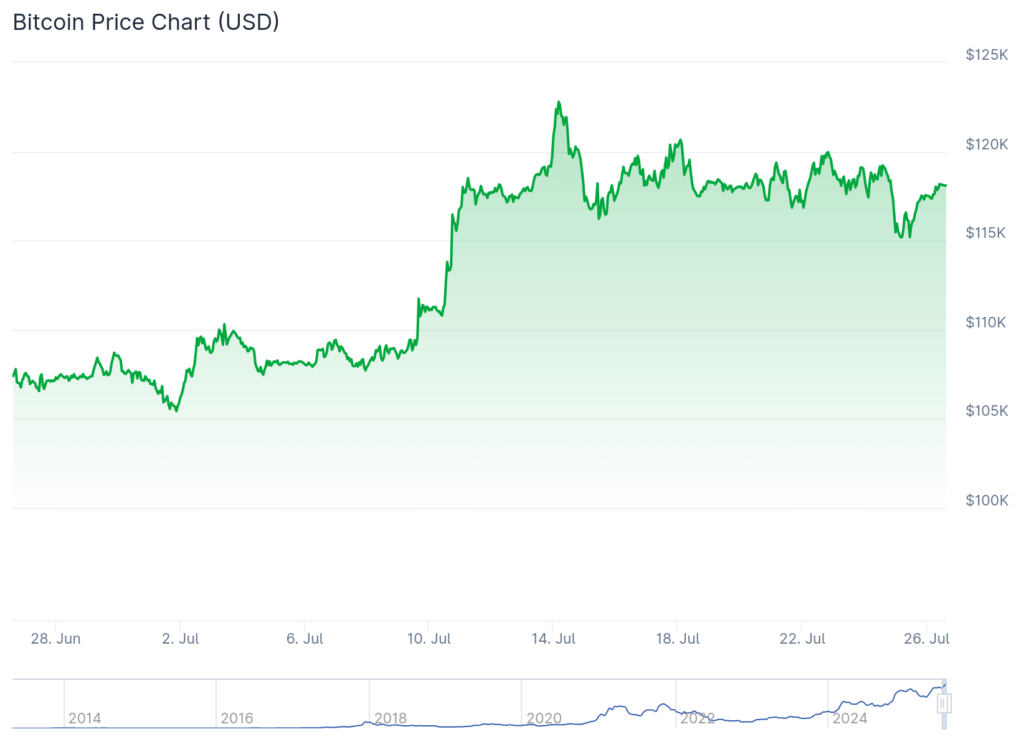
On Jul 14, it crossed $123,000, marking a gain of roughly 75% since late 2024. This rise has been fueled by over $50 billion in institutional inflows, led by BlackRock’s iShares Bitcoin Trust, which now manages more than $80 billion in assets.
Interestingly, BTC ETF’s growth has outpaced the early performance of major gold ETFs, revealing how quickly Bitcoin has moved into the mainstream of institutional allocation.
As of Jul 26, Bitcoin trades around $118,000, up 10% from a month ago.
In parallel, regulatory clarity has made meaningful progress. The U.S. has passed the CLARITY Act and the GENIUS Act, both of which define digital assets under federal law and provide clearer guidance for market participants.
Alongside these legislative moves, federal resistance to launching a central bank digital currency has reinforced Bitcoin’s distinct position as a decentralized alternative rather than a state-backed monetary instrument.
Moreover, according to VanEck, Bitcoin’s volatility relative to equities has declined, supporting its case as a maturing asset with potential use as a store of value.
As central banks reevaluate their reserve strategies, they are not only diversifying into gold and foreign currencies but also closely monitoring the maturation of digital assets in terms of structure and function.
Bitcoin remains largely speculative in the context of sovereign reserves. Still, its growing institutional footprint and increasing regulatory clarity suggest that it may be laying the foundation for future consideration.
You May Also Like

MoneyGram launches stablecoin-powered app in Colombia

Solana Treasury Firm Holdings Could Double as Forward Industries Unveils $4 Billion Raise
