Theta Network Unveils 2026 Roadmap Focused on Decentralized AI and GPU Infrastructure
- Theta Network has unveiled its 2026 roadmap, with the main focus placed on edge computing and decentralized artificial intelligence.
- It pledges to push the real-world utility of TFUEL and THETA, and says it has been working with enterprises, professional sports, and academia to spur adoption.
2026 will be the year for decentralized artificial intelligence, edge computing, and token utility, Theta Network says in its new roadmap outlining this year’s priorities.
Theta joins dozens of other blockchain networks that have unveiled their roadmaps for 2026, with AI featuring prominently across the board. As we reported, ICP said this will be a breakthrough year for its decentralized AI products, while Algorand, VeChain, Cosmos, and COTI revealed similar ambitions.
Theta now says that it shall target scaling its AI agent economy with its decentralized GPU infrastructure and drive adoption across enterprise, sports, and academia.
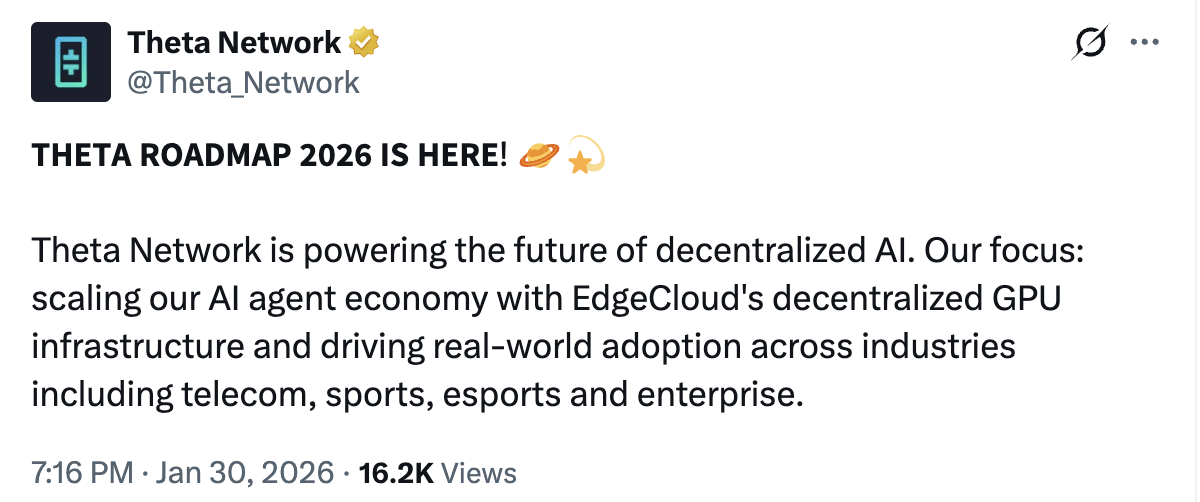 Image courtesy of Theta Network on X.
The network’s AI ambitions hinge on EdgeCloud, its decentralized cloud computing system. EdgeCloud is a hybrid cloud platform that’s powered by a distributed edge network of GPUs, that’s designed for AI and other workloads that require heavy computing power. Specifically for AI, the network uses the EdgeCloud Inference Engine, which runs these LLM models and returns results, called inference.
Theta says that the Inference Engine has evolved to meet changing needs in the past few years, and it’s now integrating with platforms like RapidAPI, “making our compute resources more accessible to developers worldwide and driving EdgeCloud demand.”
It’s also adding new users and research labs to its EdgeCloud Training Engine, which focuses on enterprise AI deployment.
It added:
“We’re also expanding our template library with cutting-edge open-source AI models, complete with on-demand model inference APIs that make deploying AI as simple as making an API call.”
Theta’s AI Ambitions for an Agent Economy
Ultimately, Theta wants to build the most expansive decentralized AI agent economy. In the first half, it will expand its EdgeCloud AI Agents, which it claims are getting more capable by the day. It will also introduce two new business tools for its agents: the AI Merch Agent and the AI Support Agent.
Still in the first half, it will revive TDROP to become the foundation of the AI agent economy. TDROP is the native token that powers ThetaDrop, the network’s NFT marketplace. As TDROP 2.0, it will become accepted as a payment method on EdgeCloud. As a bonus, users who use TDROP 2.0 to make payments on Shopify will earn rewards.
In the second half, the network will push its AI agenda even more aggressively, and its distributed inference technology will be at the heart of its efforts. It will also launch AI Ticketing Agent, enabling its agents to engage in fan management and event ticketing. Building on its H1 developments with TDROP 2.0, the network will introduce TDROP rebates for users of its EdgeCloud.
These rewards will also be available to users who interact with its agents, including by watching short videos, answering trivia questions, and purchasing tickets. It says:
The network further plans to push the adoption of its two tokens: THETA and TFUEL. It starts with incentivizing clients of its EdgeCloud to make payments in TFUEL. It will also work with enterprise validators to stake THETA to secure the network. Its main market will be in the telecoms industry, where it has already secured partnerships with Japan’s NTT Digital and Europe’s largest telecoms firm, Deutsche Telekom.
THETA trades at $0.2334, dipping 3.5% in the past four hours to bring its weekly losses to 21% for a $233 million market cap.
]]>You May Also Like

Republic Europe Launches SPV for Retail Investors in Kraken

Tokyo’s Metaplanet Launches Miami Subsidiary to Amplify Bitcoin Income