TLDR Solana (SOL) dropped 7.5% to around $114 on January 30, 2026, falling below key resistance at $120 The price declined from $128 to a low of $112, with immediateTLDR Solana (SOL) dropped 7.5% to around $114 on January 30, 2026, falling below key resistance at $120 The price declined from $128 to a low of $112, with immediate

Solana (SOL) Price: Token Drops to $112 as Market Pullback Tests Key Support Levels

3 min read

TLDR

  • Solana (SOL) dropped 7.5% to around $114 on January 30, 2026, falling below key resistance at $120
  • The price declined from $128 to a low of $112, with immediate resistance at $116 and major resistance at $120-$122
  • SOL maintains a market cap near $64.5 billion and ranks as the seventh-largest crypto asset despite the downturn
  • Total value locked on Solana DeFi reached $9 billion while spot ETF products logged eight consecutive weeks of inflows
  • Key support levels sit at $112 and $105, with a break below potentially pushing SOL toward $102

Solana closed January 30, 2026 trading at approximately $113.80 after dropping 7.6% in 24 hours. The decline pushed SOL below the $120 threshold and the 100-hourly simple moving average.
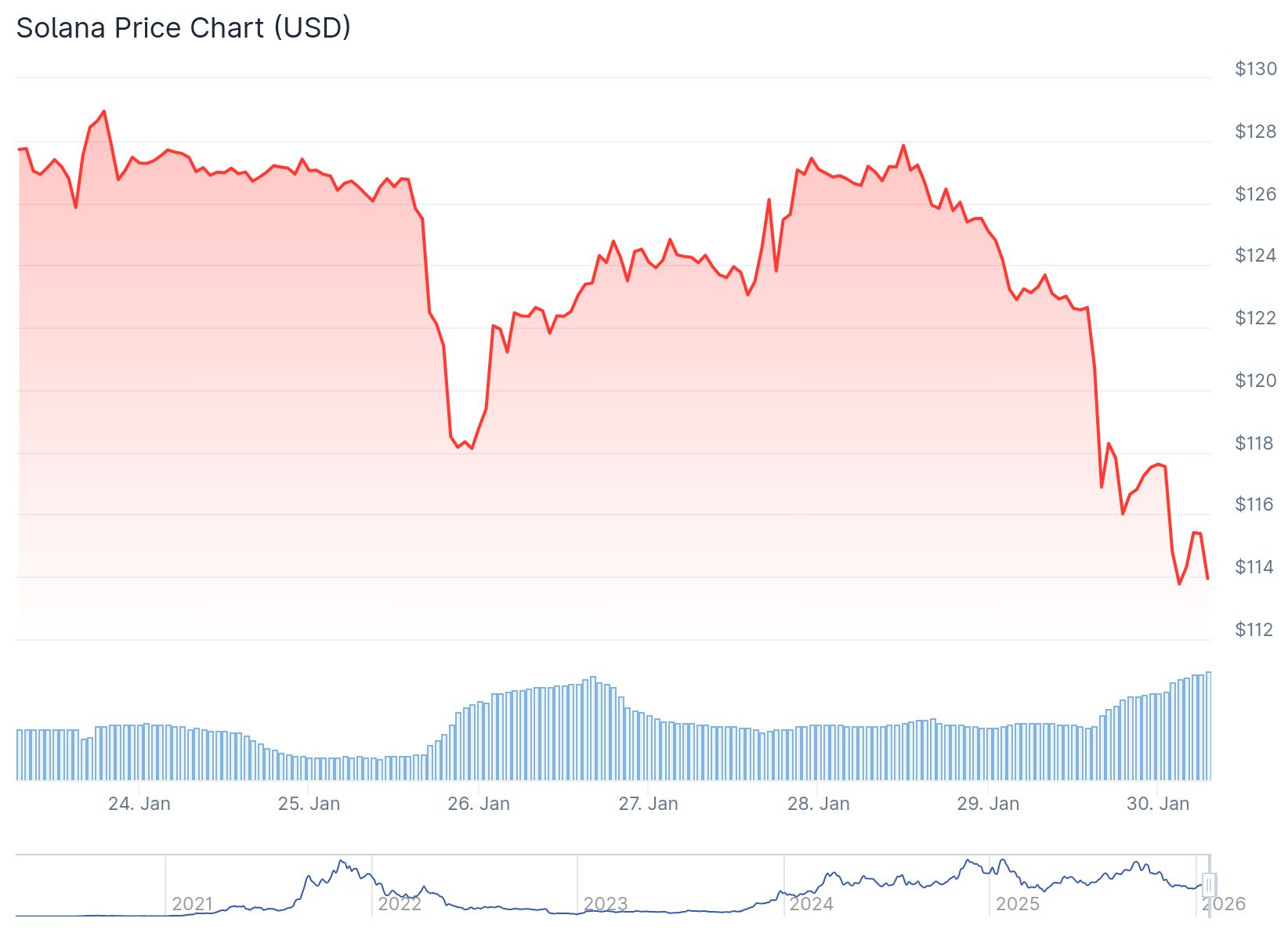
Solana (SOL) PriceSolana (SOL) Price

The cryptocurrency fell from a swing high of $128 to a low of $112 during the session. The 24-hour trading range stretched between $113.10 and $123.70 as selling pressure intensified across major crypto assets.

Bitcoin dropped to around $82,000 while Ethereum declined to near $2,730 during the same period. The broader market pullback affected high-growth altcoins including Solana.

Daily trading volume for SOL remained elevated above $7 billion. This indicates active repositioning rather than low liquidity conditions.

Solana’s market capitalization stands at roughly $64.5 billion. This ranks the token as the seventh-largest cryptocurrency by market value.

Price Levels and Technical Structure

A bearish trend line has formed with resistance at $116 on the hourly chart. The price recovered slightly from the $112 low and climbed toward the 23.6% Fibonacci retracement level.

The next major resistance sits at $120, which corresponds to the 50% Fibonacci retracement level. A move above $120 would target the $122 level.

Breaking above $122 could open the path toward $125 and potentially $132. However, failure to clear $116 resistance may extend losses.

Initial downside support is located near $114. The first major support zone is at $112, where the recent low formed.

A break below $112 could send SOL toward $105. Further declines below $105 might target the $102 support level in the near term.

On-Chain Metrics and ETF Flows

Total value locked in Solana DeFi protocols climbed to approximately $9 billion. Active addresses on the network rose toward 3.8 million in early January.
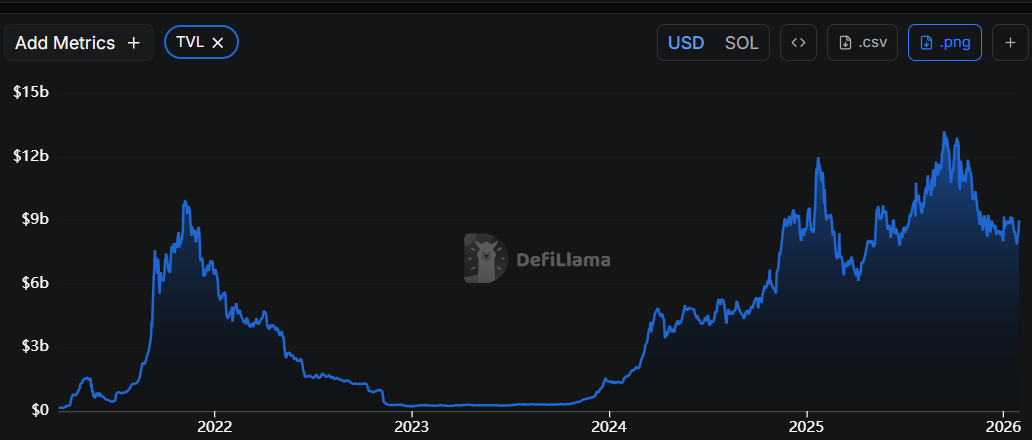
Source: DefiLlama

Spot Solana ETF products recorded roughly eight consecutive weeks of net inflows. Weekly inflows recently totaled just over $41 million, showing continued institutional interest.

Open interest in SOL futures reached between $7.9 billion and $8 billion in early 2026. Short positions made up just over 52% of open interest according to derivatives data.

Funding rates averaged around 0.46% on a periodic basis, indicating a persistent long bias among traders. Stablecoin supply on the Solana network sits at approximately $15 billion.

Network Development

Infrastructure improvements continue with the Firedancer validator client designed to reduce congestion. The upgrade aims to address past network outages that affected user confidence.

Real-world asset initiatives and stablecoin liquidity expansion are positioning Solana as a high-throughput settlement layer. Traditional financial managers have supported these developments.

The cryptocurrency had been consolidating in a falling wedge pattern around the $120 area before the recent decline. The $120-$123 range acted as support throughout January before breaking lower.

Solana began 2026 trading in the $127-$135 range and remains above its December lows. The token is now testing whether it can hold the $110-$120 support band that defined the start of the year’s rebound.

The post Solana (SOL) Price: Token Drops to $112 as Market Pullback Tests Key Support Levels appeared first on CoinCentral.

Disclaimer: The articles reposted on this site are sourced from public platforms and are provided for informational purposes only. They do not necessarily reflect the views of MEXC. All rights remain with the original authors. If you believe any content infringes on third-party rights, please contact service@support.mexc.com for removal. MEXC makes no guarantees regarding the accuracy, completeness, or timeliness of the content and is not responsible for any actions taken based on the information provided. The content does not constitute financial, legal, or other professional advice, nor should it be considered a recommendation or endorsement by MEXC.

You May Also Like

Shibarium May No Longer Turbocharge Shiba Inu Price Rally, Here’s Reason

Shibarium May No Longer Turbocharge Shiba Inu Price Rally, Here’s Reason

The post Shibarium May No Longer Turbocharge Shiba Inu Price Rally, Here’s Reason appeared on BitcoinEthereumNews.com. Shibarium, the layer-2 blockchain of the Shiba Inu (SHIB) ecosystem, is battling to stay active. Shibarium has slipped from hitting transaction milestones to struggling to record any transactions on its platform, a development that could severely impact SHIB. Shibarium transactions crash from millions to near zero As per Shibariumscan data, the total daily transactions on Shibarium as of Sept. 16 stood at 11,600. This volume of transactions reflects how low the transaction count has dropped for the L2, whose daily average ranged between 3.5 million and 4 million last month. However, in the last week of August, daily transaction volume on Shibarium lost momentum, slipping from 1.3 million to 9,590 as of Aug. 28. This pattern has lingered for much of September, with the highest peak so far being on Sept. 5, when it posted 1.26 million transactions. The low user engagement has greatly affected the transaction count in recent days. In addition, the security breach over the weekend by malicious attackers on Shibarium has probably worsened issues. Although developer Kaal Dhairya reassured the community that the attack to steal millions of BONE tokens was successfully prevented, users’ confidence appears shaken. This has also impacted the price outlook for Shiba Inu, the ecosystem’s native token. Following reports of the malicious attack on Shibarium, SHIB dipped immediately into the red zone. Unlike on previous occasions where investors accumulated on the dip, market participants did not flock to Shiba Inu. Shiba Inu price struggles, can burn mechanism help? With the current near-zero crash in transaction volume for Shibarium, SHIB’s price cannot depend on it to support a rally. It might take a while to rebuild user confidence and for transactions to pick up again. In the meantime, Shiba Inu might have to rely on other means to boost prices from its low levels. This…
Share
BitcoinEthereumNews2025/09/18 07:57
👨🏿‍🚀TechCabal Daily – When banks go cashless

👨🏿‍🚀TechCabal Daily – When banks go cashless

In today's edition: South Africa's biggest banks are going cashless || Onafriq and PAPSS pilot Naira wallet transfers from Nigeria to Ghana || South Africa just
Share
Techcabal2026/02/04 14:02
Wormhole launches reserve tying protocol revenue to token

Wormhole launches reserve tying protocol revenue to token

The post Wormhole launches reserve tying protocol revenue to token appeared on BitcoinEthereumNews.com. Wormhole is changing how its W token works by creating a new reserve designed to hold value for the long term. Announced on Wednesday, the Wormhole Reserve will collect onchain and offchain revenues and other value generated across the protocol and its applications (including Portal) and accumulate them into W, locking the tokens within the reserve. The reserve is part of a broader update called W 2.0. Other changes include a 4% targeted base yield for tokenholders who stake and take part in governance. While staking rewards will vary, Wormhole said active users of ecosystem apps can earn boosted yields through features like Portal Earn. The team stressed that no new tokens are being minted; rewards come from existing supply and protocol revenues, keeping the cap fixed at 10 billion. Wormhole is also overhauling its token release schedule. Instead of releasing large amounts of W at once under the old “cliff” model, the network will shift to steady, bi-weekly unlocks starting October 3, 2025. The aim is to avoid sharp periods of selling pressure and create a more predictable environment for investors. Lockups for some groups, including validators and investors, will extend an additional six months, until October 2028. Core contributor tokens remain under longer contractual time locks. Wormhole launched in 2020 as a cross-chain bridge and now connects more than 40 blockchains. The W token powers governance and staking, with a capped supply of 10 billion. By redirecting fees and revenues into the new reserve, Wormhole is betting that its token can maintain value as demand for moving assets and data between chains grows. This is a developing story. This article was generated with the assistance of AI and reviewed by editor Jeffrey Albus before publication. Get the news in your inbox. Explore Blockworks newsletters: Source: https://blockworks.co/news/wormhole-launches-reserve
Share
BitcoinEthereumNews2025/09/18 01:55