Michael Saylor’s Strategy has reignited a long-running Bitcoin custody debate after co-founder and CTO of Casa Jameson Lopp challenged whether the firm can knowMichael Saylor’s Strategy has reignited a long-running Bitcoin custody debate after co-founder and CTO of Casa Jameson Lopp challenged whether the firm can know

Michael Saylor Vows ‘We Buy Real Bitcoin,’ No Rehypothecation

3 min read

Michael Saylor’s Strategy has reignited a long-running Bitcoin custody debate after co-founder and CTO of Casa Jameson Lopp challenged whether the firm can know its holdings aren’t being rehypothecated by third parties. Saylor’s blunt response — “We buy real bitcoin. We don’t rehypothecate.” — quickly turned into a broader argument about what “proof” looks like for a public company warehousing BTC at institutional custodians.

The exchange landed as Strategy’s accumulation narrative is accelerating in early 2026. On Jan. 26, Saylor posted that Strategy bought 2,932 BTC for roughly $264.1 million at an average price near $90,061 per bitcoin. He added that, as of Jan. 25, the company held 712,647 BTC acquired for about $54.19 billion at an average cost of roughly $76,037 per coin.

That disclosure sparked commentary from Jesse Myers, who framed Strategy’s pace as structurally supply-tightening. Myers said the company has acquired 40,150 BTC so far in 2026, against 11,700 BTC mined year-to-date. “Eventually, the BTC price must go higher. Much higher,” he wrote, leaning on a simple imbalance: one large buyer absorbing more than new issuance.

No Paper Bitcoin?

Lopp pushed back on the implicit assumption that all of those purchases translate into unencumbered, uniquely owned UTXOs. “Your thesis is sensible… under the assumption that he’s buying real bitcoin,” Lopp wrote. “Does Strategy actually verify that their bitcoin only belongs to them and isn’t rehypothecated? I’m skeptical.”

Saylor responded with a short, definitive denial: “We buy real bitcoin. We don’t rehypothecate.” But Lopp widened the aperture from Strategy’s own behavior to the incentives and opacity of intermediaries. “But how do you know your custodians don’t? Presumably they put your BTC in segregated addresses you can monitor,” he wrote. “People ask for proof of reserves since they don’t even know what monitoring / assurances you put in place. Multiple layers of trusted black boxes make folks nervous.”

As the thread grew, some users demanded Strategy publish addresses. One account wrote, “Prove it then. Show us the addresses.” Others argued that transparency cuts both ways. “Ever considered that TradFi could be extremely frightened if Strategy were to do this, given that it opens up multiple attack Vectors?”

Defenders leaned on the mechanics of public-company controls rather than on-chain visibility. Attorney Jesse Kobernick from Miller Nash LLP argued that Strategy’s filings describe steps auditors take to verify balances and control, and that multiple third parties touch the process, including the separation between BTC purchases and the equity sales and cash proceeds that fund them. Lopp rejected that comfort. “Trusted third parties are security holes…” he replied.

Bitcoin OG Adam Back, meanwhile, pointed to mainstream custodianship norms as a reason to discount “paper bitcoin” fears. “Think about it. Their custodians are I think Fidelity and Coinbase,” Back wrote, adding that large auditors take verification and key-control standards seriously.

Lopp remained unconvinced that outside observers can know what, exactly, is being verified. “Are these auditors spinning up nodes, verifying balances at addresses, ensuring that no clients hold claims to the same BTC?” he wrote. “I’m skeptical, but ultimately we just don’t know – it’s a black box.”

Later on Jan. 28, Saylor reposted the message more broadly, escalating from denial to prescription: “We buy real bitcoin. We audit our custodians. We don’t rehypothecate.” He added: “You shouldn’t either.”

At press time, Bitcoin traded at $88,001.
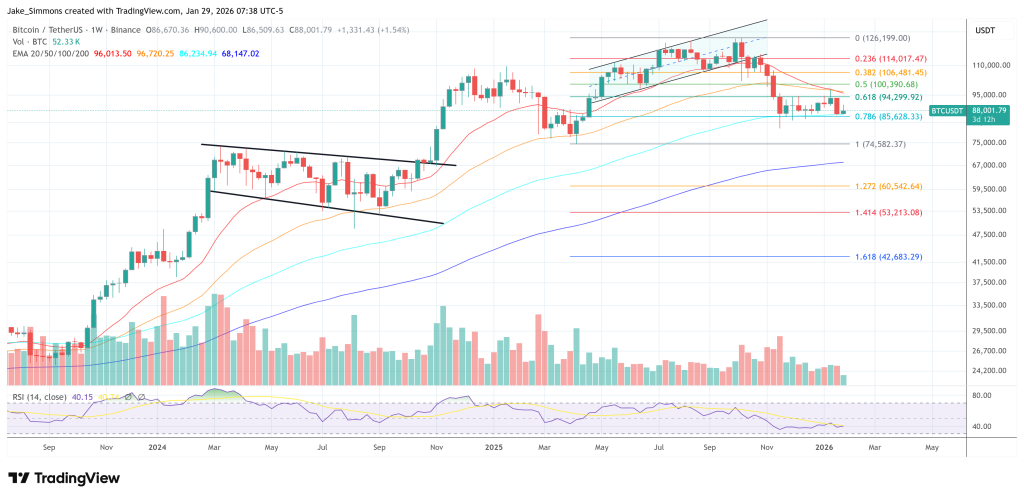
Bitcoin price chart
Disclaimer: The articles reposted on this site are sourced from public platforms and are provided for informational purposes only. They do not necessarily reflect the views of MEXC. All rights remain with the original authors. If you believe any content infringes on third-party rights, please contact service@support.mexc.com for removal. MEXC makes no guarantees regarding the accuracy, completeness, or timeliness of the content and is not responsible for any actions taken based on the information provided. The content does not constitute financial, legal, or other professional advice, nor should it be considered a recommendation or endorsement by MEXC.

You May Also Like

Three dormant wallets, suspected to belong to the same entity, purchased 5,970 ETH eight hours ago.
Three dormant wallets, suspected to belong to the same entity, purchased 5,970 ETH eight hours ago.

PANews reported on February 4 that, according to Lookonchain monitoring, three wallets that had been dormant for four years (likely controlled by the same entity
Share
PANews2026/02/04 11:36
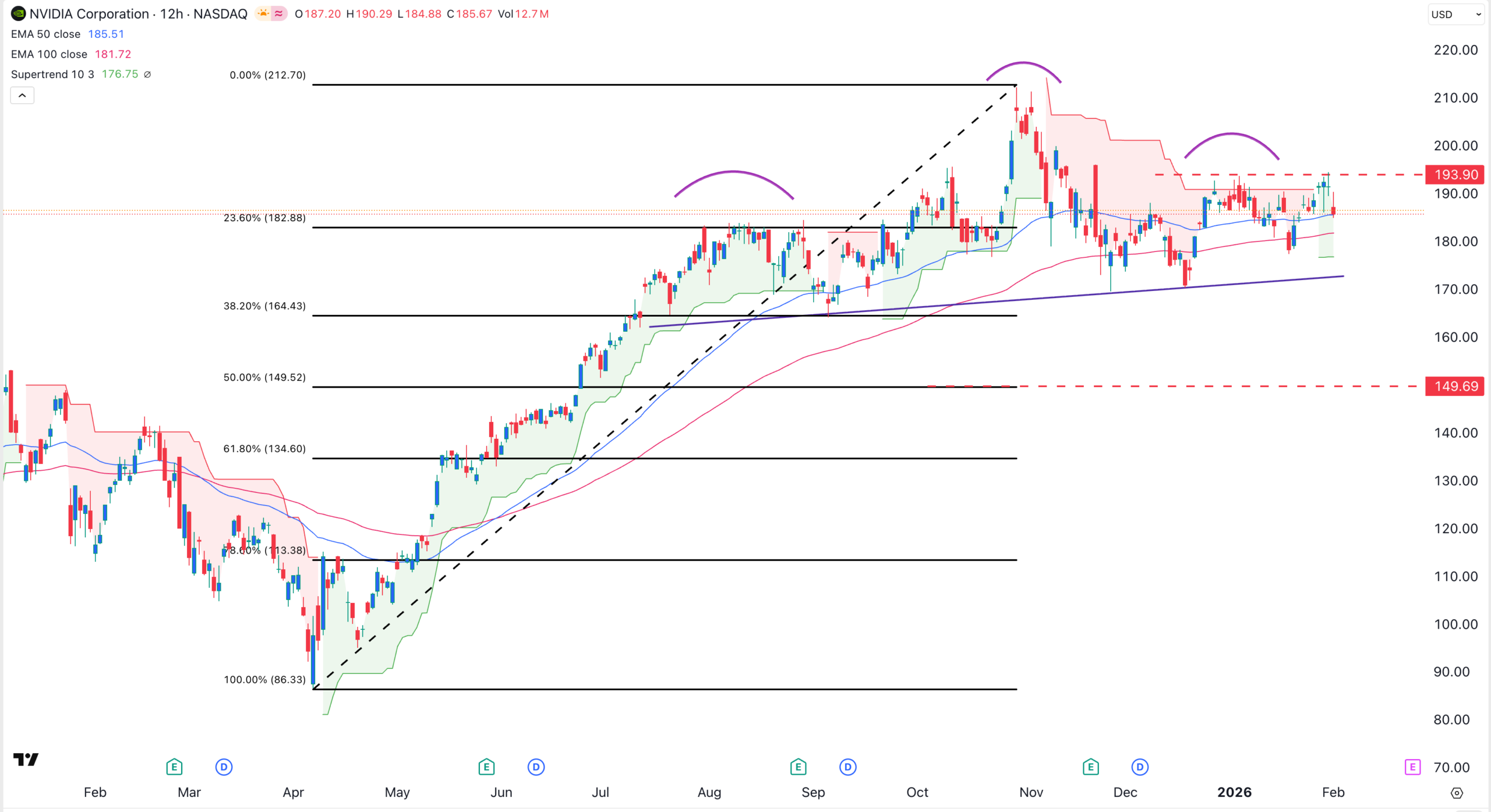
NVIDIA Stock Price Analysis as OpenAI Issues Concerns About its Chips

NVIDIA Stock Price Analysis as OpenAI Issues Concerns About its Chips

Key Insights NVIDIA stock started the week in the red. It crashed by over 2%. Meanwhile, the S&P 500, Dow Jones, and Nasdaq 100 moved close to their all-time highs
Share
Themarketperiodical2026/02/04 11:27
Ondo Finance Launches USDY Yieldcoin on Stellar, Bringing Tokenized U.S. Treasuries to Users

Ondo Finance Launches USDY Yieldcoin on Stellar, Bringing Tokenized U.S. Treasuries to Users

Ondo Finance, a U.S.-based digital asset firm specializing in bringing traditional financial products on-chain through tokenization, is expanding its yieldcoin USDY to the Stellar network. This lates update marks a step forward in merging tokenized real-world assets with a global payments infrastructure, unlocking new opportunities for users worldwide. The announcement was made at the Stellar Meridian event in Copacabana, Rio de Janeiro, on September 17. USDY Joins the Stellar Ecosystem Ondo Finance, a recognized leader in tokenized real-world assets, announced the deployment of United States Dollar Yield (USDY) on Stellar, the payments-focused blockchain known for speed and low transaction costs. USDY is the most widely available “yieldcoin,” offering investors access to onchain assets backed by U.S. Treasuries. This launch allows Stellar’s global user base to tap into permissionless, yield-bearing assets tied to one of the safest financial instruments in the world. It also aligns with Stellar’s mission of driving fast, affordable cross-border payments. Combining Yield with Payments Infrastructure “Stablecoins unlocked global access to the U.S. dollar. With USDY, we’re taking the next step by bringing U.S. Treasuries onchain in a form that combines stability, liquidity, and yield,” said Ian De Bode, Chief Strategy Officer at Ondo Finance. “Fast, affordable cross-border payments are at the center of what Stellar was designed to do. The global reach of the Stellar ecosystem combined with a yield-bearing asset like USDY levels up what is possible onchain, allowing wallets and businesses to offer yield opportunities to their users,” said Denelle Dixon, CEO of the Stellar Development Foundation. Ondo claims by pairing USDY with Stellar’s infrastructure, new possibilities open up in treasury management, collateralization, and everyday financial applications. Unlocking Institutional and Retail Use Cases USDY currently manages over $650 million in total value locked (TVL) across nine blockchains and offers a 5.3% APY. By launching on Stellar, Ondo Finance extends these benefits to global retail and institutional users. The firm explains balances on Stellar can now become productive, supporting use cases such as onchain savings, institutional treasury strategies, cost-efficient collateral for DeFi protocols, and remittance flows that carry yield rather than remaining static. A Milestone for Tokenized Treasuries With the integration of USDY, Stellar users gain more than just access to stable-value assets—they gain access to institutional-grade yield. For investors outside the U.S., the launch represents a new way to combine the safety of Treasuries with the accessibility of blockchain technology. As tokenization accelerates globally, Ondo Finance’s decision to deploy USDY on Stellar reinforces the narrative that blockchain is not just about speculation, but about reimagining the global financial system through secure, yield-bearing digital assets
Share
CryptoNews2025/09/18 00:46
