How much can you make day trading with $1000? A realistic guide
You will find clear explanations of the pattern-day-trader rule, evidence from academic and regulatory reviews, concrete trade-size math using a 1 percent risk rule, a practical risk checklist, and suggested alternatives such as paper trading and long-term investing. Use this as a framework to model your own scenarios and to plan safe steps forward.
Quick summary: what this article will tell you about day trading with $1,000
Who this is for and what to expect: learning how to trade stocks
This short section gives a clear preview so you can decide if the rest is worth your time. The focus here is realistic outcomes, not hype. If you are curious about learning how to trade stocks with small capital, this article explains the main limits, the math behind position sizing, the regulatory constraints you must know, and practical alternatives.
Most retail day traders do not net consistent profits after costs and taxes, a conclusion supported by long-standing academic research and regulator reviews, and that matters especially with only $1,000 to start Trading Is Hazardous to Your Wealth.
One-paragraph verdict and how to use the rest of the article
Bottom line: trading live from $1,000 is possible, but the account size and pattern-day-trader rules limit margin and position size, making steady compounding slow unless you achieve unusually high percentage returns; the rest of the article explains why, gives numbers you can rerun, and offers a checklist for a careful decision.
Definition and legal context: what day trading is and the pattern-day-trader rule
What counts as day trading
Day trading generally means opening and closing positions within the same trading day with the intent to profit from intra-day moves. Brokers and regulators classify frequent intraday buying and selling as day trading activity, and that classification affects margin rules, buying power, and account requirements.
FINRA and SEC warnings you should know
U.S. regulators warn that day trading carries special margin requirements and the potential for rapid losses; in particular, the pattern-day-trader rule sets a $25,000 minimum equity requirement for margin accounts that engage in frequent day trades, which can restrict small accounts trying to use margin FINRA pattern day trading.
The SEC also highlights liquidity needs, execution risks, and the behavioral pressures that make frequent trading risky for inexperienced traders, so this is not just a matter of math but of operational and psychological demands Investor Bulletin: Day Trading.
Evidence snapshot: what studies and reviews say about retail day-trader performance
Foundational academic results
Longstanding research finds that active individual traders tend to underperform broad market benchmarks after costs and that excessive trading is often harmful to net returns; this foundational result is an important baseline when considering day trading with small capital Trading Is Hazardous to Your Wealth.
The basic interpretation is that trading skill is rare, execution quality and costs matter, and for most individuals frequent trading reduces wealth growth compared with passive strategies.

Recent regulatory and industry reviews
More recent FINRA reviews and meta-analyses of retail trading show similar patterns: a minority of retail day traders can profit, but consistent profitability usually requires skill, low friction execution, strict risk control, and often more capital than $1,000 FINRA retrospective review.
These reviews also point out that market-structure changes in recent years affect execution quality and that research is still tracking net outcomes in the current trading environment.
Try the scenario worksheet before risking capital
If you want a short checklist and scenario worksheet to test your own assumptions before risking real capital, download or copy the free scenario worksheet to model fees, taxes, and position sizing.
Get the free worksheet
How account size changes the math: position sizing, margin, and what $1,000 limits you to
Position-sizing example using a 1% risk rule
A common risk rule is to limit risk to about 1 percent of account equity per trade. With a $1,000 account, that means risking roughly $10 per trade, which sets the maximum position size given your stop-loss distance and the price of the security.
That $10-per-trade limit means a trader needs large percentage swings or high win rates to grow the account materially; small absolute dollar gains per trade make compounding slow unless percentage returns are unusually large FINRA pattern day trading.
How margin and pattern-day-trader rules interact with small accounts
Margin can magnify returns but also increases the risk of rapid account depletion and margin calls; moreover, the pattern-day-trader rule imposes a distinct equity threshold that many $1,000 accounts cannot meet, limiting the use of margin for frequent intraday trading FINRA pattern day trading.
Practically, that means small accounts often must trade with cash or limited buying power, which further constrains position sizing and the ability to scale strategies that rely on leverage.
Costs and taxes that reduce net profits: commissions, spreads, slippage, and short-term tax treatment
Execution costs explained
Even with zero-commission broker pricing, trading costs remain: bid-ask spreads, slippage from imperfect fills, and execution quality differences can turn a promising gross edge into a poor net result. Modeling those costs is essential before risking capital.
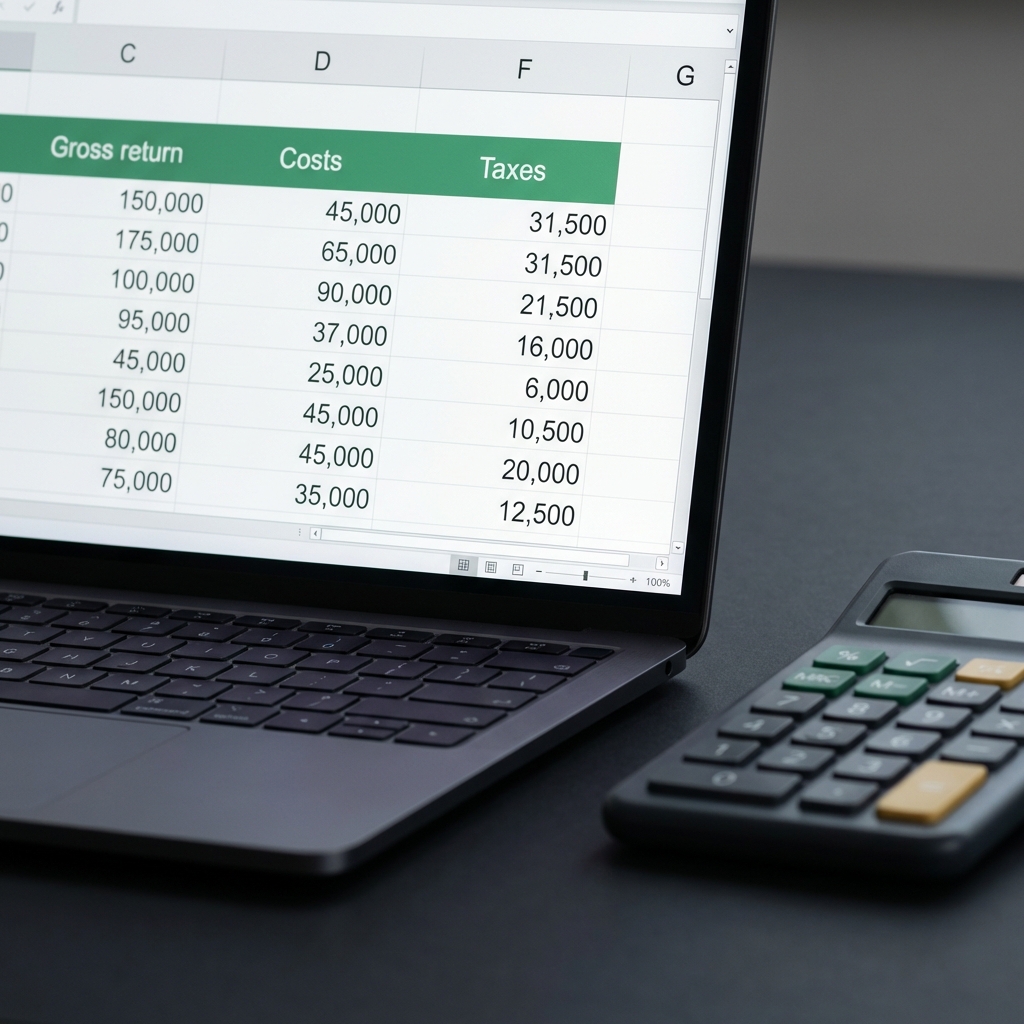
Academic and industry work shows that execution costs are a consistent drag on retail returns and that apparent gross profits can disappear once spreads and slippage are included Retail trading performance and execution costs. See day trading statistics.
Quick model of gross return minus trading costs and taxes
–
percent
Use the same units for inputs
Tax basics for short-term trading gains
Short-term trading gains are generally taxed as ordinary income unless a trader qualifies for special tax treatment, so frequent day traders commonly face ordinary income rates on net short-term profits, which lowers after-tax returns and complicates recordkeeping IRS Publication 550.
If you trade frequently, consider the recordkeeping and potential trader tax status questions early because tax treatment can shift net outcomes and requires careful documentation.
A realistic scenario: what compounding and returns look like starting from $1,000
Example math without promising outcomes
To see how compounding works, imagine a net 10 percent return each month after costs and taxes. Compounded monthly, $1,000 would grow to roughly $3,100 in about 12 months under that steady assumption, but sustained net 10 percent monthly returns are uncommon among retail day traders and should not be treated as likely Trading Is Hazardous to Your Wealth.
Key reasons this path is unlikely include trading costs, tax drag on short-term gains, execution risk, and the statistical reality that skilled, consistent performance is rare among individual day traders.
Why sustained double-digit monthly net returns are rare
Achieving double-digit net monthly returns requires either a reliable trading edge with excellent execution or significant risk that can produce large drawdowns. Most retail traders lack both the edge and the capital cushion to absorb inevitable losing streaks. See day trading profit per day.
Regulatory reviews and retrospective analyses note that a minority of traders can profit, but consistent profitability depends on skill, access to low-friction execution, strict risk control, and often greater capital than $1,000 FINRA retrospective review.
Risk management framework for small accounts: rules that matter when you only have $1,000
Setting risk per trade and maximum daily loss
With only $1,000, practical rules include limiting risk per trade to a small percentage of equity, capping total daily loss, and using firm stop-loss orders. These controls protect capital and prevent emotional overtrading when things go wrong.
Specific suggestions that many traders use are a 1 percent risk-per-trade cap and a maximum daily drawdown limit of 2 to 3 percent of account equity, though you should adapt these to your tolerance and the instruments you trade FINRA retrospective review.
For most beginners, day trading a $1,000 account is unlikely to produce consistent net profits due to position-size limits, regulatory margin rules, execution costs, and taxes; consider paper trading or low-cost investing while you learn.
How to treat losing streaks and when to stop
Define a losing-streak rule before trading, for example pausing after a certain number of consecutive losing days or after a preset dollar drawdown, and use that pause to review execution, trading costs, and journaled trades.
Stopping rules reduce the chance of revenge trading and help preserve the account so you can review what went wrong without compounding losses into a full wipeout Investor Bulletin: Day Trading.
Decision criteria: how to decide if you should try day trading with $1,000
Checklist of personal factors to weigh
Before risking $1,000, consider time availability, risk tolerance, current financial cushion, and trading education. If you lack an emergency fund or cannot afford to lose the amount without harm, day trading is not a suitable use of that capital.
Also weigh business-like factors such as fees, execution quality, and whether you can meet margin rules; if these are unfavorable, alternatives may be better Investor Bulletin: Day Trading.
When to consider alternatives
If the decision checklist raises concerns, consider paper trading, small-scale swing trades, or low-cost diversified investing while you learn. These paths let you build skills or capital without exposing a small account to high risk.
Many beginners find that simulated trading and gradual capital increases are a better path than risking real money immediately, especially when the account is limited to $1,000 Trading Is Hazardous to Your Wealth.
Common mistakes and behavioral traps that hurt small-account traders
Overleveraging and revenge trading
Overleveraging, chasing losses, and revenge trading are common behavioral errors that amplify small losses into large ones; these patterns are frequent among traders who lack strict rules and good recordkeeping. See the risks and limited rewards of day trading.
Setting automatic stop-losses and a written trading plan helps avoid emotional responses that often convert a manageable loss into a catastrophic one FINRA retrospective review.
Ignoring execution costs and tax effects
Another recurring mistake is ignoring the combined effect of spreads, slippage, and taxes. Even small execution frictions can erode a strategy that looks profitable on paper when scaled to live trading.
Empirical findings show frequent traders often underperform after including these costs, so model them in every scenario you consider Retail trading performance and execution costs. See day trading statistics.
Practical examples: trade-size calculations and two transparent scenarios
Conservative scenario using strict 1% risk
Example math: with a $1,000 account and a 1 percent risk rule, risk per trade is $10. If you trade a stock at $25 with a $1 stop-loss, each share risks $1, so you could buy 10 shares because 10 shares x $1 risk equals $10.
At that size, a 2 percent favorable move on the stock yields about $5, which is 0.5 percent of the account. That demonstrates how small-dollar accounts need many small wins or rare large percentage moves to grow meaningfully; execution costs and taxes will further reduce net gains FINRA pattern day trading.
Aggressive scenario and why it is riskier
In an aggressive example, a trader might risk 3 to 5 percent per trade to try to accelerate growth. On $1,000, that is $30 to $50 risk per trade, which increases the chance of a rapid account drawdown and possible wipeout after a few losing trades.
Higher risk per trade can produce faster short-term gains, but it also raises the probability of large drawdowns and triggers psychological pressures that often lead to poorer decision making, especially for new traders FINRA retrospective review.
Taxes and recordkeeping: what frequent trading means for your filings
Short-term gain taxation basics
Short-term gains from trading are typically taxed as ordinary income unless you qualify for different treatment. That tax profile reduces after-tax returns on frequent trading gains and makes careful pre-tax modeling important IRS Publication 550.
Because short-term gains are taxed at ordinary rates, frequent small profits can be taxed heavily relative to long-term capital gains, so track your expected tax rate when estimating net outcomes.
Recordkeeping and trader tax status overview
Trader tax status is a specific IRS concept with its own tests and recordkeeping needs; qualifying can change how you deduct expenses but requires careful documentation and often professional advice.
For most beginners, keeping detailed trade logs, receipts for trading-related costs, and accurate cost-basis records is essential for correct reporting and for evaluating whether trader tax status is relevant to your situation IRS Publication 550.
Alternatives to day trading for growing $1,000 that are less risky or more practical
Longer-term investing and dollar-cost averaging
For many beginners, low-cost diversified ETFs and dollar-cost averaging are practical ways to grow $1,000 with lower risk and far less time commitment than active day trading. These approaches avoid frequent trading costs and tax timing issues Trading Is Hazardous to Your Wealth.
Learning and simulated trading
Paper trading, skills-building courses, and small-scale swing trading help build competence without exposing limited capital to high risk. Use simulated trading to test execution assumptions and to practice entries, exits, and risk controls.
Many experienced traders recommend validating a live edge in simulation before moving to real money, which helps identify costs and behavioral leaks in your approach FINRA retrospective review.
Final checklist: quick decision guide before you risk your $1,000
Pre-trade checklist
Before trading, confirm you have an emergency fund, define your risk per trade, set a maximum daily loss, and model fees and taxes. If any of these are missing, consider alternatives or more practice first.
Also ensure you can keep detailed trade logs and that you understand the margin rules that apply to frequent intraday activity FINRA pattern day trading.
If you choose to proceed: minimum rules
If you proceed, use limit orders when possible, set stop-losses, keep a trading journal, start with paper trading, and treat early capital as learning expenses, not guaranteed seed money for fast growth.
These minimum rules lower the chance of catastrophic losses but also mean account growth will generally be slower and more incremental Investor Bulletin: Day Trading.
Conclusion: the realistic bottom line and next steps
One-paragraph bottom line
Day trading with $1,000 is possible, but practical, regulatory, and tax limits make consistent net profits uncommon for most retail traders; model scenarios with realistic costs, practice in simulation, and treat small-scale live trading as a learning exercise rather than a reliable income source Trading Is Hazardous to Your Wealth.
Where to learn more responsibly
If you want to keep learning, use paper trading, study execution costs, and consult primary sources on rules and tax treatment; FinancePolice provides educational guidance on personal finance and trading basics to help you compare options and next steps.
Use the worksheet and checklist in this article to model your own assumptions before risking capital, and consult a tax professional if you trade frequently.
It is unlikely for most retail traders to generate steady income from day trading a $1,000 account. Small accounts face position-size limits, regulatory margin rules, execution costs, and taxes that usually make consistent net profits difficult.
A common conservative approach is to risk about 1 percent of account equity per trade, or about $10 on a $1,000 account. This protects capital but also means growth will be slow unless you achieve unusually large percentage gains.
Be cautious. Margin can increase both gains and losses and pattern-day-trader rules may limit margin access for small accounts. If you rely on margin, ensure you understand margin calls and have strict risk controls.
References
- https://faculty.haas.berkeley.edu/odean/papers/Trading_Hazardous.pdf
- https://www.finra.org/investors/learn-to-invest/investing-basics/pattern-day-trader
- https://www.sec.gov/oiea/investor-alerts-and-bulletins/ib_daytrading
- https://www.finra.org/rules-guidance/retrospective-review-day-trading-2024
- https://papers.ssrn.com/sol3/papers.cfm?abstract_id=xxxxx
- https://www.irs.gov/publications/p550
- https://financepolice.com/advertise/
- https://financepolice.com/advanced-etf-trading-strategies/
- https://financepolice.com/best-micro-investment-apps/
- https://financepolice.com/
- https://www.quantifiedstrategies.com/day-trading-statistics/
- https://www.cabotwealth.com/daily/how-to-invest/risks-very-limited-rewards-day-trading
- https://www.captrader.com/en/blog/daytrading-profit-per-day/
You May Also Like

U.S. Moves Grip on Crypto Regulation Intensifies

The Role of Blockchain in Building Safer Web3 Gaming Ecosystems
- Immutable Ownership of Assets Blockchain records can be manipulated by anyone. If a player owns a sword, skin, or plot of land as an NFT, it is verifiably in their ownership, and it cannot be altered or deleted by the developer or even hacked. This has created a proven track record of ownership, providing control back to the players, unlike any centralised gaming platform where assets can be revoked.
- Decentralized Infrastructure Blockchain networks also have a distributed architecture where game data is stored in a worldwide network of nodes, making them much less susceptible to centralised points of failure and attacks. This decentralised approach makes it exponentially more difficult to hijack systems or even shut off the game’s economy.
- Secure Transactions with Cryptography Whether a player buys an NFT or trades their in-game tokens for other items or tokens, the transactions are enforced by cryptographic algorithms, ensuring secure, verifiable, and irreversible transactions and eliminating the risks of double-spending or fraudulent trades.
- Smart Contract Automation Smart contracts automate the enforcement of game rules and players’ economic exchanges for the developer, eliminating the need for intermediaries or middlemen, and trust for the developer. For example, if a player completes a quest that promises a reward, the smart contract will execute and distribute what was promised.
- Anti-Cheating and Fair Gameplay The naturally transparent nature of blockchain makes it extremely simple for anyone to examine a specific instance of gameplay and verify the economic outcomes from that play. Furthermore, multi-player games that enforce smart contracts on things like loot sharing or win sharing can automate and measure trustlessness and avoid cheating, manipulations, and fraud by developers.
- Cross-Platform Security Many Web3 games feature asset interoperability across platforms. This interoperability is made viable by blockchain, which guarantees ownership is maintained whenever assets transition from one game or marketplace to another, thereby offering protection to players who rely on transfers for security against fraud. Key Security Dangers in Web3 Gaming Although blockchain provides sound first principles of security, the Web3 gaming ecosystem is susceptible to threats. Some of the most serious threats include: