The post RAY Weekly Analysis Jan 24 appeared on BitcoinEthereumNews.com. RAY closed the week with a -2.33% decline, consolidating at $1.01, while the main downtrendThe post RAY Weekly Analysis Jan 24 appeared on BitcoinEthereumNews.com. RAY closed the week with a -2.33% decline, consolidating at $1.01, while the main downtrend

RAY Weekly Analysis Jan 24

RAY closed the week with a -2.33% decline, consolidating at $1.01, while the main downtrend maintains its dominance; holding or breaking critical supports will determine the next market phase.

RAY in Weekly Market Summary

RAY moved in a narrow range of $0.99 – $1.05 last week, balancing at $1.01. Weekly change closed negative at -2.33%, with trading volume remaining low at $1.35M compared to previous weeks. From a market structure perspective, the primary trend continues downward; RSI at 42.94 in the neutral-bearish zone, MACD confirming bearish momentum with a negative histogram. Price unable to hold above EMA20 ($1.07), giving short-term bearish signals. In the macro context, Bitcoin’s downtrend is creating pressure on altcoins, with structural supports ready to be tested for RAY. This week, in line with RAY Spot Analysis data, the risk/reward balance is becoming critical for position traders.

Trend Structure and Market Phases

Long-Term Trend Analysis

On the long-term chart, RAY’s primary trend is clearly downward; it’s moving within a descending channel from high levels ($2.00+). Weekly candles maintain the lower high/lower low structure, indicating the trend’s strength. The 200-week SMA ($1.45) above is still distant, and price approaching these levels seems unlikely for now. From a market cycle perspective, distribution phase characteristics dominate: low-volume consolidation after high-volume selling could signal preparation for a new downward wave. Trend filter gives bearish signal, and indicators like Supertrend also confirm the downtrend. For long-term portfolio managers, trend breakdown requires a close above $1.0742; otherwise, slippage toward $0.96 supports is expected.

Accumulation/Distribution Analysis

Market phase analysis shows distribution patterns dominating in recent months: price rejected from $1.22 resistance, then declined to the $1.00 band with low volume. Volume profile at $1.35M indicates low participation, signaling post-distribution consolidation phase. Accumulation signs require volume increase at $0.9630 support; in the current structure, distribution patterns (bearish engulfing candles) continue. From a Wyckoff methodology perspective, re-distribution phase is possible, as no retail holding is seen after institutional selling. RAY Futures Analysis data supports the bearish tilt of the long/short ratio. For accumulation, positive divergence is required at multi-TF support confluence.

Multi-Timeframe Confluence

Daily Chart View

On the daily timeframe, price is struggling with $1.0097 resistance (score: 62/100); this unbroken level confirms short-term bearish structure. 1D has 2 supports/2 resistances: $0.9630 (72/100) main support, $1.0742 (70/100) resistance. RSI at 42.94 near oversold but no divergence, MACD negative. Closes below EMA20 ($1.07) maintain the daily downtrend. Volume profile low, indicating lack of fuel for upside. Confluence: 1D supports align with weekly.

Weekly Chart View

Weekly view more bearish: Price below weekly EMA50 ($1.15), with 1W showing 1 support/3 resistance confluence. $0.8350 (66/100) deep support, $1.22 general resistance. Weekly candles indecisive with doji/small bodies, but overall channel downtrend intact. 8 strong levels (1D/3D/1W) confluence makes $0.9630 critical. Upside target $1.5290 (31/100) distant, downside $0.5295 (22/100) risky. In RAY and other analyses comparison, RAY weaker than BTC.

Critical Decision Points

Main support: $0.9630 (72/100) – Break targets $0.8350, then $0.5295. Main resistance: $1.0742 (70/100) – Above $1.22, failure returns to $0.99. $1.0097 intermediate level, failure to hold above current price bearish. Multi-TF confluence: 1D/1W support at $0.9630, break sell signal. Risk/reward: Upside to $1.5290 R/R 1:3.5, downside to $0.5295 1:2. Market structure remains bearish until break above $1.0742.

Weekly Strategy Recommendation

Bullish Case

Weekly close above $1.0742 triggers long position: Target $1.22 (first), $1.5290 (long-term). Stop-loss below $0.9630. Entry on $1.05 breakout, R/R 1:4. BTC above $89,698 supportive. Position with 2-3% risk, scale-in on accumulation phase confirmation.

Bearish Case

$0.9630 break triggers short: Target $0.8350, $0.5295. Stop above $1.0742. Entry on $0.99 breakdown, R/R 1:3. Sync with BTC below $88,400. Position size with 1-2% risk, expand on distribution confirmation.

Bitcoin Correlation

BTC at $89,533 (-0.35%) in downtrend, Supertrend bearish – cautious for altcoins. RAY shows +0.75 correlation with BTC; BTC $88,400 support break pressures RAY to $0.96, above $89,698 provides relief. Monitor BTC resistance $91,193/BTC support $86,644; dominance rise could accelerate RAY distribution. Altcoin rally requires BTC $92,961 breakout.

Conclusion: Key Points for Next Week

Next week, $0.9630 hold opens rally, break opens downside; volume and BTC movement decisive. Watch $1.0742 breakout, bearish bias until trend intact. Position traders, stay in R/R-focused wait-and-see; technical confluence dominates without news flow.

This analysis uses Chief Analyst Devrim Cacal’s market views and methodology.

Market Analyst: Sarah Chen

Technical analysis and risk management specialist

This analysis is not investment advice. Do your own research.

Source: https://en.coinotag.com/analysis/ray-weekly-analysis-strategic-evaluation-of-the-week-of-january-24-2026

Disclaimer: The articles reposted on this site are sourced from public platforms and are provided for informational purposes only. They do not necessarily reflect the views of MEXC. All rights remain with the original authors. If you believe any content infringes on third-party rights, please contact service@support.mexc.com for removal. MEXC makes no guarantees regarding the accuracy, completeness, or timeliness of the content and is not responsible for any actions taken based on the information provided. The content does not constitute financial, legal, or other professional advice, nor should it be considered a recommendation or endorsement by MEXC.

You May Also Like

Cashing In On University Patents Means Giving Up On Our Innovation Future

Cashing In On University Patents Means Giving Up On Our Innovation Future

The post Cashing In On University Patents Means Giving Up On Our Innovation Future appeared on BitcoinEthereumNews.com. “It’s a raid on American innovation that would deliver pennies to the Treasury while kneecapping the very engine of our economic and medical progress,” writes Pipes. Getty Images Washington is addicted to taxing success. Now, Commerce Secretary Howard Lutnick is floating a plan to skim half the patent earnings from inventions developed at universities with federal funding. It’s being sold as a way to shore up programs like Social Security. In reality, it’s a raid on American innovation that would deliver pennies to the Treasury while kneecapping the very engine of our economic and medical progress. Yes, taxpayer dollars support early-stage research. But the real payoff comes later—in the jobs created, cures discovered, and industries launched when universities and private industry turn those discoveries into real products. By comparison, the sums at stake in patent licensing are trivial. Universities collectively earn only about $3.6 billion annually in patent income—less than the federal government spends on Social Security in a single day. Even confiscating half would barely register against a $6 trillion federal budget. And yet the damage from such a policy would be anything but trivial. The true return on taxpayer investment isn’t in licensing checks sent to Washington, but in the downstream economic activity that federally supported research unleashes. Thanks to the bipartisan Bayh-Dole Act of 1980, universities and private industry have powerful incentives to translate early-stage discoveries into real-world products. Before Bayh-Dole, the government hoarded patents from federally funded research, and fewer than 5% were ever licensed. Once universities could own and license their own inventions, innovation exploded. The result has been one of the best returns on investment in government history. Since 1996, university research has added nearly $2 trillion to U.S. industrial output, supported 6.5 million jobs, and launched more than 19,000 startups. Those companies pay…
Share
BitcoinEthereumNews2025/09/18 03:26
China Blocks Nvidia’s RTX Pro 6000D as Local Chips Rise

China Blocks Nvidia’s RTX Pro 6000D as Local Chips Rise

The post China Blocks Nvidia’s RTX Pro 6000D as Local Chips Rise appeared on BitcoinEthereumNews.com. China Blocks Nvidia’s RTX Pro 6000D as Local Chips Rise China’s internet regulator has ordered the country’s biggest technology firms, including Alibaba and ByteDance, to stop purchasing Nvidia’s RTX Pro 6000D GPUs. According to the Financial Times, the move shuts down the last major channel for mass supplies of American chips to the Chinese market. Why Beijing Halted Nvidia Purchases Chinese companies had planned to buy tens of thousands of RTX Pro 6000D accelerators and had already begun testing them in servers. But regulators intervened, halting the purchases and signaling stricter controls than earlier measures placed on Nvidia’s H20 chip. Image: Nvidia An audit compared Huawei and Cambricon processors, along with chips developed by Alibaba and Baidu, against Nvidia’s export-approved products. Regulators concluded that Chinese chips had reached performance levels comparable to the restricted U.S. models. This assessment pushed authorities to advise firms to rely more heavily on domestic processors, further tightening Nvidia’s already limited position in China. China’s Drive Toward Tech Independence The decision highlights Beijing’s focus on import substitution — developing self-sufficient chip production to reduce reliance on U.S. supplies. “The signal is now clear: all attention is focused on building a domestic ecosystem,” said a representative of a leading Chinese tech company. Nvidia had unveiled the RTX Pro 6000D in July 2025 during CEO Jensen Huang’s visit to Beijing, in an attempt to keep a foothold in China after Washington restricted exports of its most advanced chips. But momentum is shifting. Industry sources told the Financial Times that Chinese manufacturers plan to triple AI chip production next year to meet growing demand. They believe “domestic supply will now be sufficient without Nvidia.” What It Means for the Future With Huawei, Cambricon, Alibaba, and Baidu stepping up, China is positioning itself for long-term technological independence. Nvidia, meanwhile, faces…
Share
BitcoinEthereumNews2025/09/18 01:37
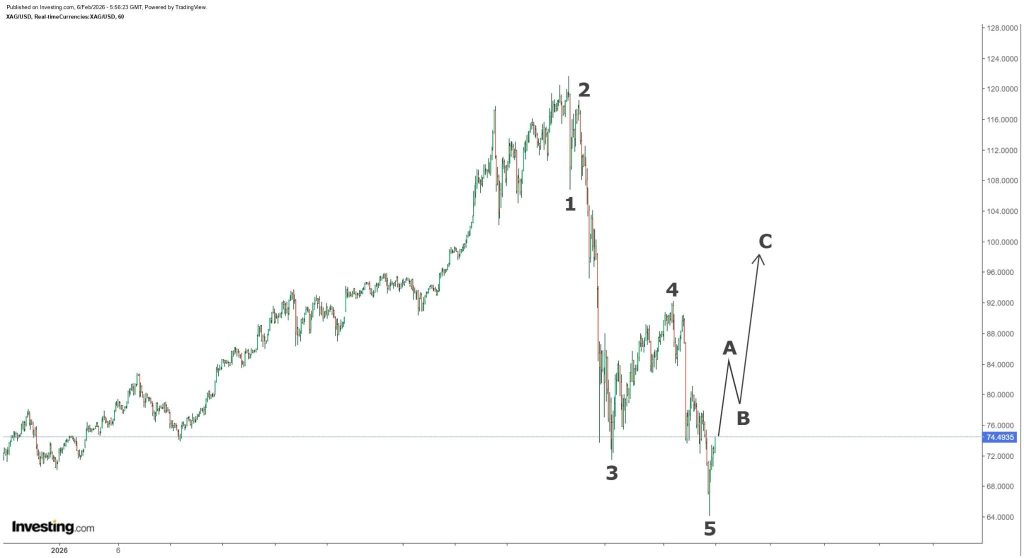
Silver Price Crash Is Over “For Real This Time,” Analyst Predicts a Surge Back Above $90

Silver Price Crash Is Over “For Real This Time,” Analyst Predicts a Surge Back Above $90

Silver has been taking a beating lately, and the Silver price hasn’t exactly been acting like a safe haven. After running up into the highs, the whole move reversed
Share
Captainaltcoin2026/02/07 03:15