Prediction markets are emerging as one of the fastest-growing corners of crypto just as meme coins retreat from their recent peak, setting up a broader debate acrossPrediction markets are emerging as one of the fastest-growing corners of crypto just as meme coins retreat from their recent peak, setting up a broader debate across

Prediction Markets vs Meme Coins: Is This Where Crypto’s Next Alpha Lives?

Prediction markets are emerging as one of the fastest-growing corners of crypto just as meme coins retreat from their recent peak, setting up a broader debate across the industry about where speculative capital is heading in 2026.

The comparison gained momentum after Kalshi’s head of crypto, John Wang, described prediction markets as “the meme coins of 2023,” arguing that both capture attention during periods when traders are searching for asymmetric opportunities.

The remark landed as meme coin activity cooled sharply following a volatile run that defined much of the last two years.

Meme Coins Had Their Moment — Is This the Collapse Phase?

Meme coins surged in 2023, driven by new token launches and heavy social media exposure.

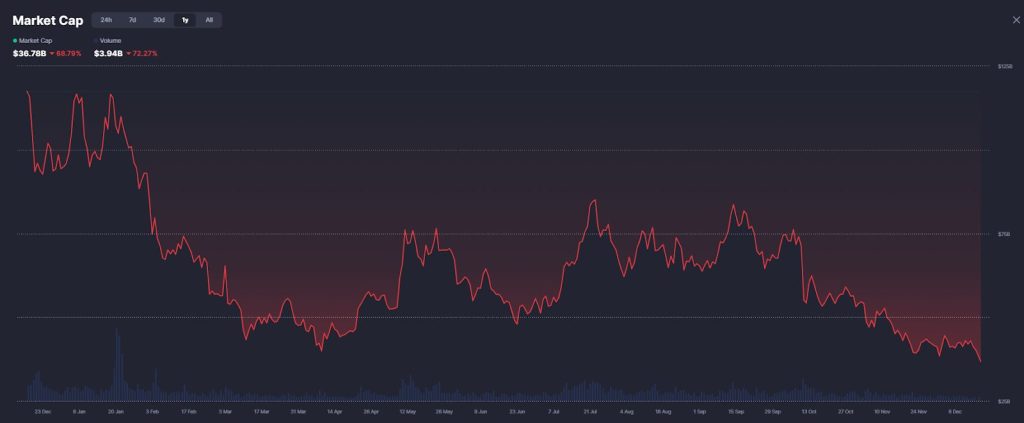
The sector’s total market capitalization reached nearly $22 billion by the end of that year, while trading activity expanded dramatically.
Source: Coinmarketcap

Data from the period shows average trading volume rising more than ninefold over the first eleven months.

Two intense rallies defined the year, particularly an April–May burst fueled by highly speculative launches.

That speculative energy carried into 2024, when meme coins climbed to an estimated peak market cap of around $150 billion in December, helped by Dogecoin, Shiba Inu, Pepe, and a wave of political-themed tokens.

The reversal was equally sharp. By late 2025, the sector’s total value had fallen below $42 billion, with daily volumes shrinking and individual tokens losing most of their prior gains.

Source: Coinmarketcap

Market data now shows memecoin trading volumes down roughly 85% from their highs, reflecting a broad pullback in risk appetite.

Are Traders Done With Meme Coins? Prediction Markets Are Quietly Taking Over

As meme coins faded, prediction markets moved in the opposite direction.

Platforms such as Kalshi, Polymarket, and Limitless recorded a combined $44 billion in trading volume this year, with Kalshi alone reaching $1 billion in weekly volume, driven largely by sports and political contracts.

Source: dune/datadashboards

On-chain prediction markets have expanded even faster. Monthly volume has jumped from under $100 million in early 2024 to more than $13 billion today, a 130-fold increase, according to joint research from Keyrock and Dune Analytics.

Non-sports markets, including economics, politics, and technology-related events, accounted for most of the growth in 2025.

The structure of prediction markets differs sharply from memecoins, a point repeatedly raised by industry participants.

Prediction contracts allow traders to buy “yes” or “no” shares tied to a specific outcome, with prices reflecting implied probabilities and settling through oracles once events conclude.

Supporters argue this creates clearer pricing and limits some of the manipulation risks that have plagued low-liquidity token markets.

Critics counter that returns are capped by design, making it harder for smaller traders to achieve outsized gains compared with early-stage memecoin trades.

Can Prediction Markets Kill Meme Coins?

Framing the trend as “prediction markets killing memecoins” misses the point.

Memecoins are not dead. Liquidity has simply receded, and that contraction is affecting many other crypto sectors as well.

History shows that meme-driven markets tend to hibernate, not disappear. When volatility returns and risk appetite expands, memecoins can resurface quickly.

At the same time, prediction markets are clearly earning a durable user base. Their growth isn’t purely cyclical hype; it’s being driven by real-world events, regulatory clarity in some jurisdictions, and demand for structured speculation. That gives them a resilience memecoins often lack during downturns.

The more likely outcome is coexistence, not replacement.

Memecoins will continue to dominate during speculative surges and attention-driven cycles. Prediction markets will attract traders seeking clarity, probability-based pricing, and event-driven exposure. They serve different psychological and financial needs.

If anything, the current shift shows a maturing crypto market, one where capital rotates rather than evaporates and where speculation takes multiple forms instead of clustering around a single narrative.

Market Opportunity
Memecoin Logo
Memecoin Price(MEME)
$0.0009574
$0.0009574$0.0009574
-0.74%
USD
Memecoin (MEME) Live Price Chart
Disclaimer: The articles reposted on this site are sourced from public platforms and are provided for informational purposes only. They do not necessarily reflect the views of MEXC. All rights remain with the original authors. If you believe any content infringes on third-party rights, please contact service@support.mexc.com for removal. MEXC makes no guarantees regarding the accuracy, completeness, or timeliness of the content and is not responsible for any actions taken based on the information provided. The content does not constitute financial, legal, or other professional advice, nor should it be considered a recommendation or endorsement by MEXC.

You May Also Like

MoneyGram launches stablecoin-powered app in Colombia

MoneyGram launches stablecoin-powered app in Colombia

The post MoneyGram launches stablecoin-powered app in Colombia appeared on BitcoinEthereumNews.com. MoneyGram has launched a new mobile application in Colombia that uses USD-pegged stablecoins to modernize cross-border remittances. According to an announcement on Wednesday, the app allows customers to receive money instantly into a US dollar balance backed by Circle’s USDC stablecoin, which can be stored, spent, or cashed out through MoneyGram’s global retail network. The rollout is designed to address the volatility of local currencies, particularly the Colombian peso. Built on the Stellar blockchain and supported by wallet infrastructure provider Crossmint, the app marks MoneyGram’s most significant move yet to integrate stablecoins into consumer-facing services. Colombia was selected as the first market due to its heavy reliance on inbound remittances—families in the country receive more than 22 times the amount they send abroad, according to Statista. The announcement said future expansions will target other remittance-heavy markets. MoneyGram, which has nearly 500,000 retail locations globally, has experimented with blockchain rails since partnering with the Stellar Development Foundation in 2021. It has since built cash on and off ramps for stablecoins, developed APIs for crypto integration, and incorporated stablecoins into its internal settlement processes. “This launch is the first step toward a world where every person, everywhere, has access to dollar stablecoins,” CEO Anthony Soohoo stated. The company emphasized compliance, citing decades of regulatory experience, though stablecoin oversight remains fluid. The US Congress passed the GENIUS Act earlier this year, establishing a framework for stablecoin regulation, which MoneyGram has pointed to as providing clearer guardrails. This is a developing story. This article was generated with the assistance of AI and reviewed by editor Jeffrey Albus before publication. Get the news in your inbox. Explore Blockworks newsletters: Source: https://blockworks.co/news/moneygram-stablecoin-app-colombia
Share
BitcoinEthereumNews2025/09/18 07:04
ServicePower Closes Transformative Year with AI-Driven Growth and Market Expansion

ServicePower Closes Transformative Year with AI-Driven Growth and Market Expansion

Double-digit growth, 50% team expansion, and accelerated innovation define 2025 momentum MCLEAN, Va., Dec. 18, 2025 /PRNewswire/ — ServicePower, a leading provider
Share
AI Journal2025/12/18 23:32
XRP Fractal Signals $6–$7 Surge by November Amid DLT Disruption

XRP Fractal Signals $6–$7 Surge by November Amid DLT Disruption

The post XRP Fractal Signals $6–$7 Surge by November Amid DLT Disruption appeared on BitcoinEthereumNews.com. XRP Fractal Analysis Hints at $6–$7 Breakout by Mid-November According to renowned market analyst EGRAG CRYPTO, XRP may be on the verge of a significant price movement. In his latest analysis, he points to a fractal formation pattern that suggests XRP could reach the $6–$7 range by mid-November.  Source: EGRAG CRYPTO This projection has quickly caught the attention of traders and long-term investors, as XRP’s current price remains well below this target. Fractals, often used in technical analysis, are recurring chart patterns that can help predict future price action by identifying historical similarities in market behavior.  Therefore, EGRAG CRYPTO argues that XRP is currently mirroring a previous structure that led to a notable rally. If this fractal setup plays out as expected, it could mark one of the most significant price surges for the digital asset in recent years. If XRP reaches $6–$7 by mid-November, it would mark a major win for investors and a symbolic breakthrough for a token that has endured regulatory battles and market volatility, validating its resilience and cementing its relevance in the evolving digital finance ecosystem. Meanwhile, a recent cup-and-handle pattern signalled that XRP had the potential of soaring to $15 by year-end with the altcoin presently trading at $3.04 per CoinGecko data.  DLT-Based Solutions: How Ripple and Stellar are Redefining Cross-Border Banking According to crypto observer SMQKE, distributed ledger technology (DLT)-based solutions are increasingly challenging the traditional correspondent banking model.  For decades, cross-border payments have relied on a chain of intermediaries, often resulting in slow settlements, high costs, and limited transparency. But with the rise of blockchain networks such as Ripple and Stellar, the industry is experiencing a seismic shift. The correspondent banking model depends on trust and pre-funded accounts, locking up liquidity and exposing banks to counterparty risk.  Transactions often take days to…
Share
BitcoinEthereumNews2025/09/19 16:12