Why is Wyoming's creation of a multi-chain stablecoin, WYST, questioned by Republican colleagues?
Author: Weilin, PANews
At the DC Blockchain Summit held in March, Anthony Apollo, executive director of the Wyoming Stable Token Commission, hosted a special fireside chat with the state governor and chairman of the Stable Token Commission, Mark Gordon. Apollo officially announced that the Wyoming Stablecoin WYST has entered the testing phase on multiple blockchain networks. Apollo said that this is the first stablecoin in the United States issued by a public entity, backed by fiat currency and fully reserved.
The stablecoin committee plans to launch WYST on publicly available blockchains, including Avalanche, Solana, Ethereum, Arbitrum, Optimism, Polygon, and Base. These initial, valueless test tokens have been deployed on the testnet in collaboration with token issuance partner LayerZero.
Nevertheless, the plan was subsequently questioned by senior Republican politicians, raising concerns about Wyoming’s establishment of a CBDC (central bank digital currency).
Wyoming takes the lead in testing the first public entity stablecoin in the United States
The Wyoming Stablecoin Commission was established in March 2023, with the legal basis being the Wyoming Stablecoin Act. Its mission is to issue stable tokens that are fully backed by state law and fiscal responsibility. Its mission is to enhance financial transparency through blockchain innovation while driving economic growth.
In an official statement, the Commission noted that LayerZero’s OFT (Omnichain Fungible Token) standard and extensive experience in developing secure smart contracts provide a robust, scalable and compliant solution that meets the Commission’s legislative requirements for providing multi-chain stablecoins.
As part of preliminary testing, Stargate, a third-party cross-chain bridge supported by LayerZero, conducted a demonstration transaction of WYST between Ethereum and Avalanche testnet. WYST's architecture as an OFT means that it can be bridged through any compatible interface - Stargate is just one example.
During the fireside chat, Governor Gordon highlighted Wyoming’s commitment to transparency and innovation, noting the potential of blockchain technology to create a secure and efficient financial ecosystem. “We are excited to share Wyoming’s vision for state leadership in the nation’s capital,” Gordon noted. “Our forward-thinking approach to blockchain and digital asset legislation positions Wyoming to serve as a model not only for other states, but also for the federal government.”
Gordon added that WYST has many advantages: including the requirement to be overcollateralized with cash and U.S. Treasury bonds to reduce the risk of "decoupling" and the use of Treasury bond interest for state education funds, thereby achieving financial returns. WYST is expected to be tested until the end of the second quarter of 2025 and is scheduled to be officially launched in July of the same year.
According to the official website of the committee, the two leaders have both financial and blockchain experience. Mark Gordon has served as the governor of Wyoming since November 2018 and has signed more than 30 pieces of legislation involving cryptocurrency, blockchain, and digital assets. He served as the Secretary of the Treasury of Wyoming (2012–2019). Anthony Apollo was appointed as the first executive director of the Stablecoin Committee in September 2023 and has extensive experience in traditional finance (KPMG, EY) and the blockchain industry (ConsenSys, Rensa).
It is worth mentioning that Cynthia Lummis, who supports the national strategic reserve of Bitcoin, is also a senator from Wyoming.
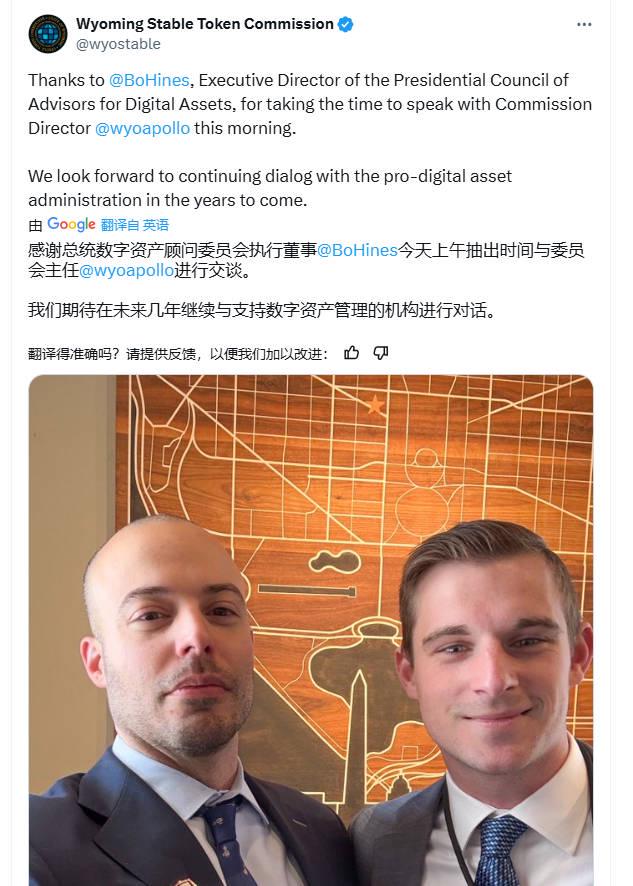
On March 27, the X platform account of the Wyoming Stablecoin Committee also posted a photo of the committee’s executive director Anthony Apollo and the executive director of the Presidential Digital Asset Advisory Committee Bo Hines, with the caption saying “We look forward to continuing our dialogue with governments that support digital asset management in the coming years.”
Stablecoin or CBDC? Commission slammed by fellow Republicans
Although the committee emphasized that WYST is not issued by the central bank and is fundamentally different from central bank digital currency (CBDC), the project has been treated with some sensitivity in Republican circles in the United States.
On March 27, after the WYST plan announced its latest progress, U.S. House Majority Whip and Republican Tom Emmer rarely publicly criticized the actions of his colleagues in the party.
“I respect the vote of the people of Wyoming, however, I personally strongly oppose any government issuing a tokenized version of its currency,” Tom Emmer told the media. “At the federal level, this would be considered a central bank digital currency.”
Central bank digital currencies (CBDCs), digital versions of national fiat currencies, have become the most feared "monster" by Republican politicians in recent years. Republican governors and President Trump have both committed to banning the development of CBDCs in the United States because they are considered a threat to user privacy. CBDCs are different from decentralized crypto assets. They are issued and managed by central institutions, have the ability to freeze and track funds, are considered to lack censorship resistance, and may be used for government intervention in personal finances.
In response, Apollo firmly denied that WYST was equated with CBDC. He said that he also opposed the concept of state-backed CBDC, but WYST was a completely different product. "Wyoming takes privacy very seriously," Apollo said. "We will develop rules that clearly define what we can and cannot collect, how to process this data, and how to act on this data."
“Wyoming is not a central bank,” Apollo added. “We don’t issue any cash.”
However, Apollo also admitted that the public and legislators frequently questioned whether WYST was equivalent to CBDC. This issue has also attracted much attention within Wyoming. Just a few weeks ago, Governor Gordon signed a bill prohibiting the development of CBDC in the state, clearly expressing the state government’s opposition to “controlled digital currency”.
The pioneer state in crypto legislation: actively embracing Bitcoin, and has proposed 4 related bills this year
This is not the first time Wyoming has attracted attention for blockchain legislation. Over the past decade, it has continuously promoted friendly legislation in the field of digital assets. Since 2019, the state legislature has passed more than 30 related bills. This year, pro-cryptocurrency lawmakers have proposed four core bills:
HB 201: State Funds Invested in Bitcoin
Proposed by Republican Congressman Jacob Wasserburger, allowing up to 3% of state fiscal funds to be invested in Bitcoin, is intended to give Wyoming an advantage before the federal government may accept Bitcoin. Although the bill ultimately failed to pass, Wasserburger said he would continue to promote related education and legislation.
HB 256: Establishment of a special committee on blockchain (failed)
HB 264: Banning CBDCs
Proposed by Congressman Daniel Singh, it aims to prohibit state agencies from accepting CBDC payments and not allow the use of taxpayer funds to build CBDC infrastructure, clearly expressing Wyoming's resistance to CBDC.
HB 308 The Encryption Frontier Act
The last major cryptocurrency-related bill is another one introduced by Singh. HB 308 would authorize state attorneys general to “investigate specific federal overreach involving blockchain or cryptocurrency.” The bill aligns with Singh and Wasserburger’s goal of increasing the ability of states to operate digital currencies without federal-level interference. However, the bill has not yet been considered for introduction in the House of Representatives.
At present, although there are some controversies about the test deployment of WYST, at the state level, the plan has a certain trial significance and also poses a challenge to the path chosen by the US federal government in the regulation of CBDC and stablecoins.
On the one hand, Wyoming has proved through its actions that stablecoins are not limited to private institutions, and local governments can also build digital currency products with compliance and public responsibility. On the other hand, the advancement of the project also makes people wonder: where is the boundary between public stablecoins and CBDCs?
In the coming months, WYST will continue to run on the test network and gradually accept external audits and public evaluations. Can it become the first successful example of a state-level "on-chain dollar" in the United States? This will not only affect Wyoming, but may also affect the overall direction of digital currency development in the United States.
You May Also Like

Fed Decides On Interest Rates Today—Here’s What To Watch For

While Shiba Inu and Turbo Chase Price, 63% APY Staking Puts APEMARS at the Forefront of the Best Meme Coin Presale 2026 – Stage 6 Ends in 3 Days!