Solana Eyes 250ms Slots—Is 200ms Next?
Overview
Solana is preparing for the next stage of its latency-reduction roadmap, targeting a move from the current 300-millisecond slot time toward 250 milliseconds under SIMD-0525. The change would reduce Solana slot time by approximately 16.7%, continuing a staged path that began at 400ms and is ultimately designed to reach 200ms.
At first glance, the upgrade looks like another attempt to make Solana faster. The more important technical point, however, is that shorter slots are primarily intended to reduce latency rather than automatically increase throughput. SIMD-0525 scales per-slot compute and data limits downward as slot duration falls, meaning the network is not simply trying to process the same workload more frequently. The goal is to provide more frequent state updates while keeping overall resource demands within manageable bounds.
This distinction is especially important for trading applications. Lower Solana slot time can shorten confirmation paths, reduce the real-world duration of leader control and give exchanges, market makers and oracles finer timing around state changes. For a network increasingly used for high-frequency DeFi and trading infrastructure, reducing latency may be more strategically important than another headline increase in TPS.
The challenge is whether validators can maintain stability and broad participation as timing requirements become tighter. That is why the roadmap progresses in stages rather than moving directly from 400ms to 200ms.
Key Takeaways
- Solana’s current slot target is around 300ms, with 250ms planned as the next stage under SIMD-0525.
- The move from 300ms to 250ms reduces slot duration by about 16.7%.
- The upgrade is mainly a latency improvement, not a direct 16.7% increase in TPS.
- Per-slot compute and data limits are reduced proportionally as slots become shorter.
- Shorter slots can benefit trading, oracle updates and confirmation speed.
- The final SIMD-0525 target is 200ms, subject to successful staged deployment.
What Does Solana Slot Time Actually Measure?
Slot Time Is a Timing Layer, Not Simply a Throughput Number
A Solana slot is a scheduled period during which a designated validator acts as leader and has the opportunity to produce blocks and process transactions. Because leadership rotates according to slot schedules, slot duration directly influences how often the network can advance to a new block-production opportunity.
This makes Solana slot time an important latency metric, but it should not be confused with finality or TPS. A 250ms slot does not mean every transaction becomes fully final in 250 milliseconds, and it does not automatically mean the network processes 20% more transactions than at 300ms. Consensus voting, transaction propagation and resource limits remain separate parts of the system.
What shorter slots do provide is more frequent opportunities for state to change. That can improve how quickly wallets, decentralized exchanges and other applications observe new account balances or market conditions. For ordinary payments, the difference between 300ms and 250ms may feel small. For automated trading systems and oracle-driven protocols, the difference can be economically meaningful.
Why Is Solana Moving From 300ms to 250ms?
The Main Goal Is Lower Latency Without Uncontrolled Resource Growth
The reduction from 300ms to 250ms shortens each slot by approximately 16.7%. In purely timing terms, the network moves from roughly 3.33 slot opportunities per second to about four. That makes state updates more frequent and reduces how long the network waits before the next leader opportunity.
The key design choice in SIMD-0525 is that resource limits scale alongside slot duration. If Solana simply reduced slot time while leaving all per-slot compute limits unchanged, the network would effectively demand more processing and network bandwidth per second. That could increase hardware requirements and make it harder for less powerful validators to keep up.
Instead, the proposal reduces limits such as compute units and data capacity proportionally. The network therefore gains finer timing while attempting to preserve broadly similar resource demands over real time. This is why describing the change as “Solana becomes 16.7% faster” is incomplete. The more accurate statement is that the network becomes more responsive, while total computational throughput remains governed by separate limits.
Why Does the Leader Window Matter?
Shorter Slots Reduce the Time One Validator Controls Ordering
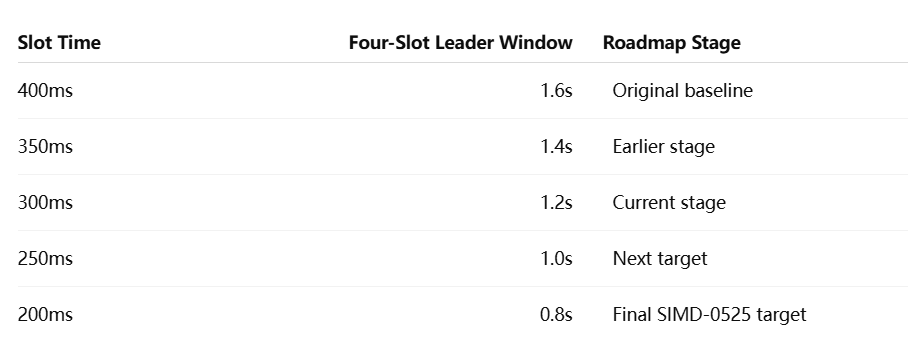
Solana leaders typically control several consecutive slots. That means reducing slot duration also reduces the total real-world time during which one leader influences transaction ordering.
Does 250ms Mean Solana Throughput Will Rise?
Shorter Slots Do Not Automatically Produce Higher TPS
This is the most common misunderstanding around the upgrade. TPS and latency are related but different. Throughput measures how much work the network can process over time, while latency measures how quickly individual state changes can be observed.
Under SIMD-0525, shorter slots are paired with proportionally lower per-slot resource limits. If a 300ms slot allows a certain compute budget, a 250ms slot does not simply inherit that full budget and repeat it more often. Instead, the resource allocation is reduced to keep total processing demand within a similar range.
The result is that the network can provide more frequent state transitions without automatically pushing validator hardware requirements sharply higher. This is a more sustainable way to improve responsiveness, particularly if Solana wants to preserve validator participation rather than optimizing only for the fastest machines.
For users, the improvement may therefore appear less dramatic in headline TPS statistics than in real application behavior. Faster state refreshes, more frequent scheduling opportunities and shorter leader control can improve the quality of interaction even if total computational capacity per second remains relatively stable.
Why Does Lower Solana Slot Time Matter for Trading?
Trading Applications Care About Milliseconds More Than Most Users
The strongest use case for lower latency is onchain trading. Decentralized exchanges, liquidators and arbitrage systems continuously monitor prices, balances and collateral conditions. When external market prices move, these systems compete to update or respond to blockchain state before conditions change again.
A shorter Solana slot time provides more frequent opportunities for those changes to be recorded. A market maker can adjust quotes sooner, a lending protocol can incorporate new state faster and an arbitrage strategy can react with less timing delay. This does not guarantee better execution, because network congestion, priority fees and application design still matter, but it reduces one component of the delay.
For Solana, this is strategically important because the network is increasingly positioned as infrastructure for high-frequency financial applications. In that environment, latency can matter as much as throughput. A chain capable of processing many transactions is less useful for trading if state changes remain too slow to reflect fast-moving markets.
Oracles and propAMMs Could Benefit From Finer Timing
Oracle systems are another important beneficiary. DeFi protocols depend on external prices to determine collateral values, liquidations and settlement. Shorter slots create more opportunities to publish and consume updated oracle data, reducing the time between an external price move and its appearance onchain.
The same logic applies to propAMMs and other professional market-making systems. Stale prices create risk because a quote can become outdated before a market maker has time to adjust it. Finer timing reduces that gap, potentially making onchain liquidity more competitive with centralized trading infrastructure.
However, faster slots do not improve oracle quality by themselves. Data-source reliability, aggregation methodology and update rules remain critical. The network simply creates a faster environment in which high-quality data can be used.
Why Is Solana Not Moving Directly to 200ms?
The Staged Rollout Is a Stability Test
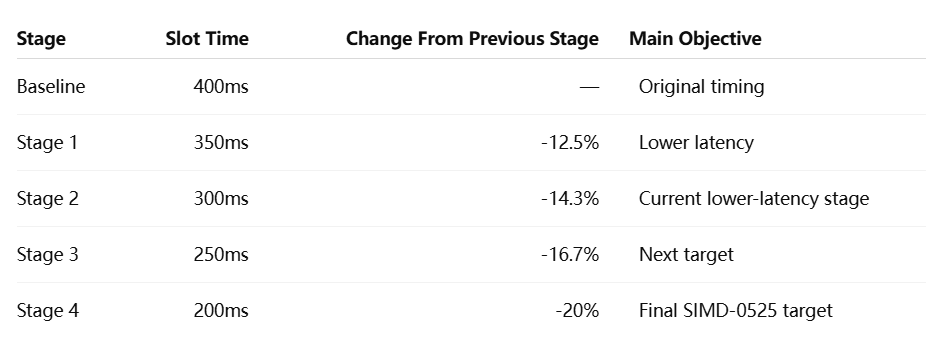
The progression from 400ms to 350ms, 300ms, 250ms and eventually 200ms is deliberate. Each reduction gives developers and validator operators time to measure propagation delays, execution performance and network stability before shortening the timing further.
Shorter slots leave validators with less time to receive transactions, execute them, package block data and propagate results through the network. If timing becomes too aggressive, validators with weaker hardware or poorer network connectivity may begin missing more opportunities. That could reduce validator diversity and undermine decentralization.
The challenge is therefore not simply whether Solana’s fastest machines can operate at 250ms or 200ms. The more important question is whether a sufficiently broad validator set can do so reliably. The staged approach allows the network to test that trade-off incrementally rather than making a large jump that could create instability.
Solana Slot Time Roadmap
What Are the Main Risks of 250ms Slots?
Validator and Network Pressure Could Increase
The most important risk is that tighter timing requirements place additional pressure on validators and data propagation. Solana already prioritizes high performance, and reducing slot duration further gives the system less tolerance for network delays or slow execution.
If a large share of validators cannot keep up, the network could become more dependent on high-end infrastructure providers. That would create a trade-off between speed and decentralization. Client diversity adds another layer of complexity because all major validator implementations need to handle the new timing assumptions consistently.
Propagation systems also need to distribute block information quickly enough that downstream validators can remain synchronized. At 250ms and especially at 200ms, small inefficiencies become more significant because there is less time available before the next slot begins.
This is why network stability, validator participation and missed-slot behavior will matter more than the headline number itself.
MEXC View: Latency May Matter More Than Headline TPS
For trading-focused users, Solana’s next stage of competition may be defined less by TPS and more by how quickly the network can observe, price and settle state changes. Throughput remains important, but once a blockchain has enough capacity to support large transaction volumes, latency becomes the next bottleneck for financial applications.
A decentralized exchange does not only need to process many trades; it also needs market prices, collateral values and account states to update quickly enough that those trades remain economically relevant. This is where shorter Solana slot time can have a meaningful impact even if total compute per second remains broadly stable.
The key metric is therefore not whether 250ms produces another large TPS headline. It is whether the network can deliver faster and more predictable state updates without causing validator concentration or instability. If Solana can achieve that balance, lower latency could strengthen its position as infrastructure for high-frequency onchain finance.
Solana’s 250ms Upgrade Is About Responsiveness, Not Just Speed
The move toward 250ms slots is best understood as a latency optimization rather than a simple throughput upgrade. Solana is not attempting to compress the same amount of work into shorter and shorter windows without limits. Instead, SIMD-0525 adjusts per-slot resources so that the network can refresh state more frequently while keeping total processing demands under control.
That design choice matters because lower latency can improve several aspects of network behavior at once. Traders and market makers gain faster opportunities to react, oracle systems can update more frequently and leader control windows become shorter in real-world time. These benefits are especially relevant for Solana’s growing role in high-frequency DeFi.
The trade-off is that tighter timing increases pressure on validators and network propagation. That is why the path to 200ms is gradual rather than immediate. The 250ms stage will be an important test of whether Solana can continue reducing latency without compromising validator diversity or network stability.
If that test succeeds, the significance will extend beyond a 16.7% reduction in slot duration. It would show that Solana can make its execution environment more responsive while preserving the operational characteristics needed for a large decentralized network.
Sources
https://github.com/solana-foundation/solana-improvement-documents
Risk Disclaimer: This article is for reference only and does not constitute investment advice. The cryptocurrency market is highly volatile. Please make decisions cautiously based on your individual circumstances.
You May Also Like

SEC Innovation Exemption: How Tokenized Stocks Can Trade Onchain

U.S. Stock Perps Are Coming: Why Kalshi and Coinbase Want In