CME Group will offer round-the-clock cryptocurrency futures and options trading starting early 2026, subject to regulatory review and approval. The post Leading TradFi Derivatives Marketplace CME Group Expands Crypto Offerings to 24/7 appeared first on Coinspeaker.CME Group will offer round-the-clock cryptocurrency futures and options trading starting early 2026, subject to regulatory review and approval. The post Leading TradFi Derivatives Marketplace CME Group Expands Crypto Offerings to 24/7 appeared first on Coinspeaker.

Leading TradFi Derivatives Marketplace CME Group Expands Crypto Offerings to 24/7

The CME Group, a leading derivatives marketplace in traditional finance (TradFi), announced the expansion of its crypto offerings—in particular, futures and options—to around-the-clock trading, working 24 hours a day, seven days a week.

According to a press release published on October 2, this offering is planned to start by early 2026, depending on regulatory review by the proper government agencies. Operations happening at times when TradFi markets are closed will come with a trade date of the following business day, with clearing, settlement, and regulatory reporting processed the following business day as well.

Tim McCourt, Global Head of Equities, FX, and Alternative Products at CME Group, explained the change is due to the growth of client demand for around-the-clock cryptocurrency trading, requiring market participants to adjust their risks accordingly. “Ensuring that our regulated cryptocurrency markets are always on will enable clients to trade with confidence at any time,” McCourt concluded.

CME Group has the world’s highest notional value in some products, ranking among the top 10 in others, and is also the third-largest marketplace by number of contracts available for trading. On September 18, crypto notional open interest at the CME Group reached a record $39 billion, and in August the platform saw a daily average of 335,200 open contracts.

Cryptocurrency offerings by the group started with Bitcoin BTC $120 134 24h volatility: 2.5% Market cap: $2.40 T Vol. 24h: $67.31 B on December 18, 2017, with Ethereum ETH $4 485 24h volatility: 4.0% Market cap: $542.63 B Vol. 24h: $44.52 B following through only on February 8, 2021. Solana and XRP futures were added on March 17 and May 19 of 2025, respectively.

Crypto Derivatives and Futures Trading

The cryptocurrency derivatives market, however, goes beyond the CME Group, having most of its activities happening on crypto-native centralized platforms or, as a growing trend, on decentralized exchanges like Hyperliquid and Aster.

According to CoinGlass data at the time of writing, total open interest stands at $218.48 billion, up 3.35% in the last 24 hours. The top cryptocurrencies by open interest are BTC, ETH, SOL, XRP, and DOGE DOGE $0.26 24h volatility: 4.8% Market cap: $39.04 B Vol. 24h: $3.19 B , with $88.58 billion, $59.95 billion, $14.22 billion, $8.22 billion, and $4.48 billion, respectively.Reintentar
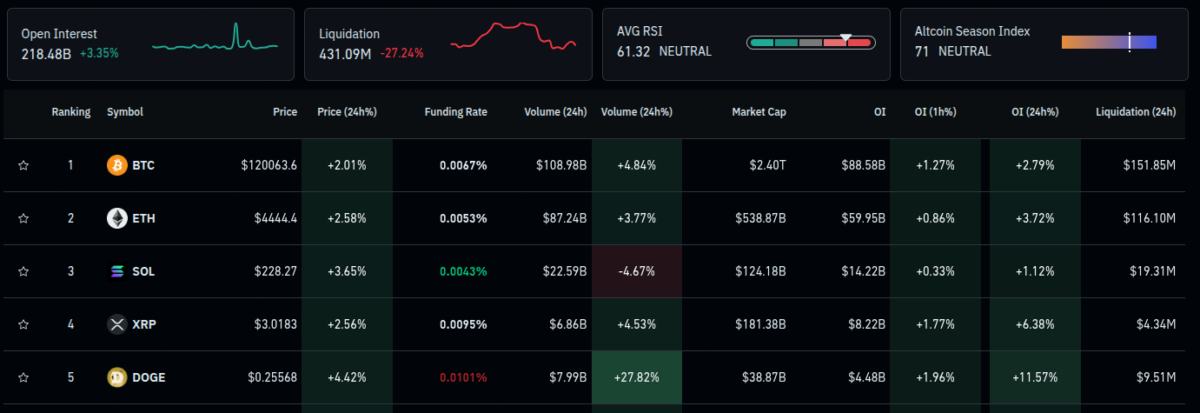
Crypto derivatives market data and open interest as of October 2, 2025 | Source: CoinGlass

Crypto derivatives market data and open interest as of October 2, 2025 | Source: CoinGlass

The CME Group is also not the only TradFi company expanding its crypto offerings or pushing regulators to a more crypto-friendly environment. Nasdaq submitted an SEC filing on September 8 to allow trading of tokenized equities and ETPs on its exchange, potentially reducing settlement times and market friction through blockchain integration, Coinspeaker reported. As things develop, other institutions are likely to join the movement if worldwide regulators continue to ease the pressure and to embrace innovation.

next

The post Leading TradFi Derivatives Marketplace CME Group Expands Crypto Offerings to 24/7 appeared first on Coinspeaker.

Disclaimer: The articles reposted on this site are sourced from public platforms and are provided for informational purposes only. They do not necessarily reflect the views of MEXC. All rights remain with the original authors. If you believe any content infringes on third-party rights, please contact service@support.mexc.com for removal. MEXC makes no guarantees regarding the accuracy, completeness, or timeliness of the content and is not responsible for any actions taken based on the information provided. The content does not constitute financial, legal, or other professional advice, nor should it be considered a recommendation or endorsement by MEXC.

You May Also Like

The Channel Factories We’ve Been Waiting For

The Channel Factories We’ve Been Waiting For

The post The Channel Factories We’ve Been Waiting For appeared on BitcoinEthereumNews.com. Visions of future technology are often prescient about the broad strokes while flubbing the details. The tablets in “2001: A Space Odyssey” do indeed look like iPads, but you never see the astronauts paying for subscriptions or wasting hours on Candy Crush.  Channel factories are one vision that arose early in the history of the Lightning Network to address some challenges that Lightning has faced from the beginning. Despite having grown to become Bitcoin’s most successful layer-2 scaling solution, with instant and low-fee payments, Lightning’s scale is limited by its reliance on payment channels. Although Lightning shifts most transactions off-chain, each payment channel still requires an on-chain transaction to open and (usually) another to close. As adoption grows, pressure on the blockchain grows with it. The need for a more scalable approach to managing channels is clear. Channel factories were supposed to meet this need, but where are they? In 2025, subnetworks are emerging that revive the impetus of channel factories with some new details that vastly increase their potential. They are natively interoperable with Lightning and achieve greater scale by allowing a group of participants to open a shared multisig UTXO and create multiple bilateral channels, which reduces the number of on-chain transactions and improves capital efficiency. Achieving greater scale by reducing complexity, Ark and Spark perform the same function as traditional channel factories with new designs and additional capabilities based on shared UTXOs.  Channel Factories 101 Channel factories have been around since the inception of Lightning. A factory is a multiparty contract where multiple users (not just two, as in a Dryja-Poon channel) cooperatively lock funds in a single multisig UTXO. They can open, close and update channels off-chain without updating the blockchain for each operation. Only when participants leave or the factory dissolves is an on-chain transaction…
Share
BitcoinEthereumNews2025/09/18 00:09
BFX Presale Raises $7.5M as Solana Holds $243 and Avalanche Eyes $1B Treasury — Best Cryptos to Buy in 2025

BFX Presale Raises $7.5M as Solana Holds $243 and Avalanche Eyes $1B Treasury — Best Cryptos to Buy in 2025

BFX presale hits $7.5M with tokens at $0.024 and 30% bonus code BLOCK30, while Solana holds $243 and Avalanche builds a $1B treasury to attract institutions.
Share
Blockchainreporter2025/09/18 01:07
Singapore Entrepreneur Loses Entire Crypto Portfolio After Downloading Fake Game

Singapore Entrepreneur Loses Entire Crypto Portfolio After Downloading Fake Game

The post Singapore Entrepreneur Loses Entire Crypto Portfolio After Downloading Fake Game appeared on BitcoinEthereumNews.com. In brief A Singapore-based man has
Share
BitcoinEthereumNews2025/12/18 05:17