

Gold Plunges Under $4,000 as Federal Reserve Hawkishness Intensifies
Quick Summary
- Precious metal breached the $4,000 threshold for the first time since November 2025
- Yellow metal has plummeted approximately 30% from its January peak of $5,595.46
- Dollar strength at 13-month highs is pricing out international purchasers
- Traders now see 66% probability of Federal Reserve tightening by September
- Declining geopolitical risk premium has diminished safe-haven buying interest
The precious metal market is experiencing significant downward pressure as the strengthening U.S. dollar combined with mounting anticipation of Federal Reserve monetary tightening drives prices to their lowest point in seven months.
Spot gold declined 0.2% to settle at $3,984.83 per ounce during Thursday’s trading session. U.S. Gold Futures remained largely unchanged, hovering around the $4,008 level.
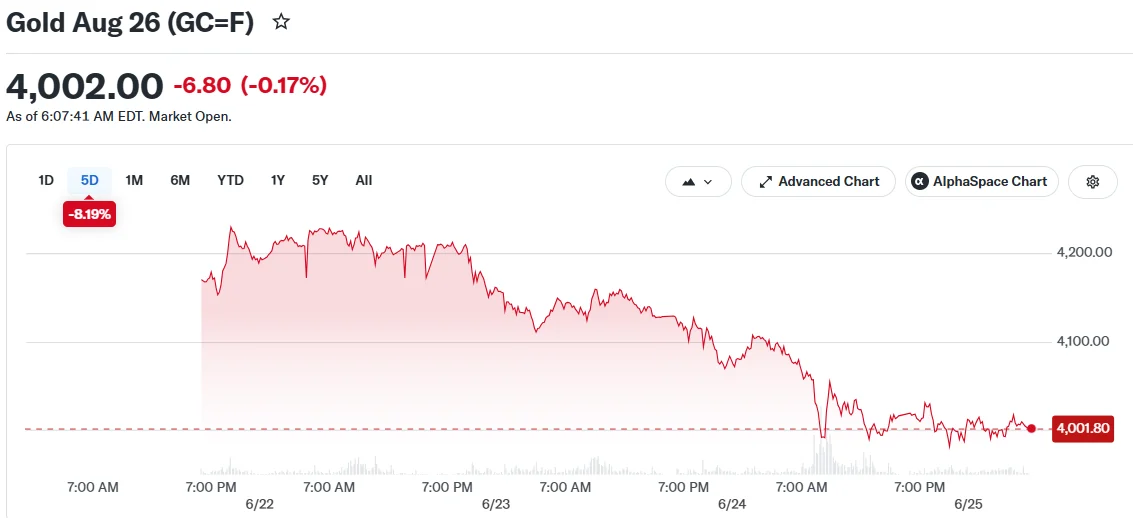 Gold Aug 26 (GC=F)
The yellow metal crashed through the psychologically significant $4,000 barrier on Wednesday, marking its first breach of this level since November 2025. Market participants had been closely monitoring this threshold as a critical support zone.
The precious metal has experienced a dramatic decline of nearly 30% from its all-time high of $5,595.46 recorded in January 2026. This represents a substantial correction within a relatively compressed timeframe.
The U.S. dollar’s performance has emerged as a primary catalyst behind the selloff. The currency has reached a 13-month peak following six consecutive sessions of appreciation.
A robust dollar increases the cost of gold for international buyers operating in alternative currencies. This dynamic typically suppresses demand for the precious metal.
Federal Reserve Policy Expectations Pressure Precious Metals
Market participants are currently assigning approximately one-third probability to an interest rate increase in July. These odds escalate to 66% for policy tightening by September, based on CME FedWatch analytical data.
Elevated interest rates create headwinds for gold since the commodity generates no income stream. As rates climb, investors can secure superior returns from fixed-income securities and cash equivalents, diminishing gold’s relative appeal.
ANZ research team noted that worries surrounding persistent inflationary pressure have triggered a “re-rating of monetary policy expectations.” They further observed that the Federal Reserve’s hawkish posture seems to have “derailed the debasement trade” that previously supported gold valuations.
ING market strategists indicated that gold’s underperformance demonstrates how market sentiment has pivoted away from defensive positioning toward focusing on the implications of rising rates and restrictive financial conditions.
Diminishing Geopolitical Risk Premium
Decreasing tensions across Middle Eastern regions have contributed to the downward trajectory. Advancement in U.S.-Iran diplomatic negotiations has eliminated portions of the risk premium that had underpinned gold valuations during the earlier months of this year.
Weakening oil prices have reinforced this transition. Investors demonstrate reduced appetite for gold as an insurance mechanism when geopolitical uncertainties appear to be subsiding.
Market observers are now directing attention toward Friday’s scheduled release of U.S. Personal Consumption Expenditures figures. The PCE represents the Federal Reserve’s prioritized inflation metric and could significantly influence projections for subsequent policy adjustments.
Silver registered a modest 0.1% gain to reach $57.50 per ounce on Thursday, recovering slightly after dropping more than 6% in the previous trading session. ING analysts observed that several of silver’s most robust demand catalysts are showing signs of weakening.
Platinum decreased 0.3% to settle at $1,581.60 per ounce. Copper futures advanced approximately 1.7% on the London Metal Exchange to reach $13,255.95 per ton.
Gold continues facing downward momentum with limited visible catalysts to reverse the prevailing trend ahead of the PCE data release.
The post Gold Plunges Under $4,000 as Federal Reserve Hawkishness Intensifies appeared first on Blockonomi.


You May Also Like

Bitcoin’s AI Correlation Problem: Why Semiconductor Sell-Offs Are Starting to Move BTC

Binance Coin (BNB) Alert: $620 Support Tested While This New Crypto Hits 3x

Bithumb Crypto Exchange Fined 210M Won for Unauthorized User Data Sharing



