

Kentucky Sues Kalshi and Polymarket, Escalating Prediction Market Legal Fight
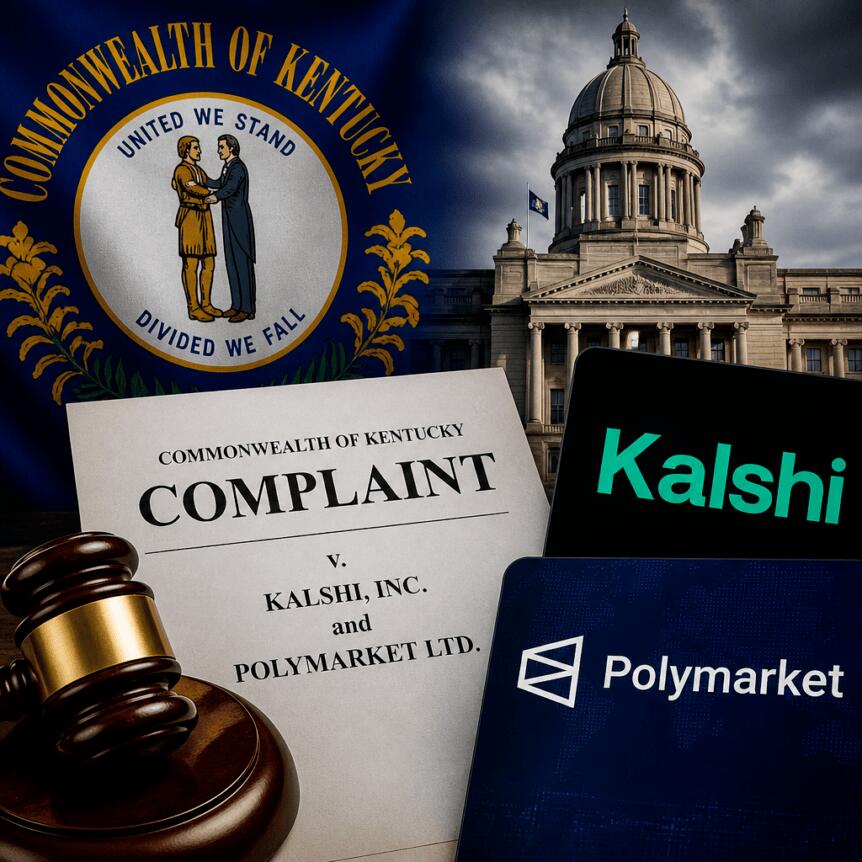
Kentucky has filed lawsuits against prediction market platforms Polymarket and Kalshi, escalating a dispute that pits state gambling regulators against the U.S. Commodity Futures Trading Commission (CFTC) over how sports-linked event contracts should be classified and regulated.
In court filings announced by Kentucky Attorney General Russell Coleman on Wednesday, the state also named Kalshi partners Coinbase, Robinhood and Webull. Kentucky accuses the platforms of operating unlicensed and illegal sports betting and gambling services, arguing their products fall under state “sports wagering” law rather than federal commodities rules.
Key takeaways
- Kentucky alleges Polymarket and Kalshi are offering sports event contracts that constitute “sports wagering” under Kentucky law.
- The lawsuits also target Kalshi partners Coinbase, Robinhood and Webull, alleging they are involved in providing access to the platforms without proper licensing.
- State enforcement actions have drawn repeated challenges and CFTC involvement, with conflicting outcomes in different courts.
- Prediction market operators argue their contracts are swaps regulated by the CFTC, not state gambling laws.
A state-led push to treat prediction markets as sports betting
Kentucky’s attorney general framed the case as part of a broader pattern among states trying to control sports-related gambling. Coleman said his office filed suits in state court against Polymarket and Kalshi, accusing both of “operating unlicensed and illegal sports betting and gambling platforms.”
Kentucky’s complaint also asserts that the platforms are operating without a Kentucky gaming license and without complying with state regulations. The state further claims that contracts tied to sports outcomes “fall squarely within the definition of ‘sports wagering’ under Kentucky law.”
Beyond licensing and classification, Kentucky also alleges the platforms do not provide adequate resources for problem gambling support, a requirement the state says is mandated by law.
The federal-regulator argument: event contracts as swaps
Polymarket rejected Kentucky’s position. A Polymarket spokesperson told Cointelegraph that the state’s action “runs counter to the CFTC’s established framework for regulating prediction markets,” adding that the company expects to address the allegations through the legal process.
Kalshi, meanwhile, insisted its setup is already within federal oversight. Kalshi spokesperson Jacki McGavick told Cointelegraph that “Kalshi is a federally regulated exchange — the CFTC is our regulator, not the states,” arguing that courts have recognized this and that the same outcome should apply in Kentucky.
The CFTC did not immediately respond to a request for comment, according to the report.
At the heart of the dispute is a jurisdictional split. Multiple state authorities have argued that event contracts connected to sports are functionally sports betting and therefore require state licenses. Prediction markets counter that these event contracts should be treated as swaps regulated under federal commodities law—an argument that is backed by the CFTC.
Why these lawsuits could reshape access to major markets
Kentucky’s move arrives as state actions against prediction platforms have grown into a multi-jurisdiction conflict. According to Token Terminal, Polymarket and Kalshi recorded $25 billion in monthly trading volume in May combined. For platforms seeking to scale, losing access to large state markets can quickly become more than a legal inconvenience—it can affect liquidity, product distribution, and the user base.
The legal and regulatory stakes are also reflected by the breadth of involvement from federal and state actors. As reported, at least 17 other states have brought prediction market operators into court, and the CFTC has pursued its own legal action—suing eight states after state authorities took steps against prediction markets and, in the CFTC’s view, stepped beyond federal authority.
Mixed court outcomes increase uncertainty for the next fights
While prediction markets have not uniformly prevailed, some rulings have favored their argument about federal jurisdiction. In Wednesday’s coverage, a Michigan federal judge ruled against Polymarket in its lawsuit against the state, finding that Polymarket’s sports event contracts are not swaps under the CFTC’s authority.
Other cases have gone the opposite direction. The report notes that the Third Circuit Court of Appeals ruled in April that New Jersey regulators could not prevent Kalshi from offering sports event contracts in the state—supporting, at least in that circuit and context, the view that states cannot simply override federal regulatory authority.
The Kentucky filing also follows an earlier round of litigation involving the same market ecosystem. As reported by Cointelegraph, Kalshi and Polymarket are already in legal action with Kentucky over the state’s tax on prediction market transaction fees. The platforms sued after Kentucky imposed a first-in-the-country 14.25% tax on prediction market transaction fees, arguing it is discriminatory and conflicts with federal law.
Outside Kentucky, cease-and-desist letters and subsequent lawsuits have involved multiple states, including Montana, Nevada, Utah, Iowa, Illinois, Ohio, Tennessee, New York, New Jersey, Connecticut and Maryland—while other states such as Washington, Arizona, New Mexico, Wisconsin, Michigan, Massachusetts and Kentucky have also chosen to sue prediction platforms, including Kalshi.
What to watch next
With Kentucky now adding to a growing enforcement track record—and with courts issuing contrasting decisions on whether sports event contracts qualify as swaps—readers should watch how Kentucky’s claims are argued and whether the case outcome aligns with favorable appellate rulings or the more skeptical reasoning seen in Michigan. The legal answers will likely determine not just Kentucky’s approach, but how much room states have to regulate (or restrict) prediction markets nationwide.
This article was originally published as Kentucky Sues Kalshi and Polymarket, Escalating Prediction Market Legal Fight on Crypto Breaking News – your trusted source for crypto news, Bitcoin news, and blockchain updates.


You May Also Like

SNB’s Schlegel Warns of Persistent Franc Appreciation Risk

Kraken’s U.S. Perp Expansion: Can Regulated Derivatives Steal Volume From On-Chain Perps?

Here’s How Pi Network Pioneers Can Support the Ecosystem During PI’s Slump



