

U.S.-Iran Peace Deal Progress Sends Oil to Four-Month Low
TLDR
- Brent crude fell 3.4% to $87.33, its lowest since March 5, ending the week down 6.2%
- The U.S. and Iran are edging toward a deal that could reopen the Strait of Hormuz
- Pakistan confirmed a final agreed text has been reached and is working with both sides
- Iran’s Foreign Minister said an MoU has “never been closer” despite conflicting messages
- OPEC cut its 2026 oil demand growth forecast from 1.2 million to 1 million barrels per day
Oil prices fell sharply on Friday, with Brent crude dropping to its lowest level since early March. The sell-off came as hopes grew that the U.S. and Iran may be close to a peace deal that would reopen the Strait of Hormuz.
Brent futures settled at $87.33 a barrel, down 3.4% on the day and 6.2% for the week. West Texas Intermediate fell 3.2%. European gas prices dropped as much as 8.4%.
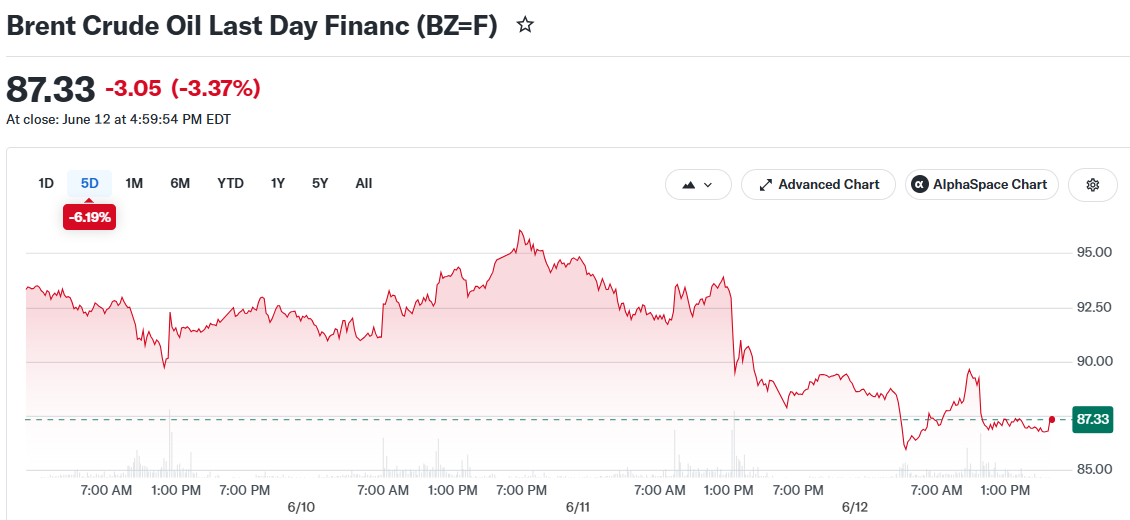 Brent Crude Oil Last Day Financ (BZ=F)
The Strait of Hormuz has been effectively closed since the war between the U.S. and Iran began in late February. Before the conflict, the waterway handled about a fifth of the world’s oil and gas supply.
President Trump said Thursday that a deal had been reached and could be signed soon. He said it would reopen the strait, end the U.S. naval blockade of Iran, and ensure Iran never develops a nuclear weapon.
Signs of Progress
Despite the positive signals, markets remain cautious. Several earlier claims of a breakthrough proved wrong, and the back-and-forth between Washington and Tehran has added uncertainty.
Supply Concerns Remain
Oil is still down around 30% from the peak of the conflict. But analysts warn that prices may have a floor, as supply remains constrained.
Chevron’s CEO Mike Wirth warned Friday that oil inventories are falling toward “uncomfortable” levels. The U.S. is exporting crude from its emergency reserves at record volumes.
Macquarie energy strategist Vikas Dwivedi said the recent $11 per barrel sell-off was driven by optimism over a deal. He said crude prices still have a floor as long as the strait stays closed.
Some ships have been crossing the strait with satellite signals turned off, and markets have found other workarounds to the supply disruption. But analysts say even if the strait reopens, buyers may prefer U.S. crude over Persian Gulf barrels for some time.
Rob Haworth of U.S. Bank said tankers transiting the strait to Asia would take two months for a round trip. Scott Shelton of ICAP said markets would likely “diversify away” from Persian Gulf supply in the near term.
OPEC cut its 2026 oil demand growth forecast to 1 million barrels per day, down from 1.2 million. It raised its 2027 outlook. Other forecasters, including the IEA and EIA, are more pessimistic, with both projecting demand to fall in 2026.
The European Central Bank cited the Iran-linked oil spike as a key reason for its decision to raise interest rates this week.
The post U.S.-Iran Peace Deal Progress Sends Oil to Four-Month Low appeared first on CoinCentral.


You May Also Like

A quiet transformation is reshaping modern finance

AI Agent Accounts Meet DeFi: The Next Risk Layer Is Authorization, Not Yield

MCA chief calls for answers from Teo, DAP on J-Kom



