

$1.4M Milestone: Is IPO Genie the Smartest Way to Play the Tokenized Pre-IPO Trend Before SpaceX Debut

So, is IPO Genie the smartest way to approach the tokenized pre-IPO trend before SpaceX? For now, that claim is too early. $IPO is still an early-stage access token, not a proven path to private-market returns. Its case will depend on whether IPO Genie can show verified deal flow, clear allocation rules, working KYC, completed audits, and real platform delivery.
What if the SpaceX IPO shows that retail investors are not late by choice, but late by design? Many private companies build much of their value before the public listing begins. That timing gap is why the tokenized pre-IPO trend is getting attention.
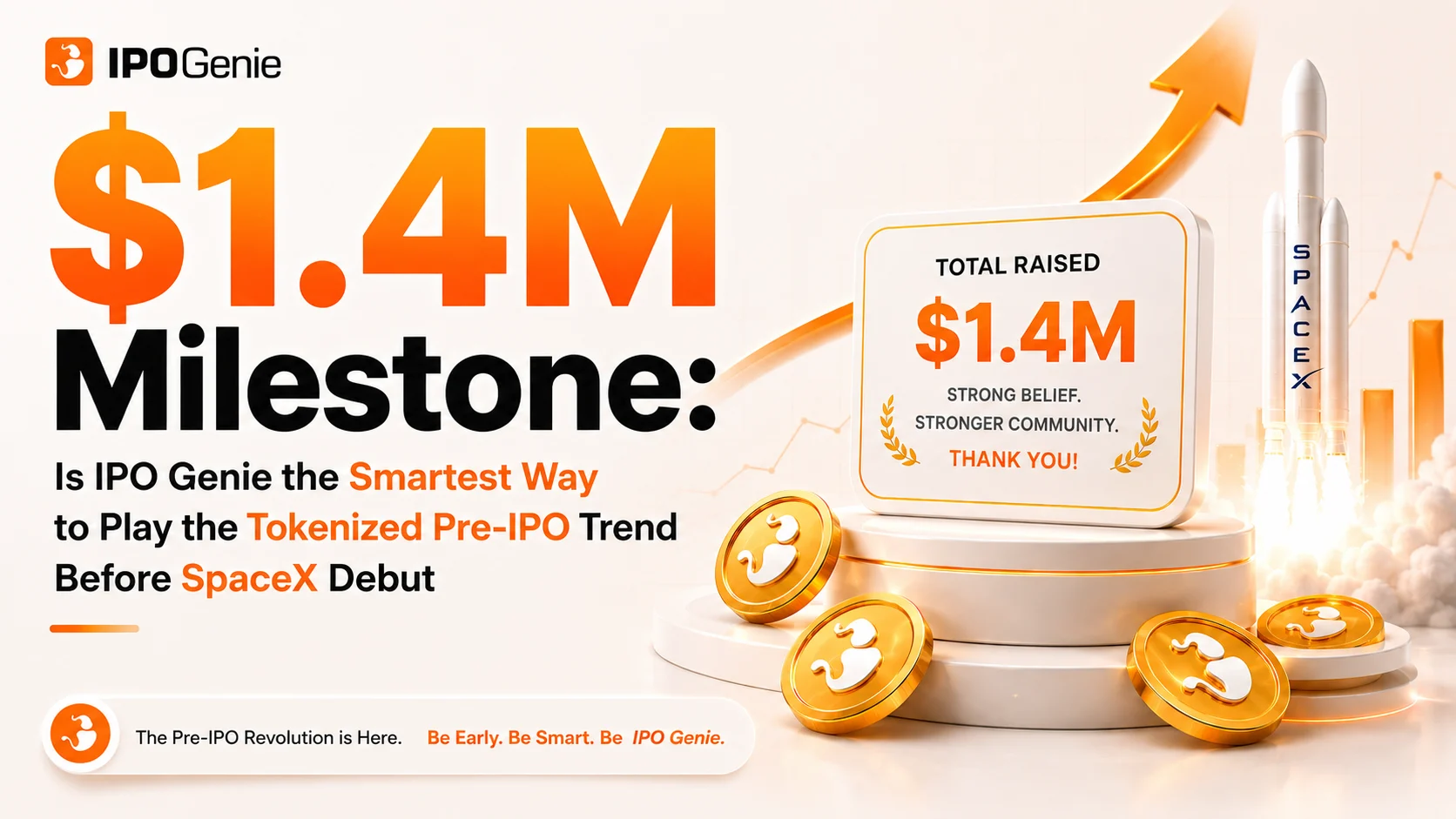
IPO Genie ($IPO) enters with a reported $1.4M presale milestone and a model built around access to private-market-style opportunities. It does not offer SpaceX shares. Instead, $IPO is an early-stage access token whose case depends on delivery, clear rules, and user trust.
SpaceX IPO: Behind the Retail Access Gap
SpaceX is targeting a $135 share price and a Nasdaq listing under SPCX. The offering would sell about 555.6 million shares and raise roughly $75 billion, giving the company a valuation near $1.75 trillion.
For retail buyers, those numbers make the timing problem clear. A large part of a private company’s valuation can be built before public buyers get access.
IPO Genie ($IPO) is trying to frame that gap through a tokenized access model for private-market-style opportunities. Its case depends on whether smaller buyers can reach curated deals before they become public-market stories.
IPO Genie’s $1.4M Presale Milestone
IPO Genie’s reported $1.43M raise gives $IPO a reason for review. The cited source lists 2,500+ wallets and more than 12.9B $IPO tokens sold, which points to early participation in the private-market access idea.
Still, $IPO remains an early-stage token sale, not a proven platform. Wallet count and tokens sold show activity, not success.
Readers should check audits, vesting, token supply, KYC rules, and real product delivery. The raise does not confirm live deal flow, liquidity, or token performance.
IPO Genie as a Tokenized Pre-IPO Play
1.$IPO is an Access Token
$IPO is the token IPO Genie uses for platform access. According to the whitepaper, holding $IPO can unlock tiered deal access, staking rewards, governance, revenue participation, and selected protection features.
It is not only a token for trading. It is designed to connect users with IPO Genie’s private-market ecosystem. The whitepaper also says $IPO holders may access vetted startups and pre-IPO companies sourced through VC networks.
In this context, $IPO should be judged as an access token, not as SpaceX equity.
2.The $10 Entry Model
IPO Genie’s $10 entry model is about access efficiency, not profit. The whitepaper says traditional private-market deals can require $250K to $1M+ per deal. It also lists 7–10 year lockups as a usual barrier.
IPO Genie’s materials compare that with a $10 starting point, which makes the entry barrier about 25,000x lower than a $250K minimum. That does not make the model safer. It only lowers the starting barrier.
That matters before SpaceX because retail access usually comes after private pricing has already moved.
3.$IPO Tokenomics and Tiered Utility
IPO Genie lists 437B $IPO as the total token supply. The split is 50% presale, 20% liquidity and exchanges, 18% community rewards, 7% staking rewards, and 5% team allocation. The whitepaper says team tokens are locked for two years, then vest over 12 months.
The tier system runs from Bronze to Platinum. Each tier links $IPO holdings with platform benefits such as access rights, priority allocation, staking, governance, and selected protection features.

As SpaceX moves toward public trading, tokenomics matters because access rules decide who gets platform benefits. For $IPO, tokenomics only matter if the platform later delivers real access, clear allocation rules, and usable liquidity routes.
4.AI Deal Screening and Genie Vault
IPO Genie’s AI layer works as a research filter, not a return promise. AI Agents review founder history, funding activity, and traction. They also check sector strength, liquidity depth, social sentiment, and audit signals.
Genie Vault gives that screening a public test case. Vault #1 featured Redwood AI Corp. (AIRX). IPO Genie says it flagged AIRX before its CSE listing. Vault #2 adds a company-guessing campaign with a $10,000 $IPO reward pool.
These Vault examples give users public signals to review. They do not prove future deal quality or token value.
This matters before the SpaceX debut because early access needs better screening, not just a lower entry point. Vault records give users public signals to check before treating $IPO as a private-market access play.
Is IPO Genie a Pre-IPO Access Model Before SpaceX?
IPO Genie may become a high-risk access model if it proves real platform delivery. That means live deal flow, clear allocation rules, audited contracts, working KYC, transparent token terms, and usable liquidity routes.
$IPO should not be treated as SpaceX exposure or a shortcut into SpaceX shares. Its use case depends on access utility, token structure, and execution.
Until those pieces are clear, $IPO remains an early-stage position on private-market access.
Stay Safe: Verify contracts, audits, and the official website before joining any presale. Avoid unofficial groups, copied ads, and unknown wallet prompts.
Official channels include the IPO Genie website, Telegram, and X community.
Disclaimer: This article is for informational purposes only. It is not financial advice. Always conduct your own research and consult a licensed financial advisor before investing.
This article is not intended as financial advice. Educational purposes only.


You May Also Like

Congress nears final vote on $70 billion immigration funding package

Japanese Tech Giant’s Ambitious Bitcoin Accumulation

Token Surpasses $1.14 After Stunning 367% Rally



