

EXPLORE: Next Crypto to Explode in 2026
SBI Remit: How Japan's Remittance Boom Powers XRP The post XRP News in Japan: Why Ripple is Quietly Becoming a Liquidity Powerhouse appeared first on icobench.comSBI Remit: How Japan's Remittance Boom Powers XRP The post XRP News in Japan: Why Ripple is Quietly Becoming a Liquidity Powerhouse appeared first on icobench.com
XRP News in Japan: Why Ripple is Quietly Becoming a Liquidity Powerhouse
For feedback or concerns regarding this content, please contact us at crypto.news@mexc.com
In XRP news Today, SBI Remit, the remittance subsidiary of SBI Holdings in Japan, has surpassed ¥2.5 trillion (approximately $15Bn) in cumulative cross-border payments using Ripple’s On-Demand Liquidity.
The company achieved this milestone by connecting corridors to the Philippines, Vietnam, and Indonesia. Notably, while it took 14 years to reach the first ¥2 trillion, the next ¥500 billion was added in just 17 months, highlighting XRP’s efficiency in cross-border settlements.
This development underscores XRP’s potential as a bridge asset, facilitating faster and cheaper transactions for migrant workers. The key question remains whether this volume can significantly influence XRP’s demand and pricing dynamics.
This news dropped as XRP fell -2.2% overnight, hovering just above key support at $1.31 with a daily trading volume of over $1.42 Bn.
XRP News: What SBI Remit’s Corridor Expansion Actually Does for Cross-Border Payments Infrastructure
ODL addresses the issue of pre-funded accounts in correspondent banking. For instance, a Japanese remittance firm sending money to the Philippines needs to maintain idle peso balances in local nostro accounts, which ties up capital.
This requirement is eliminated with XRP, which serves as a bridge asset. In SBI Remit’s process, yen is converted into XRP on its domestic crypto exchange, then transferred across the XRP Ledger and converted into local currencies such as pesos, dong, or rupiah before reaching the recipient’s account. This operation is faster than a SWIFT confirmation.
The Japan–Southeast Asia corridor benefits from this system, as many migrant workers from the Philippines, Vietnam, and Indonesia frequently send remittances and often incur high fees.
SBI Remit, leveraging Ripple and the Singapore-based Tranglo network, aims to serve this demographic effectively. For example, around 47,000 Thai nationals in Japan receive funds directly into SCB accounts within seconds, demonstrating the system’s efficiency.
DISCOVER: Best Meme Coins to Buy Right Now
Why the ¥2.5 Trillion Milestone Now Functions as a Dual-Reading Signal for the XRP Liquidity Thesis
The constructive reading indicates that SBI Remit’s Q1 2025 Asia corridor volume reached $3.7Bn, a 45% year-over-year increase, where XRP is essential for every transaction in the ODL model. This reflects functional demand due to payment settlements on the XRP Ledger rather than speculative demand.
As SBI Remit expands its corridors, XRP’s purchase-and-sale cycles increase, highlighting measurable on-chain activity. With XRP classified as a non-security in Japan, SBI operates efficiently while US firms await similar regulations.
Conversely, the cautionary perspective emphasizes that ODL transactions quickly buy and sell XRP, thereby limiting its net price exposure to near zero per transaction. While SBI Remit’s volume is notable, it still pales in comparison to SWIFT’s daily throughput.
Significant changes in XRP’s liquidity would require ODL volume to exceed $50Bn quarterly across various institutions, alongside sustained growth in XRPL order book depth.
What Japan’s ODL History and Ripple’s Corridor Playbook Tell Us About the Current Expansion Signal
SBI Remit’s partnership with Ripple began in 2017, making it one of the first to deploy ODL internationally. The Japan–Thailand corridor was the initial focus, followed by an expansion to the Philippines in 2021, positioning SBI Remit as the first Japanese company to utilize ODL-based remittances.
This strategy of starting with anchor corridors before expanding regionally, leveraging Tranglo’s Southeast Asian payout network, reflects Ripple’s broader approach.
Japan’s early success in high-volume ODL was due to SBI Group’s institutional support, a clear regulatory framework from the Financial Services Agency, and significant remittance demand to Southeast Asia.
The replicability of this model in the Philippines, Vietnam, and Indonesia will depend on local regulatory attitudes toward XRP and whether local financial institutions are willing to use it in settlements.
(SOURCE: TradingView)
SBI Remit and XRP News: The Operational Thresholds That Define What Happens Next
In other XRP news, to upgrade SBI Remit from proof-of-concept to a structural demand driver, three conditions must be met: First, SBI Remit’s ODL volume must exceed $5Bn per corridor per quarter for two consecutive periods, indicating operational scale.
Second, another major Japanese financial institution must launch ODL integration, showing the model’s replicability beyond the SBI Group. Third, financial institutions in the Philippines, Vietnam, or Indonesia need to publicly confirm participation in XRP settlements, demonstrating maturity in the destination-side infrastructure.
Currently, these thresholds haven’t been met, but it has been shown that SBI Remit’s ODL rails can process remittances more efficiently than traditional banking. The upcoming reporting cycle will assess whether this momentum leads to sustained demand for XRP.
The post XRP News in Japan: Why Ripple is Quietly Becoming a Liquidity Powerhouse appeared first on icobench.com.
Market Opportunity
XRP Price(XRP)
$1,2827
$1,2827$1,2827
USD
XRP (XRP) Live Price Chart


Disclaimer: The articles reposted on this site are sourced from public platforms and are provided for informational purposes only. They do not necessarily reflect the views of MEXC. All rights remain with the original authors. If you believe any content infringes on third-party rights, please contact crypto.news@mexc.com for removal. MEXC makes no guarantees regarding the accuracy, completeness, or timeliness of the content and is not responsible for any actions taken based on the information provided. The content does not constitute financial, legal, or other professional advice, nor should it be considered a recommendation or endorsement by MEXC.
You May Also Like

Valiant Funds’ Mining Partner Secures Strategic Agreement to Enhance Cost Efficiency and Drive Investor Value
Valiant Funds announced a strategic development within its Bitcoin mining infrastructure strategy as its mining partner, Deep Hash Mining, has entered into an agreement
Share
Globalfintechseries2026/06/01 22:03
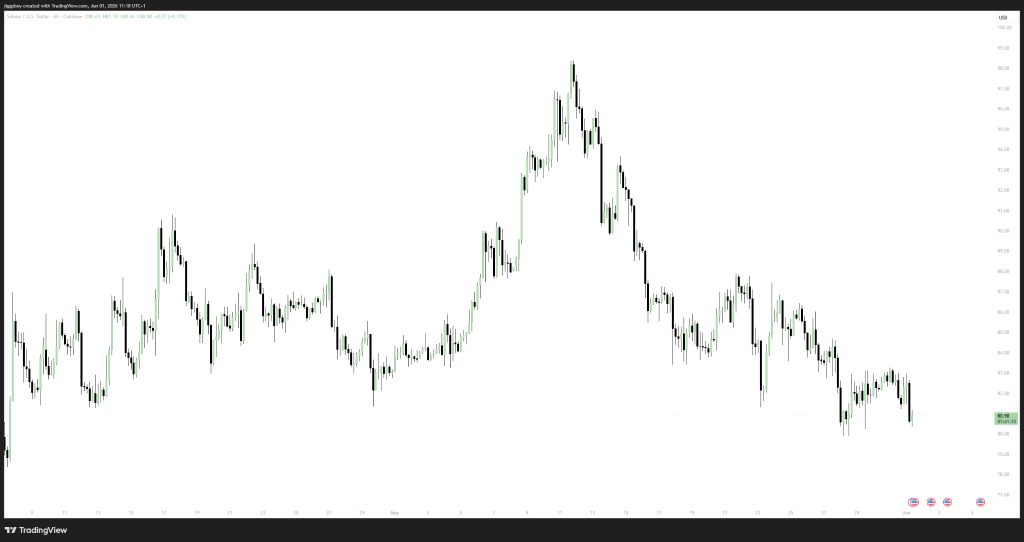
DeepSeek AI Predicts Solana Price for June – Will SOL Survive the Sell‑Off?
The Solana (SOL) price is down 1.87% to $81.07 in 24 hours, underperforming a slightly weaker broader market, primarily driven by institutional selling pressure
Share
Captainaltcoin2026/06/01 22:30

BNB slips below $590 as Trump threatens to strike Iranian power plants
The post BNB slips below $590 as Trump threatens to strike Iranian power plants appeared on BitcoinEthereumNews.com. Key takeaways Binance’s BNB is down 4.5% in
Share
BitcoinEthereumNews2026/04/02 19:39


Trending News
More24/7 Live News
MoreQuick Reads
More
