

Nigeria Q1 2026 GDP: Trade and real estate outweigh tech
When the National Bureau of Statistics releases a headline like “services sector reaches all-time high share of GDP,” the instinct in tech circles is to read it as validation, that is, proof that Nigeria’s digital economy narrative is finally showing up in the macroeconomic data.
The Q1 2026 GDP figures tell a more complicated story.
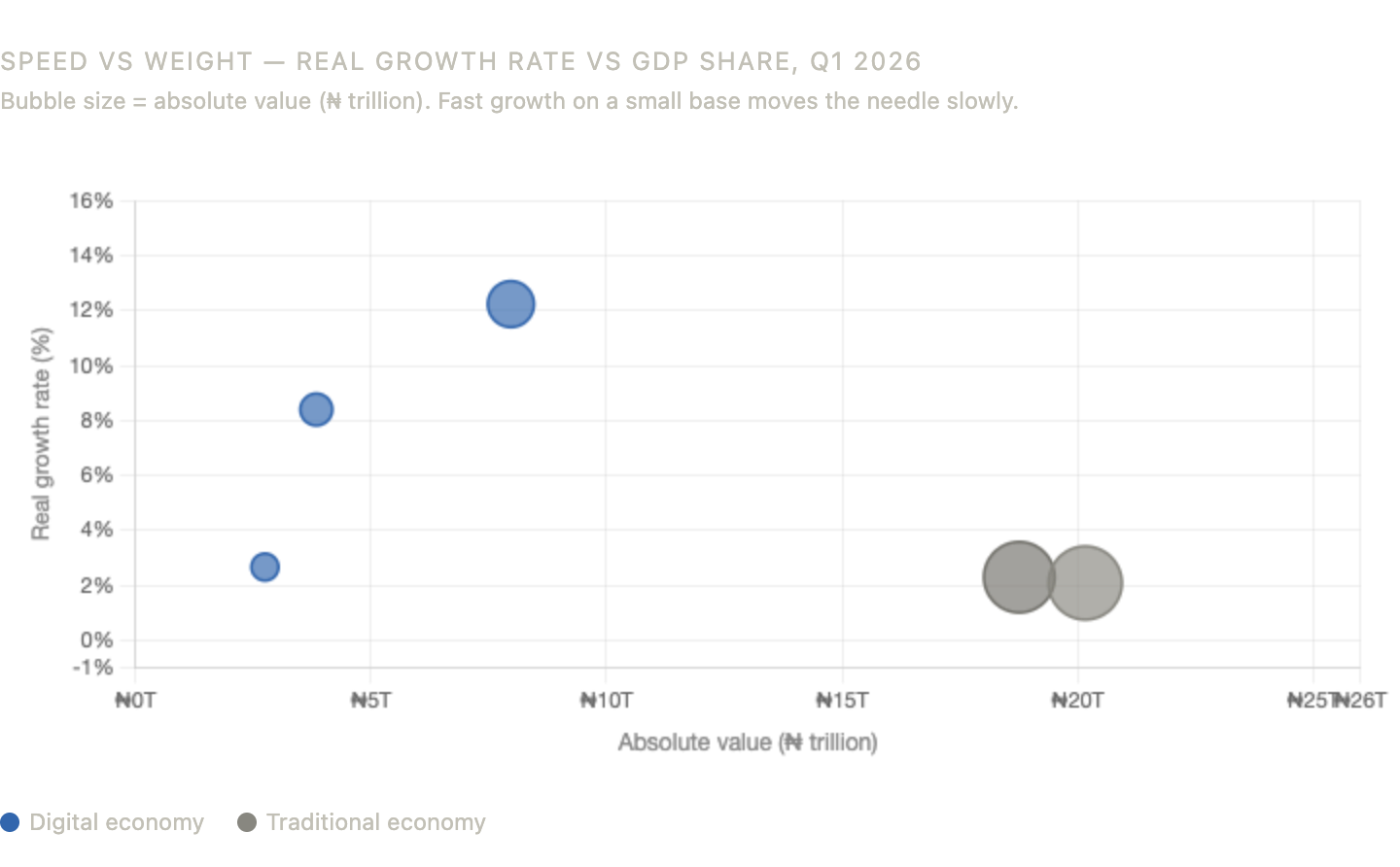
Services did reach 57.73% of GDP in Q1 2026, up from 57.50% in Q1 2025 and 56.84% in Q1 2024. It is, technically, the highest share on record in this data span. But the sectors doing the actual work are Trade (₦20.16 trillion) and Real Estate (₦18.76 trillion). Together, they account for roughly ₦39 trillion out of a total services output that runs well above ₦60 trillion. Telecoms and Information Services, the sector most directly associated with Nigeria’s digital economy ambitions, contributed ₦7.97 trillion.
To put that in plain terms: commerce and property are the load-bearing columns of Nigeria’s services economy. Tech is a beam, not a pillar. Not yet.
The “default” problem
Services is growing its share incrementally by about 0.9 percentage points over two years. But look at what’s happening around it. Agriculture has shed nearly a full percentage point. Industries have gone essentially nowhere, hovering around 19% across the entire period.
Services isn’t surging, it’s inheriting share as agriculture contracts. The economy isn’t rebalancing toward a services-led model in any dramatic sense; it’s drifting there, slowly, for structural reasons that have less to do with deliberate policy and more to do with the long-term squeeze on smallholder farming and the stagnation of manufacturing.
Real GDP growth confirms this reading. Services grew at 4.31% in real terms in Q1 2026, which is solid but not exceptional. Agriculture came in at 3.15% and Industries at 3.50%. All three broad sectors are growing. There is no breakout moment here.
The oil footnote that reframes everything
There is one number in the data that deserves more attention than it typically gets: oil’s share of GDP was 3.9% in Q1 2026.
Non-oil GDP is 96.1% of the economy.
This is the context in which ‘services at 57.7%‘ should be read. Nigeria’s economy has already diversified away from oil, not into tech or manufacturing, as the reform narrative would prefer, but into the same sectors that have always absorbed economic activity in the absence of alternatives: trade, property, and informal services. The services sector’s rise is partly a reflection of how marginal crude has become as a share of the real economy.
That is a form of diversification, but it is not the kind that builds long-term productive capacity.
What Telecoms’ 12.2% real growth actually means
Telecoms and Information Services grew at 12.24% in real terms in Q1 2026, the fastest growth rate of any major services subsector. Financial Institutions grew at 8.4%. Arts, Entertainment and Recreation grew at 11.25%.
These are genuinely strong numbers. The problem is weight. Fast growth on a small base moves the needle slowly. Telecoms at ₦7.97 trillion growing at 12% adds roughly ₦960 billion to the economy. Real Estate at ₦18.76 trillion growing at just 2.3% adds ₦431 billion. The math still favours scale over velocity at this stage.
Read also: Telecoms contributed 8.3% to Nigeria’s real GDP in 2025
For the digital economy narrative to show up meaningfully in GDP share data, Telecoms and Financial Services would need to sustain double-digit real growth for several consecutive years while the rest of the economy grows at its current pace. That is achievable. But it is a project that is still in early innings, not a transformation that has arrived.
The honest read
Nigeria’s services sector at 57.73% of GDP is a milestone, but a mild one. The number is real and the direction is consistent. What it is not is evidence that the digital economy has become the primary driver of Nigerian economic output.
Trade and Real Estate are the economy’s anchors. Telecoms and Fintech are growing fast from a smaller base. Agriculture is in slow structural decline. Industries are flat.
The story of Nigeria’s economic structure in Q1 2026 is not one of digital transformation. It is one of a large, complex economy moving incrementally in a direction that could support a digital transformation, if the policy environment, infrastructure investment, and private sector momentum all hold.
That is worth tracking. It is not yet worth celebrating.


You May Also Like

Robotics Automation Prototyping: Engineering Kinetic Agility into End-Effectors

Fed Governor Calls For Strong Stablecoin Oversight As CLARITY Act’s Final Text Gets Delayed

XAU/USD Daily Analysis Shows Gold Buyers Defending $4,540 Support



