VerseTap: How Pastor Simeon Taiwo built an AI-powered note-taking app for believers
Every piece of purpose-built software is born from a precise moment of human friction. For Pastor Simeon Adeola Taiwo, that moment arrived on a certain Thursday afternoon while preparing for an evening ministration. He found himself trapped in a repetitive, maddening digital loop on his Samsung tablet: toggling back and forth between the YouVersion Bible app and his digital notepad. He was manually copying verses, switching screens, and pasting text, a tedious workflow he had to repeat for over a dozen scriptural references.
“Why can’t this note app be just so smart that if I tap on Jeremiah, it pops up the passage?” he said to himself, staring at his screen. “Why must I be copying and pasting?”
It was a simple question that highlighted a glaring gap in the market for faith-based technology. Traditional note-taking apps were failing modern believers, demanding too much manual effort during intense study or live preaching. Taiwo realised that if a seamless, auto-detecting digital notebook didn’t exist, someone had to build it. Moments later, he realised he was that someone. That Thursday afternoon friction birthed VerseTap.
VerseTap: Faith meets tech
Taiwo is not your typical startup founder, nor is he merely a clergyman dabbling into tech. Based in Port Harcourt, Nigeria, he operates precisely at the intersection of deep technical infrastructure and active ministry. As the CEO and founder of Clarylife Global Limited, a systems automation agency, he tells me that he literally “eradicates paper for a living.” Concurrently, he serves as the regional administrator for the MFM Youth Church. He has been a clergyman for over a decade.
 VerseTap
When discussing the integration of artificial intelligence into deeply personal spiritual environments, Taiwo is remarkably pragmatic, stripping away the global apprehension often associated with machine learning. To him, the integration of automation into ministry is simply a continuation of historical precedent.
“Through every dispensation and through every civilisation, God has always given His word to His people. And there were tools that God used. In the time of Moses, they used tablets of stone carved from the rock. As civilisation changed, people began to use ink with feathers on leather. The tool changed, but the assignment remained the same,” Pastor Taiwo said.
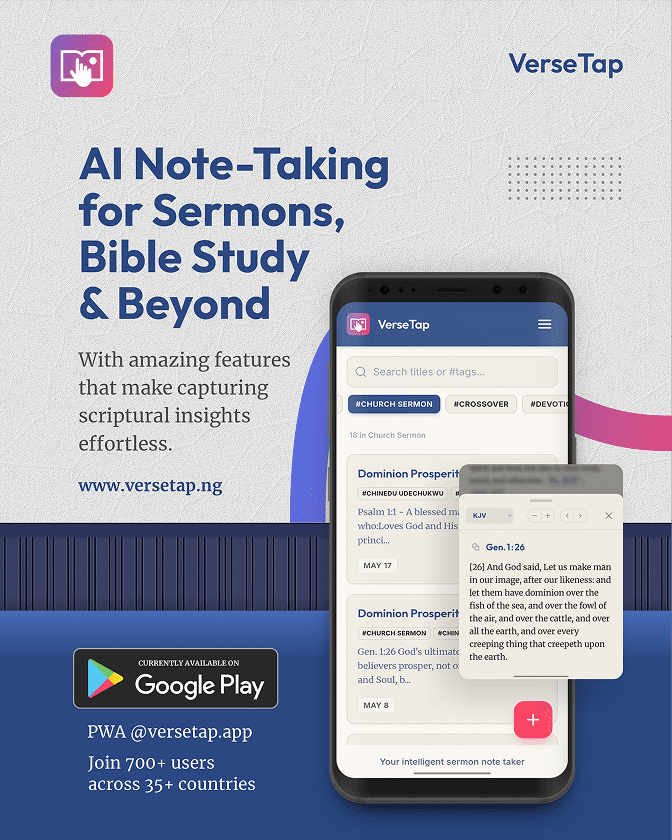
For Taiwo, AI is not a spiritual driver; it is a vehicle. It does not replace the human element of receiving and delivering a message but acts as a sophisticated midwife, easing the delivery process. VerseTap was designed to be this modern vehicle, a highly specialised journaling tool that instantly recognises scriptural abbreviations, pulling up the full text on demand without breaking the user’s flow.
Data sovereignty and the offline reality
Building for the African technology ecosystem, and scaling to the global church at large, requires a nuanced understanding of environmental and social realities. VerseTap was deliberately engineered with two main friction points in mind: data sovereignty and connectivity.
In an era where technology giants treat user data as a commodity, Taiwo opted for a strict privacy-first architecture. VerseTap operates with zero central servers for note storage, actively protecting the intellectual property of its users.
 Pst Simeon Taiwo, founder and CEO of VerseTap
“I understand how sensitive matters around doctrine and people’s sermons are,” Taiwo explains. “We’ve seen bloggers and social media platforms cashing out on pastors’ content, pitting them against one another. The best thing for me to do as a minister playing in this field is to keep this thing private.”
Instead of harvesting data, VerseTap leverages a Progressive Web App (PWA) architecture backed directly by a user’s own Google Drive. The proprietary thoughts, sermons, and notes remain strictly between the user, their local device, and their personal cloud.
Furthermore, the reality of physical church infrastructure necessitated an engineering pivot. Historically, church buildings, with their thick walls and expansive roofing, are notorious for blocking cellular signals. The platform is an offline-first application with embedded Bible, meaning that whether a minister is in a high-tech auditorium in Lagos or a rural parish in Brass Island, the app functions flawlessly without a single bar of internet.
Also read: Surveyo AI: How Samuel Damfe is empowering struggling often overlooked students with a voice
This focus on solving a genuine, localised problem with world-class engineering has triggered a phenomenal organic viral loop. In just a few months, VerseTap has scaled to over 700 unique users across 35 countries. Strikingly, the United States represents the app’s second-largest demographic, proving that the friction of modern ministry is a universal pain point that transcends borders.
 VerseTap
The user feedback consistently validates the architecture. Taiwo recounts stories of Sunday school teachers finally able to manage their 15-minute windows efficiently, no longer losing half their session waiting for congregants to manually find scripture. He points to an infamous incident where renowned preacher Joshua Selman lost his entire sermon notes just hours before speaking at Harvard University. Had solutions like VerseTap with automated, instant cloud restoration been in existence, the crisis would have either been averted or resolved in under thirty seconds.
As VerseTap prepares for its imminent iOS launch in the coming months to capture the massive Apple user base, Taiwo is already architecting the platform’s future. Implementing lazy loading and advanced file storage systems ensures the app won’t crash when power-users amass hundreds of notes. He envisions expanding beyond congregational use, introducing cross-references, commentaries, and concordances for full-time ministers navigating extreme time constraints.
By addressing his own Thursday afternoon frustration, Taiwo has built more than just an offline note-taking app. He has demonstrated that the next wave of indispensable, globally adopted utility software is just as likely to emerge from an indigenous developer in Port Harcourt as it is from a boardroom in San Francisco.


You May Also Like

AI giants Meta, Microsoft, NVIDIA stocks slip amid Iran threat, AI cryptos crash

Wintermute Launches Armitage for Custom DeFi Lending Vaults