Bridging the past and the future: Museo del Galeón as a center of maritime studies
PHILIPPINE history contains treasure troves beyond the same dozen blurry, photocopied pictures circulated in textbooks — and there’s now an institution that makes the 1500s to 1700s accessible today.
Museo del Galeón, a museum centered on seafaring during the Spanish galleon trade, will fill an overlooked, 250-year gap in history. Opening to the public from May 1 onwards, it is also “crucial to the Philippines’ maritime future,” said historian Manuel L. Quezon III, who is the executive director of the Museo del Galeón, at a press briefing last week.
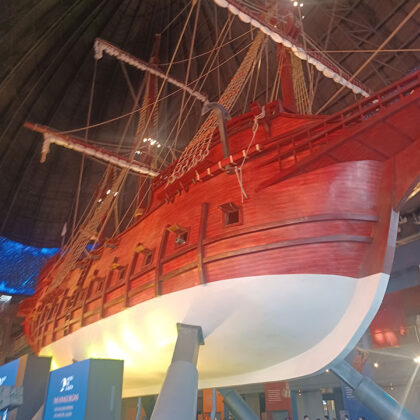
“This is a museum that features time travel through a giant representation of a galleon,” he said, referring to the full-scale reconstruction of the 17th century ship Galeón Espíritu Santo, which serves as the centerpiece of the museum.
“You are going to be brought on a journey to a part of our national life, our national story, which you perhaps never knew existed, but you’ll discover is part of everyday life.”
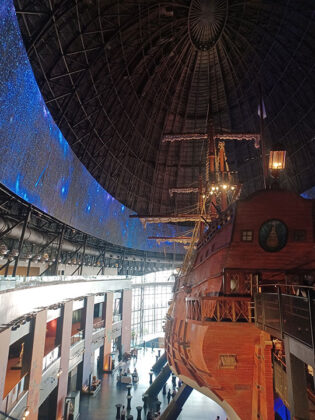
Located at the SM Mall of Asia Complex, the museum is housed in a four-level, dome-shaped structure spanning about 9,000 square meters. But in addition to its experiential thrust, it aims to be a center for maritime studies.
GALLERIES
Aside from the centerpiece, which represents the 181 ships that linked Asia to the Americas from 1565 to 1815, there are two other galleries — about the early Filipinos as ancient mariners with their balanghais, and about Ferdinand Magellan’s landing in Cebu which was a key transpacific encounter in maritime history.
Mr. Quezon pointed out that most of the vegetables listed in the folk song “Bahay Kubo” were brought to the Philippines through the galleon trade, as well as the Filipino words pitaka, tiangge, palengke, nanay, and tatay (wallet, bazaar/flea market, public market, mother, and father) which originate from indigenous Mexico. So, a third gallery, which is opening in October, will center on the sociocultural exchange made possible by the Manila-Acapulco galleon trade.
“This museum is about rediscovering and celebrating who we are, and it’s different from other museums because it’s experiential. You can explore, touch, and engage with the ship,” he said.
More importantly, Museo del Galeón has a goal of inculcating an interest in Philippine shipbuilding and seafaring, made possible through a fourth gallery, also set to open in October, about the Philippines’ contemporary maritime history.
“From the perspective of industry, the museum serves as a link between past and present, from the shipbuilders and crews of those galleons to the Filipinos who make up the bulk of seafarers today,” said Philippine Transmarine Carriers Group of Companies’ chief executive officer, Gerardo A. Borromeo, who is also a member of the Museo del Galeón board of trustees.
“Through this, we can feel pride for how we contributed to the start of what you can consider globalization,” he noted. “This is a chance to raise the level of dignity of modern seafarers, who we can consider global maritime professionals. We now have an opportunity to raise the standard, raise awareness, and build pride.”
LEARNING CENTER
The Museo del Galeón will be working closely with schools, universities, tour operators, and maritime institutions to offer tour packages and research facilities for various educational endeavors.
“For the younger ones, it’s designed to be a living textbook. We encourage everyone to interact and feel what it was like to be a sailor in the galleons,” said Victor L. Gelano, managing director of the Museo del Galeón. “We’ll welcome students, academics, historians, and as many people as possible.”
Patrons are welcome to sponsor or gift tickets to local government units and public schools, so that the underserved can visit the museum, he added.
The museum is also large enough to serve as a place to hold company events and international conferences, for those who want a venue with a piece of Filipino culture.
Their projection for the number of expected visitors is about 250,000 a year, largely comprised of student groups, people walking in from the nearby mall, and foreigners. Meanwhile, future-looking facilities will cater to researchers.
The Ocean Learning Center is one, touted as a “hub for education, sustainability, and collaboration,” with a digital library of resources about the galleon trade and Philippine maritime history organized and made accessible to the world’s scholars.
“It will be a space in the museum with world-class communication technology that welcomes research and discussions,” said Mr. Gelano. “They can present research and hold discourse there.”
Mr. Quezon explained that the importance of research can be found in both the past and present. “We’re all paying attention to the Strait of Hormuz now, but there was a similar bottleneck 500 years ago when the Silk Road was closed due to the crusades. They had to find another route and that led to the galleon trade,” he said.
MUSEUM TOUR
Upon going up the escalator from the welcome hall to the main museum space, the massive structure of the Galeón Espíritu Santo immediately fills your vision. It is 30 meters high and 40 meters long, looking exactly like a seaworthy galleon — except it isn’t.
“One galleon ship required a forest’s worth of narra or molave hardwood, which is a lot,” Mr. Quezon told BusinessWorld. “That’s why this representation is made of plexiglass.”
It’s not just any recreation, though. The craftsmen who made it are the same ones who are responsible for theme park attractions, so its resemblance to the real thing is a sight to behold.
Around the ship are 10 columns that tower from the second to the third level, encircling half of the galleon. Below the colonnade are displays on artifacts which were traded extensively during the galleon trade: flora, fauna, garments, religious items, and ceramics, to name a few.
Before boarding the ship, the galleries offer an insight into Philippine maritime history. Gallery 1, which is about ancient mariners, has a mini balanghai with information about pre-Spanish era sea routes. Gallery 2 has paintings of the arrival of Christianity through Magellan and statues of key figures in the end of his voyage, like Lapulapu and Rajah Humabon.
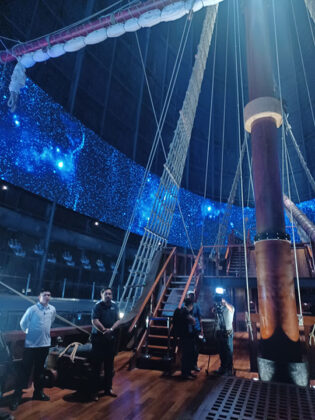
Because Galleries 3 and 4 are not yet open, the next part of the tour is boarding the ship. Stepping onto the deck and going inside makes one feel like they are a sailor getting ready for a voyage. The more imaginative visitors out there can think of themselves as a Filipino slave brought aboard due to polo y servicio*, which is how most shipbuilders and crew members got there, according to Mr. Quezon.
During the tour, he pointed out areas of the ship which offered insights to life back then, like the cannons on the sides which were used to fire at fleets of other countries or at pirates set to steal their goods, and the corner with barrels of salted meat or water which were meant to last for the months each voyage took.
Up on the deck is the most breathtaking part, where visitors can look at the mast and the starboard side and up at a panoramic LED screen displaying a vast seascape or night sky.
THE ESPÍRITU SANTO
Mr. Quezon said that they selected the Galeón Espíritu Santo, constructed in Cavite in 1603, to be the museum’s centerpiece because it was a rare example of a ship that completed 10 peaceful voyages between Manila and Acapulco — or so they thought.
“Research showed that, though every galleon was a cargo vessel, very few had a tranquil existence. We found the most reliable and peaceful one was this ship, until history further revealed that when it was in retirement, it came out for one last battle,” he said.
It turns out that an episode of the FX series Shogun, where a galleon is captured by a Japanese warlord and has to make an escape, was based on the Espíritu Santo’s very first voyage. They had found evidence of its misadventure upon further research.
“Much like a telenovela, this ship really represents our story,” said Mr. Quezon. “These discoveries are the best example of how we piece things together by going into the history.”
The Museo del Galeón was constructed based on the vision of its founding chairman, the late Senator Edgardo J. Angara. It is accredited by the National Commission for Culture and the Arts, and is a member of the International Congress of Maritime Museums, with many of its contents acquired with the help of the Embassy of Spain.
Tickets to the museum will cost P675 for adults, P375 for children and private school students, and P275 for teachers and public school students. Discounted rates will be available for seniors and persons with disabilities. It will be open Wednesday to Sunday, from 10 a.m. to 7 p.m., starting on May 1. — Brontë H. Lacsamana
* Polo y servicio was a Spanish colonial policy of mandatory, often unpaid, labor from Filipino males aged 16 to 60 for 40 days annually, later shortened to 15 days.


You May Also Like
Fidelity ETH Deposit: $45.3M Transfer to Coinbase Sparks Institutional Confidence

Postquant Launches Quantum-Resistant Bitcoin Wallet Without Protocol Changes