

South Korea Launches First Won-Backed Stablecoin KRW1 on Avalanche

The digital currency, called KRW1, runs on the Avalanche blockchain and marks a major step forward for the country’s digital finance sector.
BDACS, a South Korean crypto custody firm, announced the launch after successfully completing technical testing with Woori Bank, one of the country’s largest financial institutions. Each KRW1 token is backed by actual Korean won held safely at the bank.
The launch comes at a time when South Korea lacks clear rules for stablecoins. However, the government is working on new laws that could change this soon.
What Makes KRW1 Different
KRW1 stands out because it connects traditional banking with modern blockchain technology. Every digital token is backed 1:1 by Korean won stored at Woori Bank. This means users can trust that their digital money has real value behind it.
The stablecoin uses real-time banking connections to prove its reserves exist. This transparency helps build trust between users and the platform. Harry Ryoo, CEO of BDACS, said his company is “building the backbone of the digital asset market, serving corporate, institutional, and public-sector partners.”
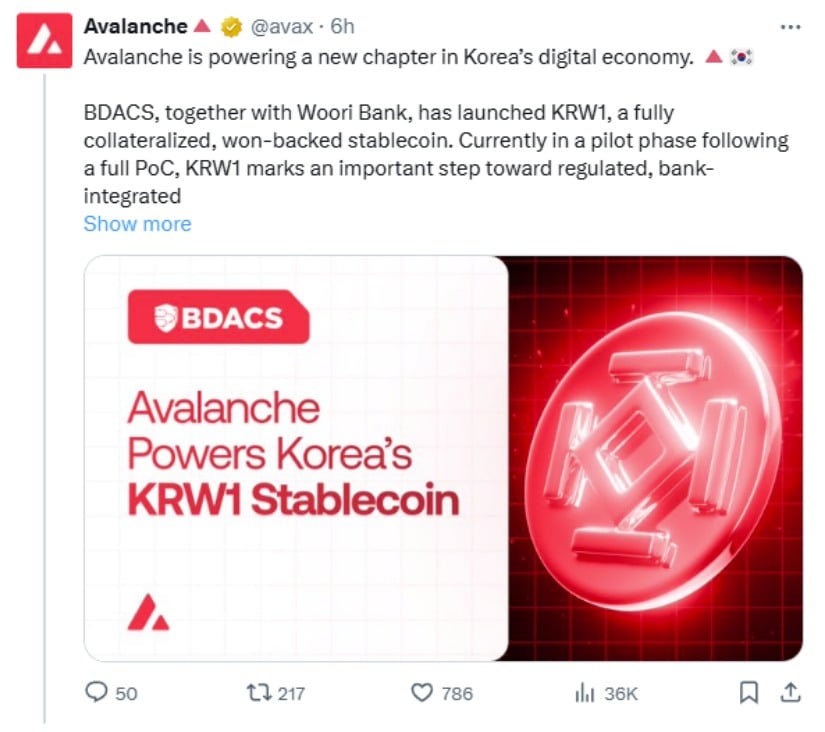
Source: @avax
BDACS chose Avalanche for its speed and security. The Korea Internet & Security Agency has recognized Avalanche as reliable for public sector use. Justin Kim, Head of Asia at Ava Labs, noted that KRW1 shows “the need for a highly-performant and reliable blockchain tailored for a regulatory-compliant stablecoin.”
Government and Public Sector Plans
KRW1 was designed with government use in mind. BDACS plans to offer it as a low-cost payment system for public programs. This could significantly reduce fees when the government distributes emergency relief money or processes other payments.
The company has already built systems for issuing tokens, managing reserves, and verifying transactions. They also created a user app that lets people send money to each other and check transaction details.
Currently, KRW1 operates as a proof-of-concept project. This means it’s not available to the general public yet. This careful approach helps the company avoid breaking any current laws while they wait for new regulations.
Regulatory Landscape Taking Shape
South Korea’s government is moving quickly to create rules for digital currencies. President Lee Jae-myung has promised to support won-backed stablecoins as part of his plan to strengthen the country’s financial independence.
The ruling Democratic Party proposed the Digital Asset Basic Act, which would allow Korean companies to issue stablecoins. Companies would need at least 500 million won (about $368,000) in capital and must keep enough reserves to guarantee refunds.
The Financial Services Commission plans to submit a government bill to lawmakers in October 2025. This new law would create the country’s first official framework for stablecoins.
However, recent political events have slowed progress. The National Assembly postponed discussions about virtual asset rules until at least 2025 following martial law declarations and impeachment proceedings.
Market Competition Heating Up
BDACS isn’t the only company preparing for South Korea’s stablecoin future. At least three major banks – Kakao Bank, Kookmin Bank, and Industrial Bank of Korea – have filed trademark applications for their own Korean won stablecoins.
This competition shows how seriously financial institutions take the stablecoin opportunity. South Korea has one of the world’s most active crypto markets, with over 18 million people – more than one-third of the population – involved in digital assets.
The numbers are impressive. In the first quarter of 2025 alone, USD stablecoin transactions reached 57 trillion won ($42 billion) on South Korean exchanges. This shows there’s strong demand for stable digital currencies.
BDACS believes it has an advantage because KRW1 is already working. The company said that while big tech companies might enter the market later, “KRW1 is already operational with strong institutional backing from Woori Bank and global blockchain partners.”
Global Implications
South Korea’s move could influence other countries considering their own national stablecoins. The combination of blockchain technology with traditional banking oversight creates a model that balances innovation with safety.
BDACS plans to expand KRW1 to other blockchains to improve compatibility. The company is also exploring partnerships with dollar-based stablecoins like USDT and USDC.
The success of KRW1 will be closely watched by regulators and companies worldwide. It could become a template for how other nations create their own digital versions of national currencies.
The Digital Won Revolution
KRW1 represents more than just a new digital currency. It shows how South Korea is positioning itself as a leader in the global shift toward digital finance. By combining the stability of traditional banking with the efficiency of blockchain technology, the country is creating a new model for digital money.
The careful, regulated approach taken by BDACS and Woori Bank could help other countries feel more comfortable about creating their own national stablecoins. As regulations become clearer and more companies enter the market, South Korea’s digital finance sector looks set for significant growth.
You May Also Like

MoneyGram launches stablecoin-powered app in Colombia

Solana Treasury Firm Holdings Could Double as Forward Industries Unveils $4 Billion Raise
