HINC Loopscale: Can Tokenized Credit Unlock DeFi Loans?
Overview
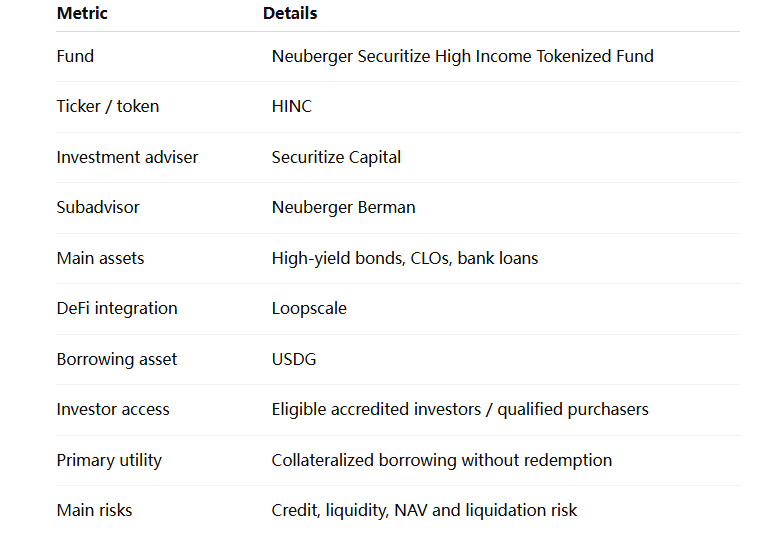
Securitize has expanded the utility of tokenized private credit by integrating the Neuberger Securitize High Income Tokenized Fund, or HINC, with Loopscale. Eligible investors can now use HINC fund interests as collateral to borrow USDG without first redeeming their underlying position, creating a direct connection between tokenized credit and onchain lending.
The HINC Loopscale integration is notable because HINC is not a Treasury-style fund. Its portfolio focuses on higher-yielding fixed-income assets, including high-yield corporate bonds, collateralized loan obligations, bank loans and other income-producing credit instruments. Securitize Capital serves as investment adviser, while Neuberger Berman acts as subadvisor. That gives the product a very different risk profile from tokenized cash-management funds built primarily around short-dated U.S. government securities.
The larger significance is structural. Tokenized assets are increasingly moving beyond simple issuance and custody into functions that resemble traditional capital markets: financing, collateralization and liquidity management. HINC can remain invested while also becoming a source of borrowing capacity. The next test is whether this model can scale without introducing excessive credit, oracle, liquidity or liquidation risk.
Key Takeaways
- HINC is now available as collateral on Loopscale for eligible investors.
- Borrowers can obtain USDG without first redeeming HINC.
- HINC invests in higher-yield credit assets rather than short-dated Treasuries.
- Tokenized credit is beginning to function as productive DeFi collateral.
- The key risks are NAV volatility, credit losses, liquidation timing and smart-contract execution.
What Does the HINC Loopscale Integration Actually Enable?
Can Investors Borrow Without Selling HINC?
Yes. Eligible investors can pledge HINC as collateral and borrow USDG while maintaining exposure to the fund.
That matters because traditional liquidity management often forces an investor to choose between remaining invested and raising cash. If a fund position must be redeemed before liquidity can be accessed, the investor loses exposure to the underlying portfolio and may face timing, settlement or tax considerations.
The HINC Loopscale model changes that sequence. Instead of redeeming first, the investor can use the tokenized fund interest as collateral. The position remains invested while the borrower receives a separate liquidity asset.
This is a familiar concept in traditional securities finance, where bonds, equities and fund interests can support secured borrowing. The difference is that the collateral representation and loan workflow are now integrated into an onchain environment.
Why Does This Matter for Capital Efficiency?
Capital efficiency improves when the same asset can perform more than one economic function.
A tokenized fund that can only be held or transferred provides some operational benefits, but its utility remains limited. A fund that can also support borrowing becomes part of a broader financial stack.
For an eligible HINC holder, the position may continue generating exposure to the underlying credit strategy while also supporting a USDG loan. That can reduce the need to liquidate assets solely to meet short-term liquidity needs.
However, this flexibility introduces leverage. Once an investor borrows against HINC, a decline in fund value can increase the effective loan-to-value ratio and create liquidation risk. Capital efficiency therefore comes with additional balance-sheet complexity.
What Is HINC?
What Assets Does HINC Hold?
HINC is a tokenized fixed-income fund designed around higher-yielding credit rather than government cash equivalents. Its strategy includes high-yield corporate bonds, collateralized loan obligations, bank loans and other income-producing debt instruments.
That distinction is important because these assets carry meaningful credit and liquidity risk. High-yield bonds can decline when default expectations rise, CLO tranches can respond differently to changes in credit conditions, and bank loans may have less immediate liquidity than exchange-traded securities.
The fund therefore offers a potentially higher income profile than a Treasury-focused tokenized product, but it also introduces more complex collateral behavior.
This makes HINC especially interesting as an onchain collateral experiment because the protocol must account for a fund whose NAV can move for reasons beyond short-term interest rates.
Why Does Neuberger Berman Matter?
Neuberger Berman provides institutional fixed-income expertise as subadvisor to the strategy.
That matters because tokenization does not replace traditional asset management. The blockchain layer can improve issuance, transferability and composability, but the economic quality of the fund still depends on security selection, credit analysis, portfolio construction and risk management.
The HINC structure therefore combines two layers: conventional institutional credit management and digital fund infrastructure.
For investors, that means the blockchain should not be viewed as reducing the underlying investment risk. Tokenization can change how the asset is accessed and financed, but it does not remove the possibility of credit losses or NAV declines.
HINC Loopscale Snapshot
How Does Tokenized Credit Become DeFi Collateral?
How Is HINC Valued Onchain?
A lending market needs a reliable value for collateral. For a tokenized fund, that usually means using NAV data rather than relying purely on secondary-market token prices.
HINC’s NAV is updated through an oracle-based process, allowing Loopscale to reference the fund’s latest valuation when determining borrowing capacity and collateral health. This is different from valuing a highly liquid token such as BTC, where continuous market prices are available across many venues.
The challenge is timing. A fund NAV may update at specific intervals, while onchain lending operates continuously. If the underlying credit portfolio moves sharply between NAV updates, there can be a lag between economic value and the price used by the lending protocol.
That gap is manageable only if collateral parameters are conservative enough to absorb short-term valuation uncertainty.
What Happens If HINC's NAV Falls?
If HINC declines in value, the borrower's collateral ratio worsens.
Suppose an investor pledges $100,000 of HINC and borrows $50,000 of USDG. If the fund value later falls to $80,000 while the debt remains unchanged, the loan-to-value ratio rises from 50% to 62.5%.
If the ratio exceeds the protocol’s liquidation threshold, the position may be partially or fully liquidated.
This is where tokenized credit differs from stablecoin collateral. The underlying assets can experience mark-to-market declines from credit spreads, defaults, interest-rate changes and liquidity stress.
The protocol therefore needs collateral parameters that reflect both fund volatility and the speed at which reliable NAV data becomes available.
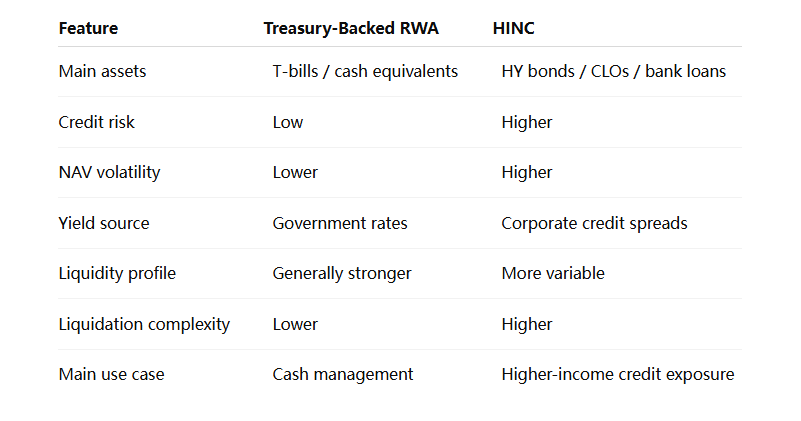
Why Is This Different From Treasury-Backed RWA Lending?
Credit Risk Changes the Collateral Model
Tokenized Treasury funds are often used as examples of low-volatility RWA collateral because their underlying assets are short-duration government securities. HINC introduces a materially different risk structure.
Why Does This Make HINC More Interesting?
Because it tests whether onchain lending can handle more complex real-world credit rather than only cash-like assets.
If tokenized private or high-yield credit can be financed safely onchain, the addressable RWA market expands significantly. Credit funds, structured products and income strategies could become usable collateral rather than passive tokenized holdings.
That would bring DeFi closer to the functions of traditional securities finance.
But the bar is also higher. Credit collateral can gap in value, become illiquid and respond to macro stress in ways that simple cash equivalents do not.
What Are the Main Risks?
Credit and Liquidity Risk
HINC's underlying assets can lose value if corporate credit quality deteriorates or market spreads widen.
High-yield bonds and CLOs are particularly sensitive to changes in default expectations and funding conditions. During stressed markets, liquidity can also decline at the same time that prices fall.
That combination creates a challenge for collateralized lending. A protocol may need to liquidate an asset precisely when the underlying market is least liquid.
This is why the headline benefit of "borrowing without selling" should not be interpreted as risk-free capital efficiency.
Oracle and NAV Timing Risk
Unlike 24/7 crypto tokens, fund NAVs are not necessarily updated every second.
If the oracle references a stale valuation during a fast-moving credit event, the protocol may temporarily overestimate collateral value. Conservative loan-to-value ratios can reduce that risk, but they cannot eliminate it entirely.
Protocols also need contingency procedures for delayed NAV updates, pricing disruptions or market holidays.
As more tokenized funds enter DeFi, oracle design will become one of the most important infrastructure questions.
Smart-Contract and Liquidation Risk
The collateral workflow depends on smart contracts, permissioning and liquidation logic functioning correctly.
A technical failure could affect borrowing, repayments or collateral release. A poorly designed liquidation mechanism could also create unnecessary losses for borrowers or insufficient protection for lenders.
Because HINC is restricted to eligible investors, compliance requirements add another layer of operational complexity.
The protocol must preserve investor eligibility while still allowing collateral to move through a liquidation process.
MEXC View: RWA Utility Is Moving Beyond Tokenization
The most important RWA metric may increasingly be how much tokenized value is actually used, not simply how much is issued.
Tokenized AUM has become a common headline, but productive collateral can create a deeper financial layer. An asset that can be held, transferred, pledged and financed has more economic utility than one that only sits in a wallet.
The HINC Loopscale integration is a useful example because it expands this model beyond Treasury-like products into higher-risk credit. That makes the experiment more meaningful but also more demanding.
For market participants, the key data to watch are collateral utilization, loan volume, liquidation frequency, average LTV and whether HINC borrowing activity remains stable during periods of credit stress. Those metrics will show whether tokenized credit can function as reliable financial infrastructure rather than only as a technically transferable asset.
HINC Shows RWA Is Becoming Productive Collateral
The HINC Loopscale integration represents an important step in the evolution of tokenized credit. Securitize has moved HINC beyond digital issuance by making the fund usable as collateral for onchain borrowing.
That gives eligible investors a new form of capital flexibility. They can maintain exposure to a credit strategy while accessing USDG liquidity without first redeeming the fund.
The structure is more ambitious than Treasury-backed RWA lending because HINC introduces higher-yielding corporate credit, CLOs and bank loans into the collateral framework. Those assets can offer greater income potential, but they also bring more credit risk, NAV volatility and liquidation complexity.
This is exactly why the integration matters. If DeFi infrastructure can safely handle tokenized credit with real market risk, the RWA opportunity becomes much broader than cash-management products.
The next stage should be judged by usage and resilience rather than tokenized AUM alone. Stable borrowing demand, conservative collateralization and effective liquidations would provide evidence that HINC can function as productive financial collateral. If those mechanisms hold up during stressed markets, tokenized credit could begin playing a much larger role in onchain capital markets.
Sources
https://securitize.io/learn/press/hinc-goes-live-on-loopscale
Risk Disclaimer: This article is for reference only and does not constitute investment advice. The cryptocurrency market is highly volatile. Please make decisions cautiously based on your individual circumstances.


Танд мөн таалагдаж магадгүй

MEXC On-chain Daily Report: Robinhood Approved to Acquire WonderFi for $180 Million

Singapore Stablecoin Regulation: What Could MAS Change?

Gold Price Falls Toward $4,300 as Rate-Hike Expectations Return