

Our Pride In Being South African Is The Glue That Holds Us Together
The release of the latest South Africa Social Cohesion Index comes at an important moment for the country as South Africans prepare for the local government elections later this year. Understanding the strength of the bonds that hold our society together is essential as communities evaluate leadership, service delivery, and the direction of the country.
There’s a saying in business that if you can’t measure it, you can’t manage it, and that holds true for important issues in broader society too. This is where the Social Cohesion Index can play an important role by providing an evidence-based view of how South Africans relate to one another and to the institutions that shape public life.
Telkom is proud to have sponsored this important research by the Inclusive Society Institute in cooperation with the Constructor University in Germany over several years. We are confident its findings and insights will have a positive practical impact on South Africa’s growth and prosperity.
The Bertelsmann concept of defining a country’s level of social cohesion allows scores between 0 (no cohesion) and 100 (maximum cohesion). The latest results from the 2025 South Africa Social Cohesion Index show that the country’s overall cohesion score stands at 56 points, reflecting moderate cohesion and a 2.5-point improvement since the Index was first measured in 2021.
The Index also highlights areas where cohesion remains under pressure. Lower scores are recorded in dimensions such as respect for social rules (42), perceptions of fairness (47.1), and acceptance of diversity (47.7). These indicators point to underlying societal frustrationsand emphasise the importance of strengthening institutional credibility and public trust.
In the 2025 Index, the Eastern Cape recorded the highest level of cohesion at 58.9, followed by North West at 58.4 and the Western Cape at 57.2. At the bottom of the list, the Northern Cape recorded a score of 51.7. While all provinces remain within the moderate cohesion range, these differences highlight the importance of local conditions in shaping social trust and stability.
South Africa exhibits some unique and often surprising characteristics in social cohesion. These patterns include lower cohesion in more economically affluent parts of South African society. This contradicts other studies showing a positive association between GDP and cohesion in Western and Asian societies.
Racial and linguistic diversity in South Africa appear to contribute positively to social cohesion where religious diversity appears to harm it.
Interestingly, provinces with more highly educated citizens tend to have lower levels of social cohesion, suggesting frustrations about the state of the economy. In contrast, social cohesion is considerably higher in more rural areas of South Africa compared to the more fractious urban areas.
The South Africa research also shows that access to modern information technology appears to weaken social cohesion which contradicts other studies that suggest technology can advance social cohesion.
So, why does this matter? It is important that we understand what’s going on under the hood of our society so we know what to fix and what to leave alone. Research such as this provides empirical evidence to inform policy making, strengthening social cohesion that assists with stability, growth and prosperity. Social cohesion is not theoretical; it has direct implications for the well-being of citizens.
These insights are particularly important in a year where communities across South Africa will once again engage in democratic processes at the local level. Elections test not only political competition but also the strength of social trust, fairness, and civic participation within society.
Institutions, communities, and businesses all play a role in strengthening the trust and cooperation that enable societies to function effectively. Telkom is proud to support initiatives such as the Social Cohesion Index because evidence-based insights help policymakers, civic leaders, and citizens better understand the social dynamics that shape the country’s future.
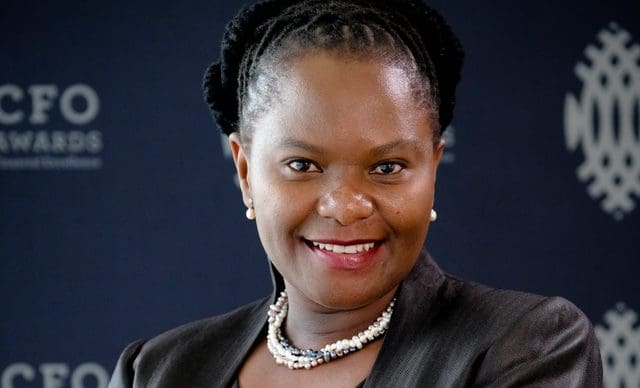 Nonkululeko Dlamini. Image source: CFO South Africa
The reason for hope lies in the research’s finding that our sense of national identity shines brightly, despite the more surprising and textured results the index reveals. South African national identification emerges as the strongest dimension of cohesion in the study, scoring 76.7 in the 2025 Index, with some 91.4% of respondents agreeing with the statement that “I am proud to be South African”.
This is not a variable that changes significantly across the country through different communities and classes of citizens – being South African is truly the glue that holds us together. It is evident that diversity is not an impediment to social cohesion of a higher order such as being a South African
While public discourse often emphasises our differences, this is an important truth to bear in mind. It provides a foundation on which stronger social cohesion can continue to develop.
We see how powerful our national identity can be when we celebrate together as our national sporting heroes bring us glory. Can it be so difficult for us to harness this passion and pride as we tackle issues of unemployment, poverty, and our other challenges too?
- Nonkululeko Dlamini is the Group Chief Financial Officer (CFO) and Executive Director of Telkom. Telkom sponsored the research of the Inclusive Society Institute, in collaboration with Constructor University, Bremen, Germany
추천 콘텐츠

The U.S. Department of Justice files civil forfeiture lawsuit for over $225 million in crypto fraud funds

Teens Cross 600 Miles To Rob Couple Of $66M In Crypto


