Polygon price continued its freefall, reaching its lowest level since April 21, as the broader crypto sell-off gained momentum. Polygon (POL) dropped to $0.1915, down 32% from its highest point in May and 74% below its 2024 peak. The crash…Polygon price continued its freefall, reaching its lowest level since April 21, as the broader crypto sell-off gained momentum. Polygon (POL) dropped to $0.1915, down 32% from its highest point in May and 74% below its 2024 peak. The crash…

Here’s why Polygon price is at risk of a 25% plunge

2025/06/19 00:56
2분 읽기

Polygon price continued its freefall, reaching its lowest level since April 21, as the broader crypto sell-off gained momentum.

Polygon (POL) dropped to $0.1915, down 32% from its highest point in May and 74% below its 2024 peak. The crash has pulled its market cap down from $5.68 billion at its peak to $2 billion today.

Polygon has underperformed the broader market due to rising competition in the layer-2 sector. Data shows it holds a total value locked of $1.17 billion and $2.3 billion in stablecoin supply. 

In contrast, Base, the Coinbase-backed layer-2 launched in 2023, has $5.14 billion in TVL and $4.16 billion in stablecoins. Similarly, Arbitrum (ARB) holds over $3 billion in assets and $3.5 billion in stablecoins.

Most importantly, Unichain, launched by Uniswap (UNI) in March, has already gained $1.12 billion in assets and $316 million in stablecoins.

The Polygon token has also tumbled following the shutdown of Polygon zkEVM, which was originally acquired as Hermes for $250 million. The CEO cited delayed technical execution, lack of product-market fit, and overly ambitious goals as key reasons for the decision.

On the positive side, Nansen data indicates that Polygon’s network activity is growing. The number of transactions jumped 33% over the past 30 days to 85.6 million, while active addresses rose 23% to 6.49 million.

Its transactions and addresses are higher than a popular network like Ethereum (ETH). Ethereum’s active addresses rose by 5.5%, while its transactions rose to over 34 million. 

Polygon price technical analysis
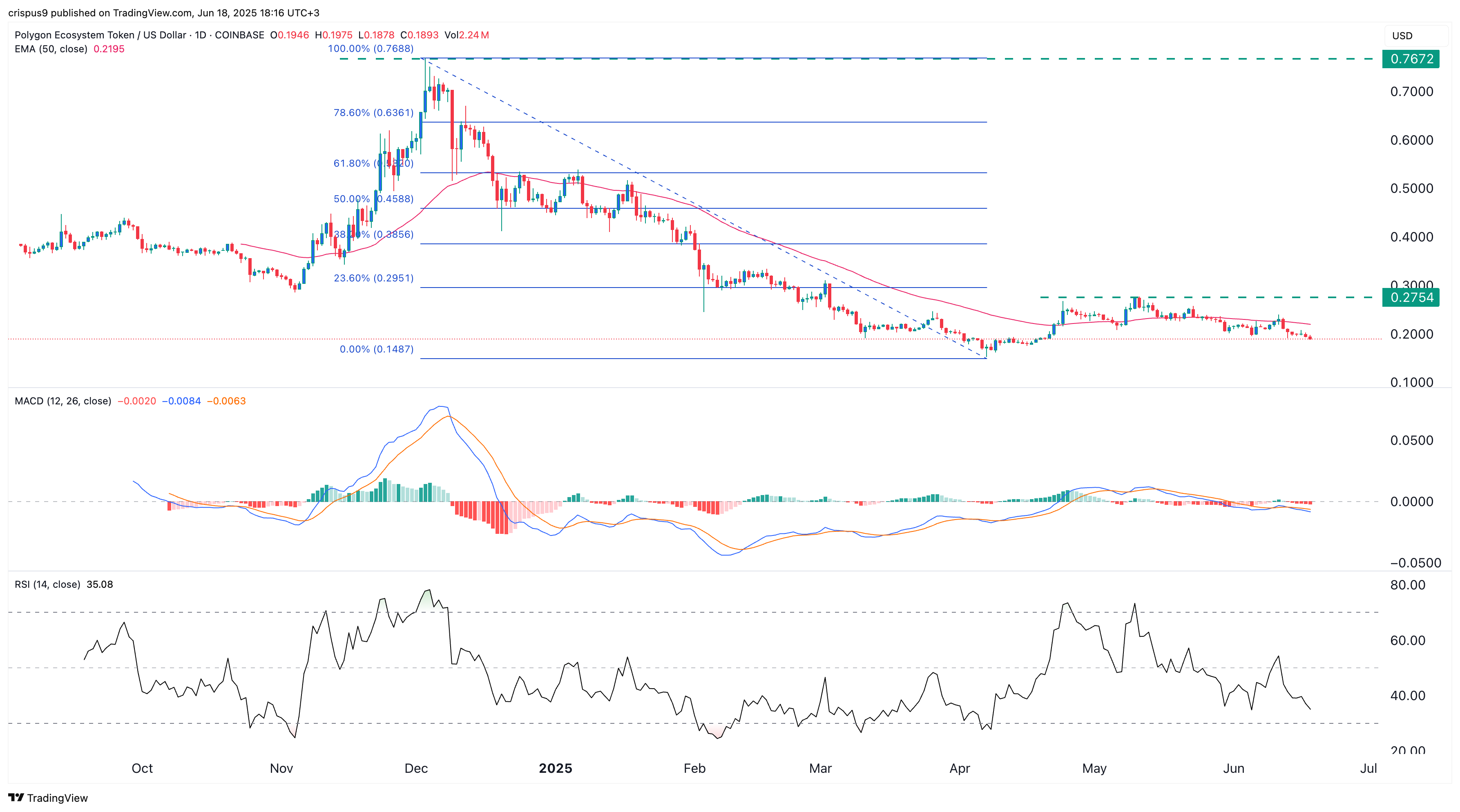
polygon price

On the daily chart, the POL token peaked at $0.7672 in December. It has since plunged below the 23.6% Fibonacci retracement level at $0.2950.

POL has also fallen below its 50-day moving average. Additionally, both the MACD and Relative Strength Index have continued to decline.

Therefore, the token will likely continue dropping as sellers target the year-to-date low of $0.1487—around 26% below the current level. A move above the 50% retracement level at $0.2195 would invalidate this bearish outlook.

시장 기회
Polygon Ecosystem 로고
Polygon Ecosystem 가격(POL)
$0,11098
$0,11098$0,11098
+0,94%
USD
Polygon Ecosystem (POL) 실시간 가격 차트
면책 조항: 본 사이트에 재게시된 글들은 공개 플랫폼에서 가져온 것으로 정보 제공 목적으로만 제공됩니다. 이는 반드시 MEXC의 견해를 반영하는 것은 아닙니다. 모든 권리는 원저자에게 있습니다. 제3자의 권리를 침해하는 콘텐츠가 있다고 판단될 경우, service@support.mexc.com으로 연락하여 삭제 요청을 해주시기 바랍니다. MEXC는 콘텐츠의 정확성, 완전성 또는 시의적절성에 대해 어떠한 보증도 하지 않으며, 제공된 정보에 기반하여 취해진 어떠한 조치에 대해서도 책임을 지지 않습니다. 본 콘텐츠는 금융, 법률 또는 기타 전문적인 조언을 구성하지 않으며, MEXC의 추천이나 보증으로 간주되어서는 안 됩니다.

추천 콘텐츠

The Channel Factories We’ve Been Waiting For

The Channel Factories We’ve Been Waiting For

The post The Channel Factories We’ve Been Waiting For appeared on BitcoinEthereumNews.com. Visions of future technology are often prescient about the broad strokes while flubbing the details. The tablets in “2001: A Space Odyssey” do indeed look like iPads, but you never see the astronauts paying for subscriptions or wasting hours on Candy Crush.  Channel factories are one vision that arose early in the history of the Lightning Network to address some challenges that Lightning has faced from the beginning. Despite having grown to become Bitcoin’s most successful layer-2 scaling solution, with instant and low-fee payments, Lightning’s scale is limited by its reliance on payment channels. Although Lightning shifts most transactions off-chain, each payment channel still requires an on-chain transaction to open and (usually) another to close. As adoption grows, pressure on the blockchain grows with it. The need for a more scalable approach to managing channels is clear. Channel factories were supposed to meet this need, but where are they? In 2025, subnetworks are emerging that revive the impetus of channel factories with some new details that vastly increase their potential. They are natively interoperable with Lightning and achieve greater scale by allowing a group of participants to open a shared multisig UTXO and create multiple bilateral channels, which reduces the number of on-chain transactions and improves capital efficiency. Achieving greater scale by reducing complexity, Ark and Spark perform the same function as traditional channel factories with new designs and additional capabilities based on shared UTXOs.  Channel Factories 101 Channel factories have been around since the inception of Lightning. A factory is a multiparty contract where multiple users (not just two, as in a Dryja-Poon channel) cooperatively lock funds in a single multisig UTXO. They can open, close and update channels off-chain without updating the blockchain for each operation. Only when participants leave or the factory dissolves is an on-chain transaction…
공유하기
BitcoinEthereumNews2025/09/18 00:09
Trump adviser demands Fed economists be 'disciplined' for arguing with presidential tactic

Trump adviser demands Fed economists be 'disciplined' for arguing with presidential tactic

President Donald Trump's longtime economic adviser Kevin Hassett suggested on CNBC Wednesday that the economists at the New York Fed who produced an analysis revealing
공유하기
Rawstory2026/02/18 22:59
Trump admin appeals after judge orders slavery exhibit returned to Philadelphia museum

Trump admin appeals after judge orders slavery exhibit returned to Philadelphia museum

President Donald Trump's Department of the Interior and its secretary, Doug Burgum, have appealed after Judge Cynthia Rufe invoked George Orwell's dystopian novel
공유하기
Rawstory2026/02/18 23:24