A decline in ERC-20 stablecoin supply is often interpreted as liquidity exiting the cryptocurrency market. However, on-chain data from CryptoQuant shows a differentA decline in ERC-20 stablecoin supply is often interpreted as liquidity exiting the cryptocurrency market. However, on-chain data from CryptoQuant shows a different

Stablecoin Liquidity Is Shifting Networks, Not Leaving Crypto

2026/01/29 07:23
3 min read
For feedback or concerns regarding this content, please contact us at crypto.news@mexc.com

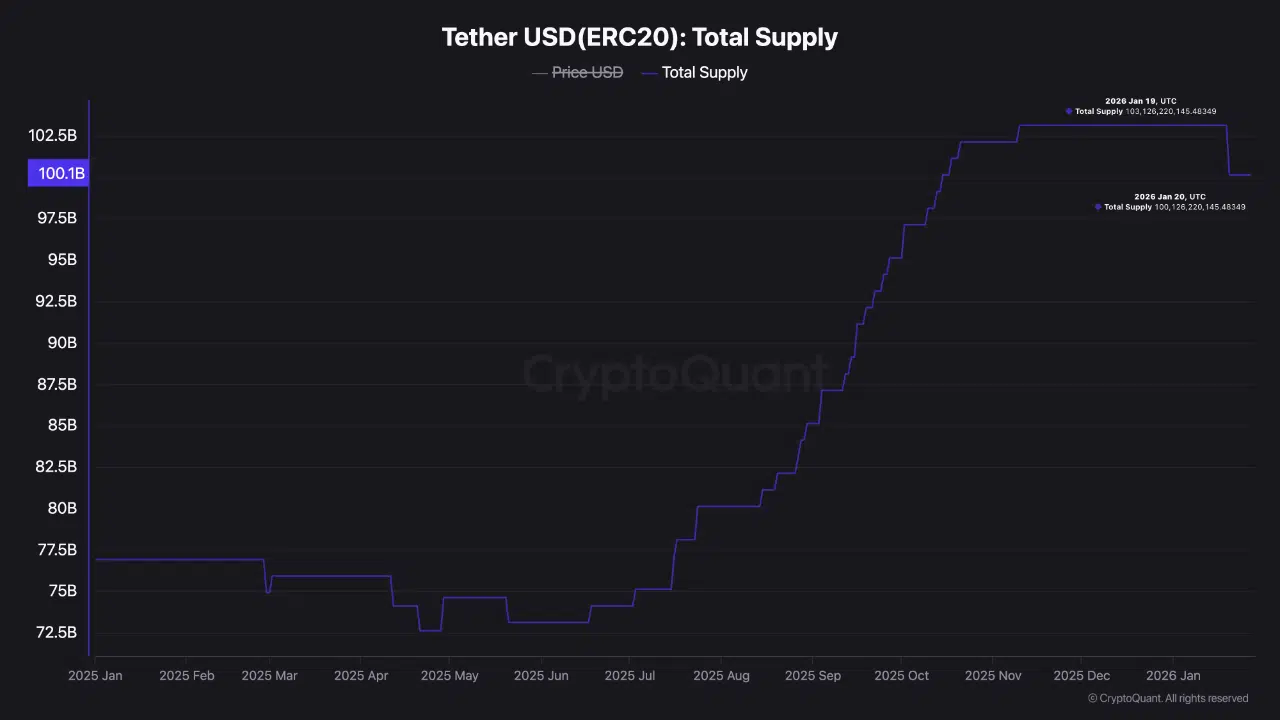
A decline in ERC-20 stablecoin supply is often interpreted as liquidity exiting the cryptocurrency market.

However, on-chain data from CryptoQuant shows a different dynamic unfolding in January 2026. Rather than leaving the system, stablecoin liquidity appears to be rotating across blockchain networks.

Stablecoin Supply Moves: January 19–20, 2026

On January 19 and 20, a clear divergence emerged between Ethereum and Tron stablecoin supplies.
On the Tron network, USDT supply increased sharply. Total TRC-20 USDT rose from 82,434,679,540 on January 19 to 83,434,679,540 on January 20, marking a net increase of $1 billion in a single day. This expansion was driven by a direct mint on Tron.

At the same time, Ethereum experienced a notable contraction in stablecoin balances. ERC-20 USDT supply declined by approximately $3.0 billion, while ERC-20 USDC fell by around $3.55 billion. Combined, this represents roughly $6.5 billion in stablecoins removed from Ethereum-based circulation.

The timing is critical. The increase in TRC-20 USDT followed immediately after the contraction on Ethereum, suggesting a coordinated liquidity shift rather than an isolated redemption event.

What the Flow Data Indicates

This pattern does not resemble a broad exit from crypto into fiat. Instead, it reflects a redistribution of liquidity across networks and use cases.

USDT is primarily used for derivatives trading, OTC settlement, and short-term tactical positioning. Because of this role, it frequently migrates to lower-cost networks where transaction efficiency is higher. Tron has increasingly served as a preferred rail for these functions.

USDC, by contrast, is more closely tied to spot market activity and on-chain settlement. As a result, changes in ERC-20 USDC supply tend to act as a clearer signal for spot demand conditions, particularly on Ethereum.

When both USDT and USDC decline on Ethereum while USDT simultaneously expands on Tron, the most straightforward interpretation is that liquidity is changing rails, not disappearing.

OKX Launches Stablecoin Card in Europe as MiCA Takes Effect

Market Implications

The data suggests that liquidity remains inside the crypto ecosystem, but its positioning has become more defensive. Demand for Ethereum-based settlement appears to be softening, while capital preference shifts toward derivatives-oriented and parked liquidity environments.

From a market perspective, falling ERC-20 stablecoin supply carries specific implications. It is bearish for Ethereum on-chain activity, neutral to bearish for spot-driven risk appetite, and not evidence of capital exiting crypto entirely.

Rather than signaling capitulation, the stablecoin flows point to structural reallocation, a rotation within crypto infrastructure driven by cost efficiency and evolving use cases.

The post Stablecoin Liquidity Is Shifting Networks, Not Leaving Crypto appeared first on ETHNews.

Disclaimer: The articles reposted on this site are sourced from public platforms and are provided for informational purposes only. They do not necessarily reflect the views of MEXC. All rights remain with the original authors. If you believe any content infringes on third-party rights, please contact crypto.news@mexc.com for removal. MEXC makes no guarantees regarding the accuracy, completeness, or timeliness of the content and is not responsible for any actions taken based on the information provided. The content does not constitute financial, legal, or other professional advice, nor should it be considered a recommendation or endorsement by MEXC.

You May Also Like

SEC Backs Nasdaq, CBOE, NYSE Push to Simplify Crypto ETF Rules

SEC Backs Nasdaq, CBOE, NYSE Push to Simplify Crypto ETF Rules

The US SEC on Wednesday approved new listing rules for major exchanges, paving the way for a surge of crypto spot exchange-traded funds. On Wednesday, the regulator voted to let Nasdaq, Cboe BZX and NYSE Arca adopt generic listing standards for commodity-based trust shares. The decision clears the final hurdle for asset managers seeking to launch spot ETFs tied to cryptocurrencies beyond Bitcoin and Ether. In July, the SEC outlined how exchanges could bring new products to market under the framework. Asset managers and exchanges must now meet specific criteria, but will no longer need to undergo drawn-out case-by-case reviews. Solana And XRP Funds Seen to Be First In Line Under the new system, the time from filing to launch can shrink to as little as 75 days, compared with up to 240 days or more under the old rules. “This is the crypto ETP framework we’ve been waiting for,” Bloomberg research analyst James Seyffart said on X, predicting a wave of new products in the coming months. The first filings likely to benefit are those tracking Solana and XRP, both of which have sat in limbo for more than a year. SEC Chair Paul Atkins said the approval reflects a commitment to reduce barriers and foster innovation while maintaining investor protections. The move comes under the administration of President Donald Trump, which has signaled strong support for digital assets after years of hesitation during the Biden era. New Standards Replace Lengthy Reviews And Repeated Denials Until now, the commission reviewed each application separately, requiring one filing from the exchange and another from the asset manager. This dual process often dragged on for months and led to repeated denials. Even Bitcoin spot ETFs, finally approved in Jan. 2024, arrived only after years of resistance and a legal battle with Grayscale. According to Bloomberg ETF analyst Eric Balchunas, the streamlined rules could apply to any cryptocurrency with at least six months of futures trading on the Coinbase Derivatives Exchange. That means more than a dozen tokens may now qualify for listing, potentially unleashing a new wave of altcoin ETFs. SEC Clears Grayscale Large Cap Fund Tracking CoinDesk 5 Index The SEC also approved the Grayscale Digital Large Cap Fund, which tracks the CoinDesk 5 Index, including Bitcoin, Ether, XRP, Solana and Cardano. Alongside this, it cleared the launch of options linked to the Cboe Bitcoin US ETF Index and its mini contract, broadening the set of crypto-linked derivatives on regulated US markets. Analysts say the shift shows how far US policy has moved. Where once regulators resisted digital assets, the latest changes show a growing willingness to bring them into the mainstream financial system under established safeguards
Share
CryptoNews2025/09/18 12:40
Visa Crypto Labs Launches Command-Line Tool for Secure AI Payments

Visa Crypto Labs Launches Command-Line Tool for Secure AI Payments

The post Visa Crypto Labs Launches Command-Line Tool for Secure AI Payments appeared on BitcoinEthereumNews.com. Visa Crypto Labs launches “Visa CLI,” a Command
Share
BitcoinEthereumNews2026/03/19 19:06
Trump just shattered an economic record — and it's catastrophic

Trump just shattered an economic record — and it's catastrophic

Under President Donald Trump, the United States national debt crossed $39 trillion for the first time as of Tuesday — meaning that it has grown by $1 trillion since
Share
Alternet2026/03/19 18:14
