Publicly listed crypto treasuries are turning defensive as market volatility prompts a wave of corporate share buybacks across the digital asset treasury (DAT) sector. Recently, Nasdaq-listed Upexi has authorized a $50 million share repurchase program, showing a broader shift toward capital preservation even as firms continue to hold massive Solana reserves on their balance sheets. Upexi Greenlights Share Buyback Amid 47% Stock Drop Upexi, a Solana-focused digital asset treasury company and consumer brands operator, said its board approved the buyback to provide “flexibility to purchase shares in the open market” depending on market conditions. The company emphasized that the program reflects confidence in its long-term strategy while maintaining a strong treasury position. The CEO, Allan Marshall, also added that the repurchase is a tool to enhance shareholder value and will be executed only when returns are attractive. The company’s treasury holds roughly 2 million SOL, valued at $283 million, representing about 0.35% of Solana’s total supply.Source: Sol Treasury Despite a recent decline in Solana’s price, from about $143 to $134, Upexi’s on-chain reserves remain among the largest institutional holdings in the ecosystem. The firm’s crypto-backed position has, however, been mirrored by sharp volatility in its own stock, which has fallen nearly 47% over the past month from a high of $6.50 to around $3.43.Source: Sol Treasury Upexi’s move comes amid a turbulent period for Solana-linked treasuries. According to institutional reserve data, the top 20 Solana treasury and ETF holders control 24 million SOL worth about $3.4 billion, or 3.5% of the total supply.Source: Sol Treasury Around half of these holdings are staked for yield at an average return of 7.7%, while the remainder remains liquid for balance sheet management. Forward Industries (FORD) leads with 6.8 million SOL valued near $966 million, followed by Solana Company (HSDT), DeFi Development Corp (DFDV), Sharps Technology (STSS), and Upexi rounding out the top five. These firms account for roughly 76% of all institutional Solana holdings, showing how companies use digital assets strategically. Solana Treasury Firms Trade Below Asset Value as Institutions Maintain Positions Market data shows that despite Solana’s price drop of nearly 7% in 24 hours, institutional positions have largely remained intact, with no major liquidations reported. Analysts view this stability as a sign of long-term confidence in Solana’s network fundamentals and its growing role as a blockchain for corporate treasuries. Public market valuations differ. Most Solana treasuries are currently trading at a discount to their net asset value (mNAV), indicating investor caution Upexi’s mNAV stands at 0.68, while Forward Industries sits at 0.82, suggesting cautious sentiment in equity markets despite strong on-chain balance sheets. The divergence between treasury value and stock performance has been a defining feature of the DAT sector. Upexi, which reported $66.7 million in net income in its most recent quarter, driven largely by $78 million in unrealized Solana gains, still faces investor skepticism tied to broader crypto market swings. Its stock previously surged more than 600% after revealing its Solana strategy earlier this year, but has since retraced sharply as digital assets weakened. Other treasuries act similarly. On November 6, Forward Industries authorized a $1 billion share repurchase program for flexibility amid volatility. Despite the short-term pullback in prices, the overall trend in corporate Solana holdings remains upward. The rise of Solana-focused treasuries marks an evolution from the Bitcoin treasury strategies that dominated earlier cycles. These firms use Solana not only as a store of value but also as a yield-generating asset through staking and validator participation. Companies like DFDV, which stakes its entire 2.2 million SOL holding, illustrate how treasury management in crypto is becoming more active and income-drivenPublicly listed crypto treasuries are turning defensive as market volatility prompts a wave of corporate share buybacks across the digital asset treasury (DAT) sector. Recently, Nasdaq-listed Upexi has authorized a $50 million share repurchase program, showing a broader shift toward capital preservation even as firms continue to hold massive Solana reserves on their balance sheets. Upexi Greenlights Share Buyback Amid 47% Stock Drop Upexi, a Solana-focused digital asset treasury company and consumer brands operator, said its board approved the buyback to provide “flexibility to purchase shares in the open market” depending on market conditions. The company emphasized that the program reflects confidence in its long-term strategy while maintaining a strong treasury position. The CEO, Allan Marshall, also added that the repurchase is a tool to enhance shareholder value and will be executed only when returns are attractive. The company’s treasury holds roughly 2 million SOL, valued at $283 million, representing about 0.35% of Solana’s total supply.Source: Sol Treasury Despite a recent decline in Solana’s price, from about $143 to $134, Upexi’s on-chain reserves remain among the largest institutional holdings in the ecosystem. The firm’s crypto-backed position has, however, been mirrored by sharp volatility in its own stock, which has fallen nearly 47% over the past month from a high of $6.50 to around $3.43.Source: Sol Treasury Upexi’s move comes amid a turbulent period for Solana-linked treasuries. According to institutional reserve data, the top 20 Solana treasury and ETF holders control 24 million SOL worth about $3.4 billion, or 3.5% of the total supply.Source: Sol Treasury Around half of these holdings are staked for yield at an average return of 7.7%, while the remainder remains liquid for balance sheet management. Forward Industries (FORD) leads with 6.8 million SOL valued near $966 million, followed by Solana Company (HSDT), DeFi Development Corp (DFDV), Sharps Technology (STSS), and Upexi rounding out the top five. These firms account for roughly 76% of all institutional Solana holdings, showing how companies use digital assets strategically. Solana Treasury Firms Trade Below Asset Value as Institutions Maintain Positions Market data shows that despite Solana’s price drop of nearly 7% in 24 hours, institutional positions have largely remained intact, with no major liquidations reported. Analysts view this stability as a sign of long-term confidence in Solana’s network fundamentals and its growing role as a blockchain for corporate treasuries. Public market valuations differ. Most Solana treasuries are currently trading at a discount to their net asset value (mNAV), indicating investor caution Upexi’s mNAV stands at 0.68, while Forward Industries sits at 0.82, suggesting cautious sentiment in equity markets despite strong on-chain balance sheets. The divergence between treasury value and stock performance has been a defining feature of the DAT sector. Upexi, which reported $66.7 million in net income in its most recent quarter, driven largely by $78 million in unrealized Solana gains, still faces investor skepticism tied to broader crypto market swings. Its stock previously surged more than 600% after revealing its Solana strategy earlier this year, but has since retraced sharply as digital assets weakened. Other treasuries act similarly. On November 6, Forward Industries authorized a $1 billion share repurchase program for flexibility amid volatility. Despite the short-term pullback in prices, the overall trend in corporate Solana holdings remains upward. The rise of Solana-focused treasuries marks an evolution from the Bitcoin treasury strategies that dominated earlier cycles. These firms use Solana not only as a store of value but also as a yield-generating asset through staking and validator participation. Companies like DFDV, which stakes its entire 2.2 million SOL holding, illustrate how treasury management in crypto is becoming more active and income-driven

Crypto Treasuries Turn Defensive as Solana Upexi’s Buyback Adds to Growing DAT Trend

2025/11/14 07:00
4 min read
For feedback or concerns regarding this content, please contact us at crypto.news@mexc.com

Publicly listed crypto treasuries are turning defensive as market volatility prompts a wave of corporate share buybacks across the digital asset treasury (DAT) sector.

Recently, Nasdaq-listed Upexi has authorized a $50 million share repurchase program, showing a broader shift toward capital preservation even as firms continue to hold massive Solana reserves on their balance sheets.

Upexi Greenlights Share Buyback Amid 47% Stock Drop

Upexi, a Solana-focused digital asset treasury company and consumer brands operator, said its board approved the buyback to provide “flexibility to purchase shares in the open market” depending on market conditions.

The company emphasized that the program reflects confidence in its long-term strategy while maintaining a strong treasury position.

The CEO, Allan Marshall, also added that the repurchase is a tool to enhance shareholder value and will be executed only when returns are attractive.

The company’s treasury holds roughly 2 million SOL, valued at $283 million, representing about 0.35% of Solana’s total supply.
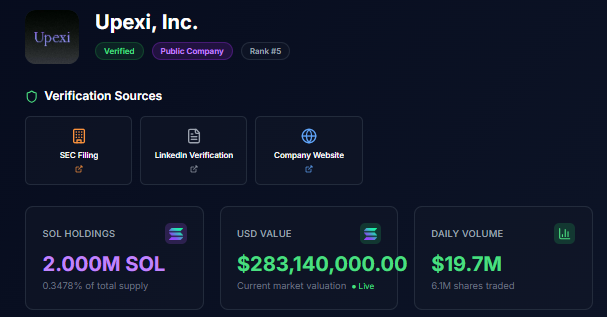
Source: Sol Treasury

Despite a recent decline in Solana’s price, from about $143 to $134, Upexi’s on-chain reserves remain among the largest institutional holdings in the ecosystem.

The firm’s crypto-backed position has, however, been mirrored by sharp volatility in its own stock, which has fallen nearly 47% over the past month from a high of $6.50 to around $3.43.

Source: Sol Treasury

Upexi’s move comes amid a turbulent period for Solana-linked treasuries. According to institutional reserve data, the top 20 Solana treasury and ETF holders control 24 million SOL worth about $3.4 billion, or 3.5% of the total supply.

Source: Sol Treasury

Around half of these holdings are staked for yield at an average return of 7.7%, while the remainder remains liquid for balance sheet management.

Forward Industries (FORD) leads with 6.8 million SOL valued near $966 million, followed by Solana Company (HSDT), DeFi Development Corp (DFDV), Sharps Technology (STSS), and Upexi rounding out the top five.

These firms account for roughly 76% of all institutional Solana holdings, showing how companies use digital assets strategically.

Solana Treasury Firms Trade Below Asset Value as Institutions Maintain Positions

Market data shows that despite Solana’s price drop of nearly 7% in 24 hours, institutional positions have largely remained intact, with no major liquidations reported.

Analysts view this stability as a sign of long-term confidence in Solana’s network fundamentals and its growing role as a blockchain for corporate treasuries.

Public market valuations differ. Most Solana treasuries are currently trading at a discount to their net asset value (mNAV), indicating investor caution

Upexi’s mNAV stands at 0.68, while Forward Industries sits at 0.82, suggesting cautious sentiment in equity markets despite strong on-chain balance sheets.

The divergence between treasury value and stock performance has been a defining feature of the DAT sector.

Upexi, which reported $66.7 million in net income in its most recent quarter, driven largely by $78 million in unrealized Solana gains, still faces investor skepticism tied to broader crypto market swings.

Its stock previously surged more than 600% after revealing its Solana strategy earlier this year, but has since retraced sharply as digital assets weakened.

Other treasuries act similarly. On November 6, Forward Industries authorized a $1 billion share repurchase program for flexibility amid volatility.

Despite the short-term pullback in prices, the overall trend in corporate Solana holdings remains upward.

The rise of Solana-focused treasuries marks an evolution from the Bitcoin treasury strategies that dominated earlier cycles.

These firms use Solana not only as a store of value but also as a yield-generating asset through staking and validator participation.

Companies like DFDV, which stakes its entire 2.2 million SOL holding, illustrate how treasury management in crypto is becoming more active and income-driven.

Disclaimer: The articles reposted on this site are sourced from public platforms and are provided for informational purposes only. They do not necessarily reflect the views of MEXC. All rights remain with the original authors. If you believe any content infringes on third-party rights, please contact crypto.news@mexc.com for removal. MEXC makes no guarantees regarding the accuracy, completeness, or timeliness of the content and is not responsible for any actions taken based on the information provided. The content does not constitute financial, legal, or other professional advice, nor should it be considered a recommendation or endorsement by MEXC.

You May Also Like

UK crypto holders brace for FCA’s expanded regulatory reach

UK crypto holders brace for FCA’s expanded regulatory reach

The post UK crypto holders brace for FCA’s expanded regulatory reach appeared on BitcoinEthereumNews.com. British crypto holders may soon face a very different landscape as the Financial Conduct Authority (FCA) moves to expand its regulatory reach in the industry. A new consultation paper outlines how the watchdog intends to apply its rulebook to crypto firms, shaping everything from asset safeguarding to trading platform operation. According to the financial regulator, these proposals would translate into clearer protections for retail investors and stricter oversight of crypto firms. UK FCA plans Until now, UK crypto users mostly encountered the FCA through rules on promotions and anti-money laundering checks. The consultation paper goes much further. It proposes direct oversight of stablecoin issuers, custodians, and crypto-asset trading platforms (CATPs). For investors, that means the wallets, exchanges, and coins they rely on could soon be subject to the same governance and resilience standards as traditional financial institutions. The regulator has also clarified that firms need official authorization before serving customers. This condition should, in theory, reduce the risk of sudden platform failures or unclear accountability. David Geale, the FCA’s executive director of payments and digital finance, said the proposals are designed to strike a balance between innovation and protection. He explained: “We want to develop a sustainable and competitive crypto sector – balancing innovation, market integrity and trust.” Geale noted that while the rules will not eliminate investment risks, they will create consistent standards, helping consumers understand what to expect from registered firms. Why does this matter for crypto holders? The UK regulatory framework shift would provide safer custody of assets, better disclosure of risks, and clearer recourse if something goes wrong. However, the regulator was also frank in its submission, arguing that no rulebook can eliminate the volatility or inherent risks of holding digital assets. Instead, the focus is on ensuring that when consumers choose to invest, they do…
Share
BitcoinEthereumNews2025/09/17 23:52
Dogecoin Price Prediction For 2025, As Analysts Call Pepeto The Next 100x

Dogecoin Price Prediction For 2025, As Analysts Call Pepeto The Next 100x

Traders hunting the best crypto to buy now and the best crypto investment in 2025 keep watching doge, yet today’s […] The post Dogecoin Price Prediction For 2025, As Analysts Call Pepeto The Next 100x appeared first on Coindoo.
Share
Coindoo2025/09/18 00:39
Vistra (VST) Stock Drops 7% as Insider Sales Spook the Market

Vistra (VST) Stock Drops 7% as Insider Sales Spook the Market

TLDR Vistra (VST) stock fell as much as 7.16% as investors reacted to heavy insider selling by the CEO and top executives filed with the SEC. The stock also hit
Share
Coincentral2026/03/21 01:25