This article applies a free and fair economy model to analyze pure exchange economies and markets with transferable payoff.This article applies a free and fair economy model to analyze pure exchange economies and markets with transferable payoff.

Game Theory and Exchange Economies: A New Model for Pure Exchange and Transferable Payoff

Abstract and 1. Introduction

  1. A free and fair economy: definition, existence and uniqueness

    2.1 A free economy

    2.2 A free and fair economy

  2. Equilibrium existence in a free and fair economy

    3.1 A free and fair economy as a strategic form game

    3.2 Existence of an equilibrium

  3. Equilibrium efficiency in a free and fair economy

  4. A free economy with social justice and inclusion

    5.1 Equilibrium existence and efficiency in a free economy with social justice

    5.2 Choosing a reference point to achieve equilibrium efficiency

  5. Some applications

    6.1 Teamwork: surplus distribution in a firm

    6.2 Contagion and self-enforcing lockdown in a networked economy

    6.3 Bias in academic publishing

    6.4 Exchange economies

  6. Contributions to the closely related literature

  7. Conclusion and References

Appendix

6.4 Exchange economies

In this section, we apply our theory to pure exchange economies (Section 6.4.1) and markets with transferable payoff (Section 6.4.2).

\ 6.4.1 Pure exchange economies

\
\
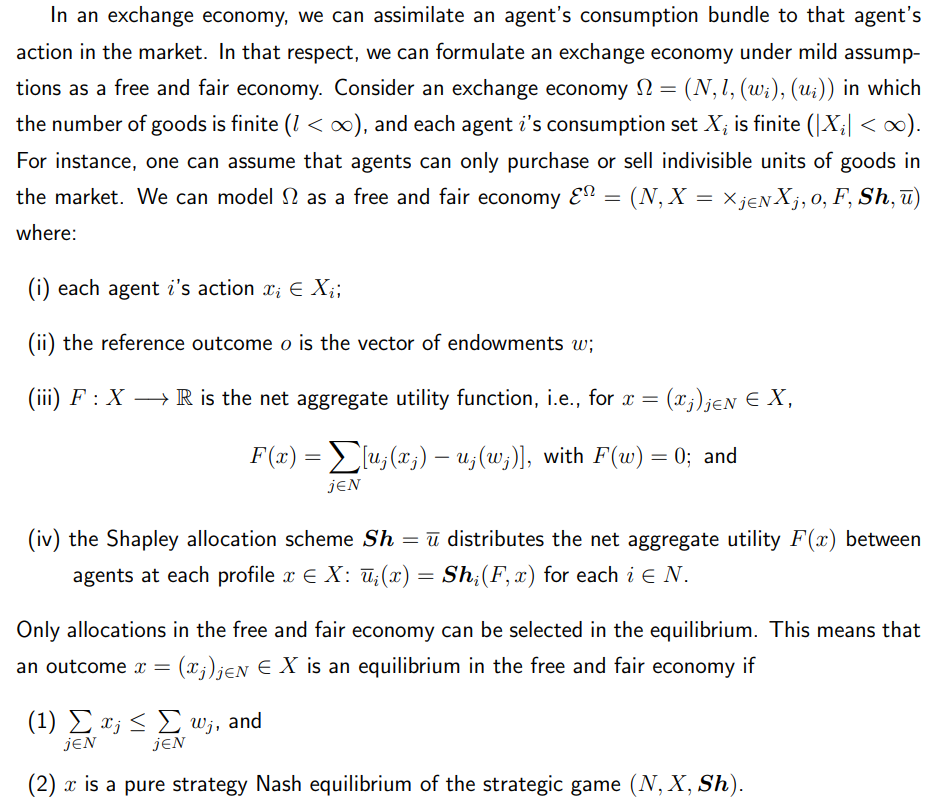
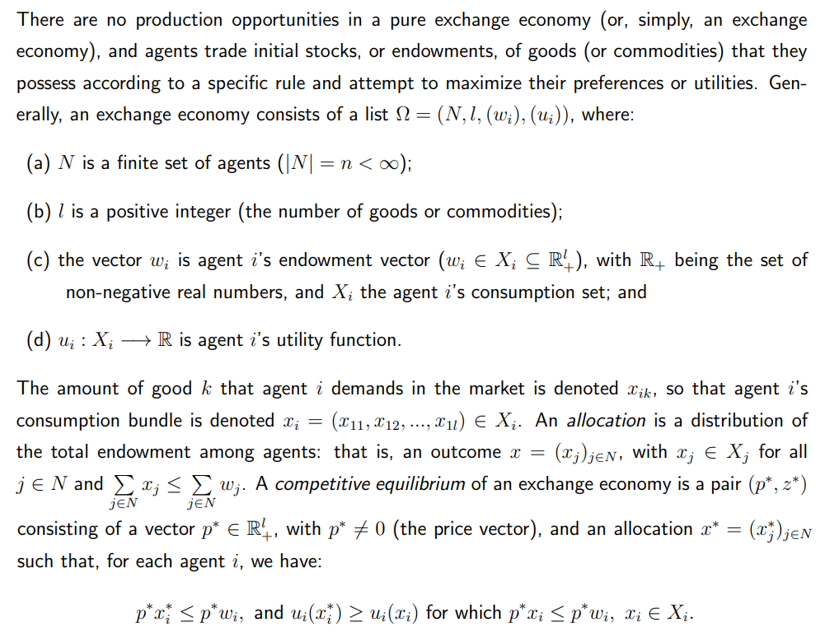
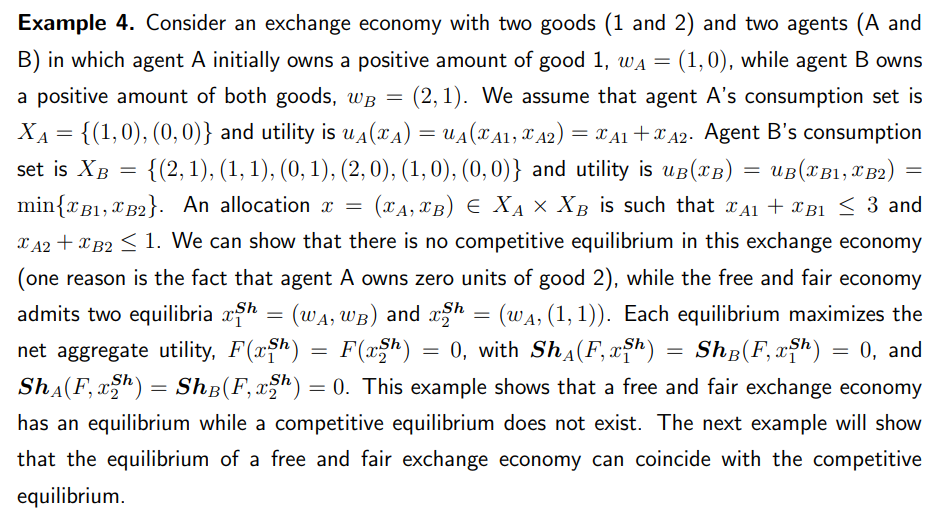
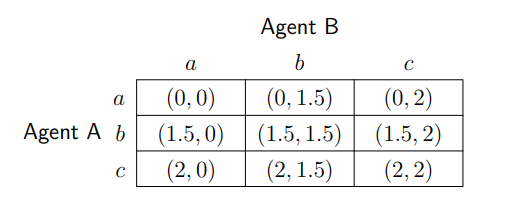
\ Our model differs from the exchange economy in at least two important respects. First, the incentive mechanism is different. Second, the equilibrium prediction from free exchanges between agents in both economies is different in general. A competitive equilibrium exists in an exchange economy when some assumptions exist on agents’ utilities and endowments. For instance, when utilities are continuous, strictly increasing, and quasi-concave and each agent initially owns a positive amount of each good in the market, a competitive equilibrium exists, and many equilibria might arise. However, under such assumptions on agents’ utilities, the net aggregate utility function F is strictly increasing, and thanks to Theorem 2, the free and fair economy admits a unique equilibrium. Additionally, it is not necessary to impose any assumptions on utilities and endowments to guarantee the existence of an equilibrium in a free and fair economy. We illustrate these points in the following examples.

\
\
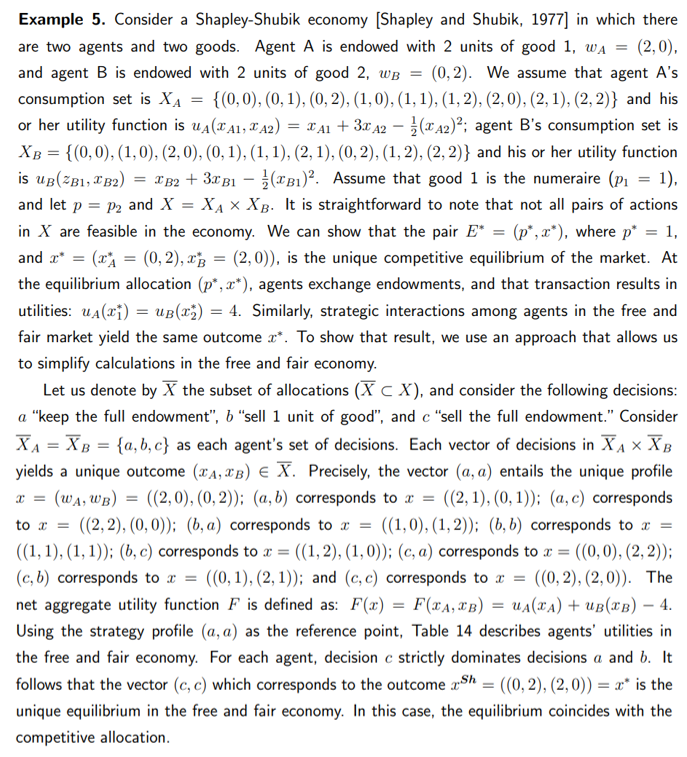
\ Table 14: Utilities in the free and fair economy
\ 6.4.2 Markets with transferable payoff

\
\
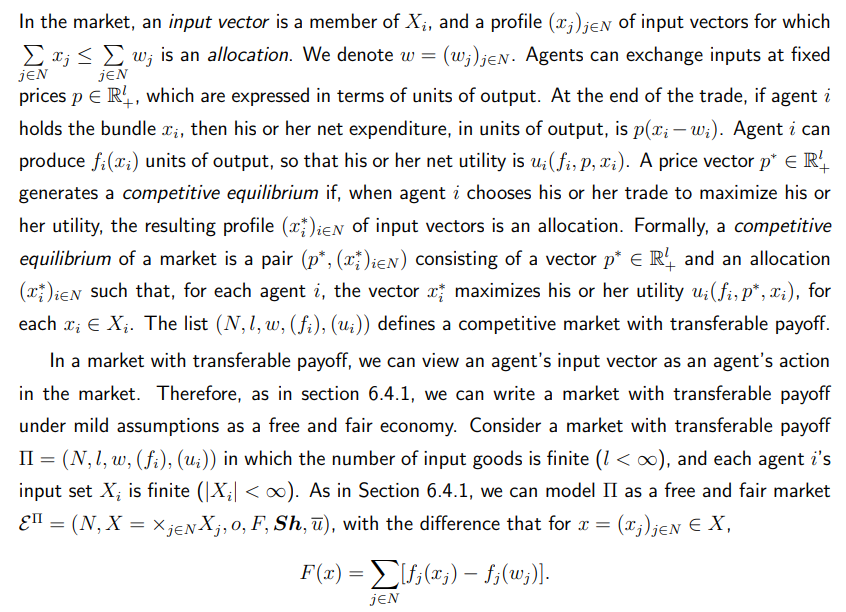
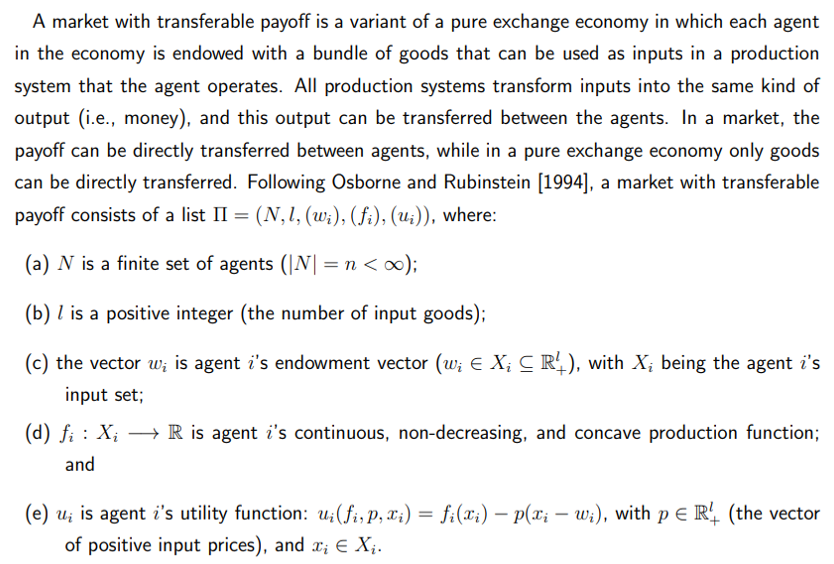
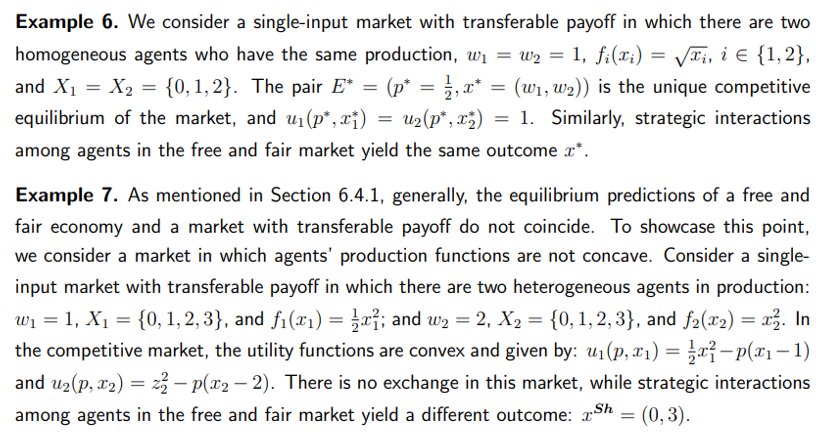
\ As in the analysis in section 6.4.1 below, we provide examples that show similarities (Example 6) and differences (Example 7) between the predictions of free and fair markets and markets with transferable payoff.

\
\

:::info Authors:

(1) Ghislain H. Demeze-Jouatsa, Center for Mathematical Economics, University of Bielefeld (demeze jouatsa@uni-bielefeld.de);

(2) Roland Pongou, Department of Economics, University of Ottawa (rpongou@uottawa.ca);

(3) Jean-Baptiste Tondji, Department of Economics and Finance, The University of Texas Rio Grande Valley (jeanbaptiste.tondji@utrgv.edu).

:::


:::info This paper is available on arxiv under CC BY 4.0 DEED license.

:::

\

Disclaimer: The articles reposted on this site are sourced from public platforms and are provided for informational purposes only. They do not necessarily reflect the views of MEXC. All rights remain with the original authors. If you believe any content infringes on third-party rights, please contact service@support.mexc.com for removal. MEXC makes no guarantees regarding the accuracy, completeness, or timeliness of the content and is not responsible for any actions taken based on the information provided. The content does not constitute financial, legal, or other professional advice, nor should it be considered a recommendation or endorsement by MEXC.

You May Also Like

Fed forecasts only one rate cut in 2026, a more conservative outlook than expected

Fed forecasts only one rate cut in 2026, a more conservative outlook than expected

The post Fed forecasts only one rate cut in 2026, a more conservative outlook than expected appeared on BitcoinEthereumNews.com. Federal Reserve Chairman Jerome Powell talks to reporters following the regular Federal Open Market Committee meetings at the Fed on July 30, 2025 in Washington, DC. Chip Somodevilla | Getty Images The Federal Reserve is projecting only one rate cut in 2026, fewer than expected, according to its median projection. The central bank’s so-called dot plot, which shows 19 individual members’ expectations anonymously, indicated a median estimate of 3.4% for the federal funds rate at the end of 2026. That compares to a median estimate of 3.6% for the end of this year following two expected cuts on top of Wednesday’s reduction. A single quarter-point reduction next year is significantly more conservative than current market pricing. Traders are currently pricing in at two to three more rate cuts next year, according to the CME Group’s FedWatch tool, updated shortly after the decision. The gauge uses prices on 30-day fed funds futures contracts to determine market-implied odds for rate moves. Here are the Fed’s latest targets from 19 FOMC members, both voters and nonvoters: Zoom In IconArrows pointing outwards The forecasts, however, showed a large difference of opinion with two voting members seeing as many as four cuts. Three officials penciled in three rate reductions next year. “Next year’s dot plot is a mosaic of different perspectives and is an accurate reflection of a confusing economic outlook, muddied by labor supply shifts, data measurement concerns, and government policy upheaval and uncertainty,” said Seema Shah, chief global strategist at Principal Asset Management. The central bank has two policy meetings left for the year, one in October and one in December. Economic projections from the Fed saw slightly faster economic growth in 2026 than was projected in June, while the outlook for inflation was updated modestly higher for next year. There’s a lot of uncertainty…
Share
BitcoinEthereumNews2025/09/18 02:59
Steve Sosnick Reflects on Silver in Market Rumblings

Steve Sosnick Reflects on Silver in Market Rumblings

Steve Sosnick discusses silver's 'meme stock' behavior amid market shifts and alternative asset trends.Read more...
Share
Coinstats2026/02/02 03:14
Justin Sun Manipulated the Market with Binance, Ex-Girlfriend Says

Justin Sun Manipulated the Market with Binance, Ex-Girlfriend Says

The post Justin Sun Manipulated the Market with Binance, Ex-Girlfriend Says appeared on BitcoinEthereumNews.com. Tron founder Justin Sun faces renewed scrutiny
Share
BitcoinEthereumNews2026/02/02 02:55