

Cardano’s Founder Admits the Brand Is Damaged Beyond Repair – Can ADA Survive?
Cardano is facing one of its most difficult periods in years, and the latest comments from founder Charles Hoskinson have brought that reality into focus. A discussion shared by Cheeky Crypto revealed a surprisingly candid assessment of the challenges surrounding Cardano, its reputation, and its future direction.
The comments arrived at a time when several important projects have disappeared from the ecosystem, governance disputes have intensified, and Cardano’s decentralized finance activity remains far below previous highs. That combination has created an important question for ADA holders and observers alike: can Cardano reinvent itself before these challenges become even harder to overcome?
Charles Hoskinson did not hold back when discussing the state of the cryptocurrency industry and Cardano’s place within it.
Speaking about the broader sector, Hoskinson argued that cryptocurrency has become associated with meme coins, NFT speculation, scams, project collapses, and controversial token launches. He stated that the industry’s brand has become damaged beyond repair and suggested Cardano must find a way to move beyond the traditional cryptocurrency narrative.
Hoskinson explained that Cardano needs to become something fundamentally different. He pointed to newer initiatives such as Midnight as examples of projects that may help the ecosystem move in a new direction.
His remarks suggest that Cardano’s leadership no longer believes the old Layer 1 blockchain strategy alone is enough to secure the network’s future. Instead, the focus appears to be moving toward new products, new use cases, and a broader identity that extends beyond the cryptocurrency sector.
That message carries particular weight because it comes directly from the person who helped create the network. It also arrives during a period when Cardano faces several internal challenges that continue to test the ecosystem.
Cardano Ecosystem Faces Project Closures And Governance Challenges
Recent developments show that Cardano’s difficulties extend beyond public perception.
Several major projects have either closed or struggled to maintain operations. JPG Store, which served as Cardano’s largest NFT marketplace, shut down operations. TapTools, one of the ecosystem’s best known analytics and token tracking platforms, also ceased operations within the same period.
Project founders pointed to rising infrastructure costs and business sustainability concerns as major reasons behind these decisions. Hoskinson has previously warned that these closures could represent early signs of broader problems across the ecosystem.
Governance has become another area of concern. Following the Voltaire upgrade, responsibility for treasury decisions moved to decentralized representatives known as DReps. The system was designed to increase community participation, yet several important funding proposals have struggled to secure enough support.
One of the most notable examples came when the Cardano Summit 2026 was canceled after a treasury proposal failed to achieve the required 66.67% approval threshold. Research funding proposals have also encountered resistance, creating friction between technical development goals and community voting outcomes.
Liquidity metrics present another challenge.
Cardano has spent years attempting to strengthen its DeFi ecosystem, yet activity remains well below levels seen on many competing blockchains. Total Value Locked has fallen dramatically from late 2024 highs. Current figures remain below $100 million, which places Cardano outside the top 20 blockchain networks by TVL.
These issues help explain why Hoskinson believes major changes may be necessary.
ADA Price Recovery Continues Despite Fundamental Concerns
Despite the challenges surrounding the ecosystem, ADA price action has shown signs of improvement over the past several days.
Cardano has climbed roughly 20% during the last 10 days, mirroring recovery moves seen across many large cryptocurrencies. That rebound suggests buyers are still willing to step into the market after recent weakness.
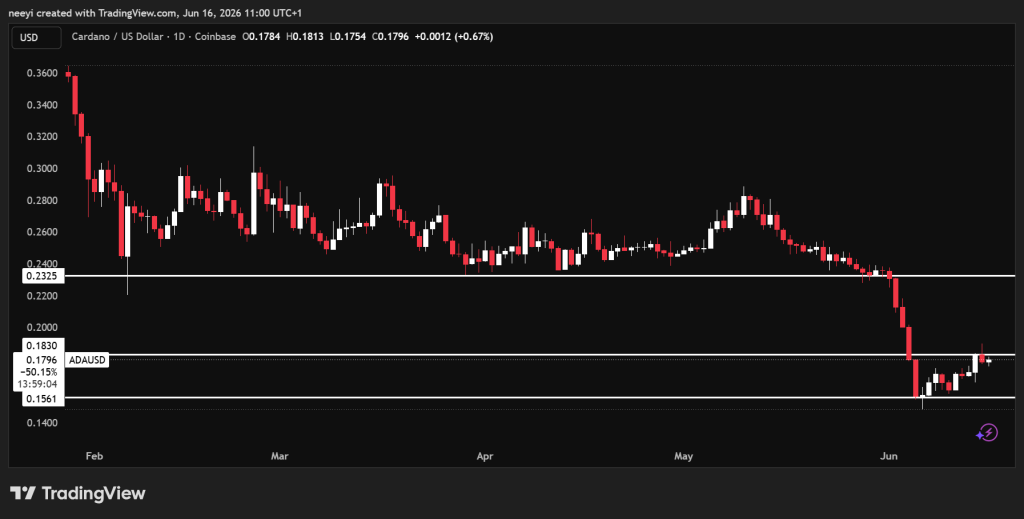 ADA Price Chart / TradingView.com
A look at the ADA chart shows that the token remains far below a major resistance zone near $0.23. The current ADA price is around $0.179.
A move from $0.179 to $0.23 would represent roughly a 30% increase. Such a move would require buyers to maintain recent strength and overcome selling pressure near key resistance levels.
Failure to break that barrier could leave ADA vulnerable to another period of consolidation or renewed weakness.
Technical Indicators Show ADA Could Move In Either Direction
Most of Cardano’s key oscillators currently present a neutral outlook.
Neutral readings often indicate that neither buyers nor sellers have established clear control of the market. This creates conditions where future price movement can develop in either direction depending on broader market sentiment and incoming news.
The MACD indicator currently shows a buy signal, which points to improving momentum. Bull Bear Power remains on a sell signal, which suggests some underlying weakness still exists.
Read Also: Here’s Why Stellar (XLM) Price Is Pumping
Other major indicators remain balanced between bullish and bearish conditions.
| Name | Value | Action |
|---|---|---|
| Relative Strength Index (14) | 38.261669 | Neutral |
| Stochastic %K (14, 3, 3) | 39.797577 | Neutral |
| Average Directional Index (14) | 41.140608 | Neutral |
| MACD Level (12, 26) | -0.017053 | Buy |
| Bull Bear Power | -0.004468 | Sell |
| Ultimate Oscillator (7, 14, 28) | 49.175565 | Neutral |
These readings show that ADA has not yet established a strong directional trend. Market participants will likely watch whether the current recovery can continue toward the important $0.23 resistance area.
FAQs
Subscribe to our YouTube channel for daily crypto updates, market insights, and expert analysis.
The post Cardano’s Founder Admits the Brand Is Damaged Beyond Repair – Can ADA Survive? appeared first on CaptainAltcoin.


You May Also Like

Mixin Launches Mixin Cash Bank Accounts, Simplifying Fund Movement Between Traditional Banking and Stablecoins

Elon Musk Just Made More Money in 6.5 Hours Than Warren Buffett Made in His Entire Life.

DoiT Expands PartnerOps Platform as Distributor and Hyperscaler Demand Accelerates



