TRM has published new research showing that North Korea-linked actors were responsible for more than half of the US$2.7 billion stolen in cryptocurrency hacks inTRM has published new research showing that North Korea-linked actors were responsible for more than half of the US$2.7 billion stolen in cryptocurrency hacks in

North Korea Linked to Over Half of 2025 Crypto Heist Losses

TRM has published new research showing that North Korea-linked actors were responsible for more than half of the US$2.7 billion stolen in cryptocurrency hacks in 2025, marking the regime as the single most dominant and sophisticated threat actor in the crypto theft ecosystem.

For years, North Korea has used crypto theft to fund weapons proliferation, evade sanctions, and pursue destabilising activities.

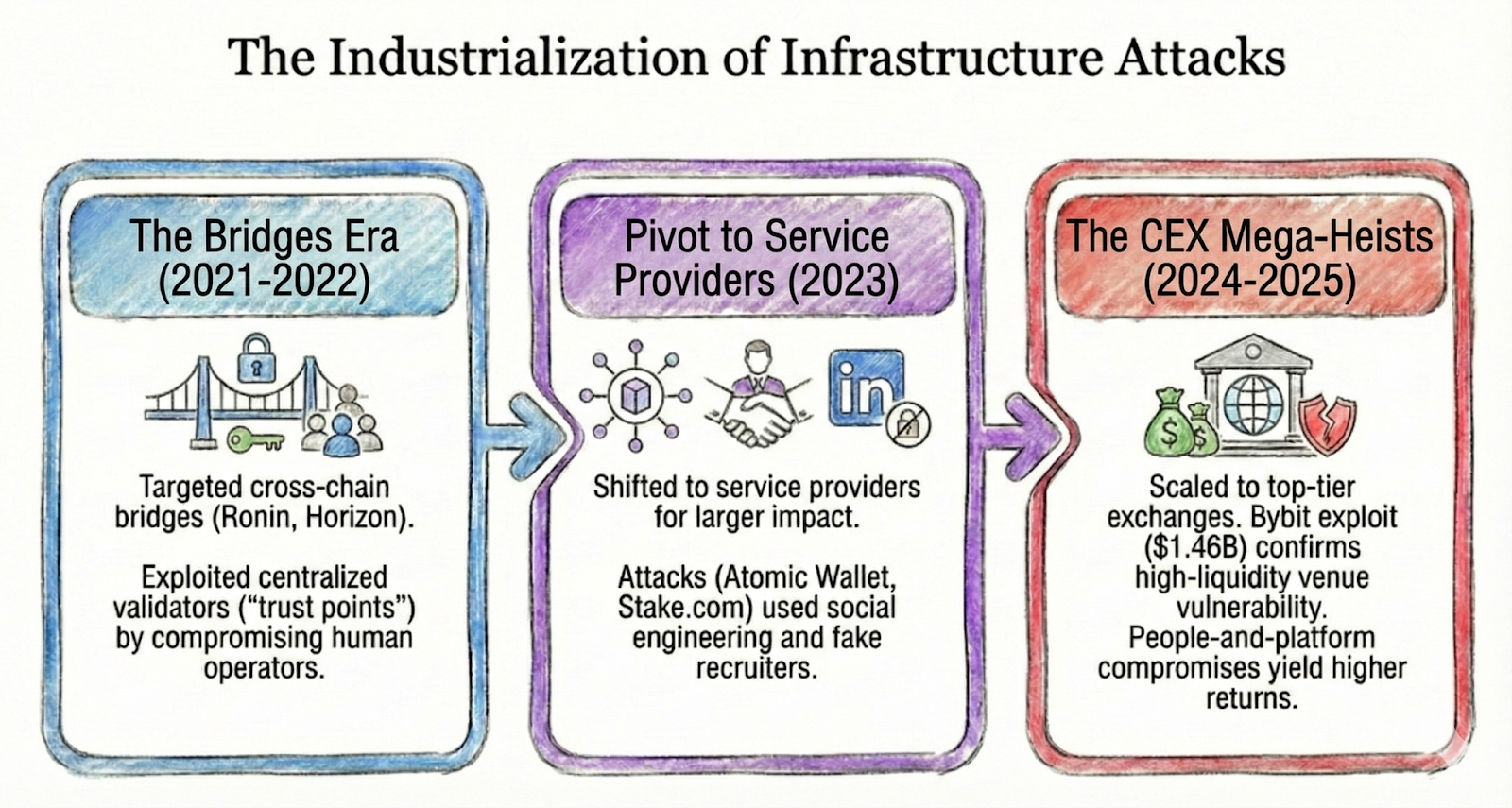
Notably, high-value heists in 2023–2025 have shifted from exploiting smart-contract flaws to targeting the operational infrastructure of exchanges and custodial services. Single points of failure in these systems allow access to large sums.
Source: TRMSource: TRM

TRM attributes several major incidents to the regime, including Atomic Wallet, CoinsPaid, Alphapo, Stake.com, CoinEx, and the February 2025 Bybit exploit.

North Korean operators typically gain entry through social engineering.

They use fake job offers or investment pitches to compromise developer systems and extract wallet keys.

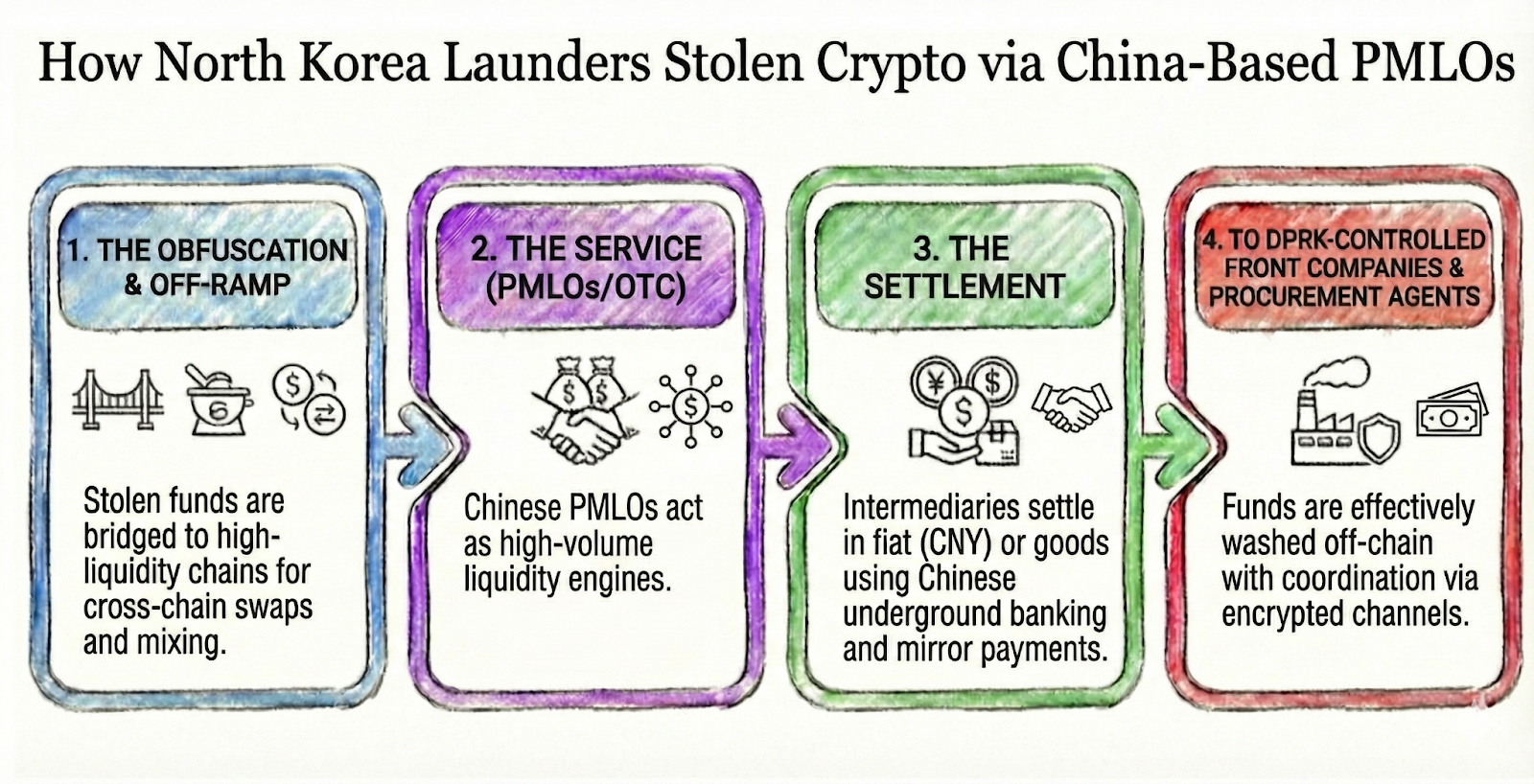
Once assets are stolen, they are laundered through a complex network known as the “Chinese Laundromat.”

This network comprises brokers, money transmitters, and trade-based intermediaries.

TRM notes that this process now occurs end-to-end with Chinese actors.

Funds move across chains, exchanges, and jurisdictions, often converting into stablecoins such as USDT on Tron before settlement in yuan, goods, or payments to North Korean front companies.
Source: TRMSource: TRM

Therefore, for exchanges and financial institutions, this evolution collapses traditional silos between cybersecurity and AML.

Static blocklists are insufficient; effective detection requires monitoring cross-chain flows and nested service counterparts, while pairing hardware-secured key storage with tiered withdrawal policies and privileged-access segmentation.

Overall, North Korea’s operations reflect the industrialisation of crypto theft.

They blend cyber activity, intelligence support, and outsourced laundering to create a state-directed revenue system.

As stablecoins and crypto payments grow, tracing stolen assets becomes increasingly complex.

This highlights the need for coordinated, cross-border measures to counter these structured, high-volume operations.

Featured image credit: Edited by Fintech News Hong Kong, based on image by aukid via Freepik

The post North Korea Linked to Over Half of 2025 Crypto Heist Losses appeared first on Fintech Hong Kong.

Market Opportunity
Moonveil Logo
Moonveil Price(MORE)
$0.002491
$0.002491$0.002491
+3.96%
USD
Moonveil (MORE) Live Price Chart
Disclaimer: The articles reposted on this site are sourced from public platforms and are provided for informational purposes only. They do not necessarily reflect the views of MEXC. All rights remain with the original authors. If you believe any content infringes on third-party rights, please contact service@support.mexc.com for removal. MEXC makes no guarantees regarding the accuracy, completeness, or timeliness of the content and is not responsible for any actions taken based on the information provided. The content does not constitute financial, legal, or other professional advice, nor should it be considered a recommendation or endorsement by MEXC.

You May Also Like

MFS Releases Closed-End Fund Income Distribution Sources for Certain Funds

MFS Releases Closed-End Fund Income Distribution Sources for Certain Funds

BOSTON–(BUSINESS WIRE)–MFS Investment Management® (MFS®) released today the distribution income sources for five of its closed-end funds for December 2025: MFS®
Share
AI Journal2025/12/23 05:45
BlackRock boosts AI and US equity exposure in $185 billion models

BlackRock boosts AI and US equity exposure in $185 billion models

The post BlackRock boosts AI and US equity exposure in $185 billion models appeared on BitcoinEthereumNews.com. BlackRock is steering $185 billion worth of model portfolios deeper into US stocks and artificial intelligence. The decision came this week as the asset manager adjusted its entire model suite, increasing its equity allocation and dumping exposure to international developed markets. The firm now sits 2% overweight on stocks, after money moved between several of its biggest exchange-traded funds. This wasn’t a slow shuffle. Billions flowed across multiple ETFs on Tuesday as BlackRock executed the realignment. The iShares S&P 100 ETF (OEF) alone brought in $3.4 billion, the largest single-day haul in its history. The iShares Core S&P 500 ETF (IVV) collected $2.3 billion, while the iShares US Equity Factor Rotation Active ETF (DYNF) added nearly $2 billion. The rebalancing triggered swift inflows and outflows that realigned investor exposure on the back of performance data and macroeconomic outlooks. BlackRock raises equities on strong US earnings The model updates come as BlackRock backs the rally in American stocks, fueled by strong earnings and optimism around rate cuts. In an investment letter obtained by Bloomberg, the firm said US companies have delivered 11% earnings growth since the third quarter of 2024. Meanwhile, earnings across other developed markets barely touched 2%. That gap helped push the decision to drop international holdings in favor of American ones. Michael Gates, lead portfolio manager for BlackRock’s Target Allocation ETF model portfolio suite, said the US market is the only one showing consistency in sales growth, profit delivery, and revisions in analyst forecasts. “The US equity market continues to stand alone in terms of earnings delivery, sales growth and sustainable trends in analyst estimates and revisions,” Michael wrote. He added that non-US developed markets lagged far behind, especially when it came to sales. This week’s changes reflect that position. The move was made ahead of the Federal…
Share
BitcoinEthereumNews2025/09/18 01:44
Foreigner’s Lou Gramm Revisits The Band’s Classic ‘4’ Album, Now Reissued

Foreigner’s Lou Gramm Revisits The Band’s Classic ‘4’ Album, Now Reissued

The post Foreigner’s Lou Gramm Revisits The Band’s Classic ‘4’ Album, Now Reissued appeared on BitcoinEthereumNews.com. American-based rock band Foreigner performs onstage at the Rosemont Horizon, Rosemont, Illinois, November 8, 1981. Pictured are, from left, Mick Jones, on guitar, and vocalist Lou Gramm. (Photo by Paul Natkin/Getty Images) Getty Images Singer Lou Gramm has a vivid memory of recording the ballad “Waiting for a Girl Like You” at New York City’s Electric Lady Studio for his band Foreigner more than 40 years ago. Gramm was adding his vocals for the track in the control room on the other side of the glass when he noticed a beautiful woman walking through the door. “She sits on the sofa in front of the board,” he says. “She looked at me while I was singing. And every now and then, she had a little smile on her face. I’m not sure what that was, but it was driving me crazy. “And at the end of the song, when I’m singing the ad-libs and stuff like that, she gets up,” he continues. “She gives me a little smile and walks out of the room. And when the song ended, I would look up every now and then to see where Mick [Jones] and Mutt [Lange] were, and they were pushing buttons and turning knobs. They were not aware that she was even in the room. So when the song ended, I said, ‘Guys, who was that woman who walked in? She was beautiful.’ And they looked at each other, and they went, ‘What are you talking about? We didn’t see anything.’ But you know what? I think they put her up to it. Doesn’t that sound more like them?” “Waiting for a Girl Like You” became a massive hit in 1981 for Foreigner off their album 4, which peaked at number one on the Billboard chart for 10 weeks and…
Share
BitcoinEthereumNews2025/09/18 01:26