

Gold Markets React to Diplomatic Efforts, Crude Oil Decline, and Central Bank Policy Signals
Key Takeaways
- Precious metal prices increased approximately 0.4% to reach ~$4,088 on Thursday following a six-month nadir earlier in trading
- Declining Brent crude prices helped alleviate inflation concerns, providing support for gold
- Diplomatic channels between Washington and Tehran remained active overnight despite ongoing military exchanges for the second day
- American consumer inflation accelerated to multi-year highs, primarily fueled by elevated fuel costs
- Market participants now anticipate Federal Reserve monetary tightening prior to 2026’s conclusion, creating downward pressure on precious metals
Precious metal valuations experienced a moderate uptick on Thursday following a retreat in petroleum prices, which helped diminish anxieties regarding accelerating inflation. Spot gold advanced approximately 0.4% to reach $4,088 per ounce during mid-morning trading. The session began with prices touching their weakest level in over half a year.
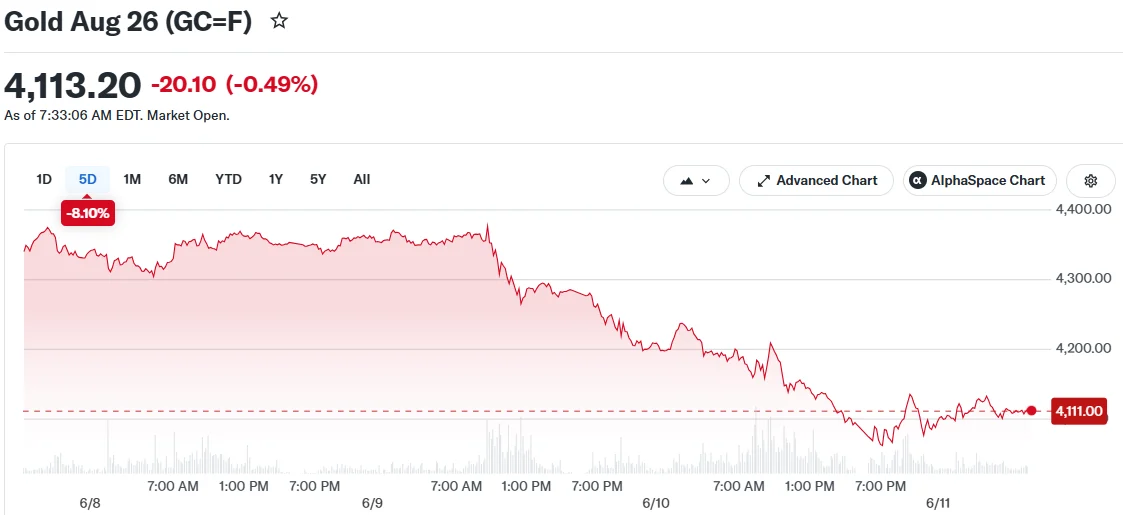 Gold Aug 26 (GC=F)
Gold futures contracts displayed contrasting momentum, declining roughly 0.6% to settle at $4,107 per ounce.
Crude Price Pullback Provides Relief for Precious Metals
Brent crude experienced a downturn on Thursday, erasing a portion of recent advances that followed the most recent round of military confrontations between Washington and Tehran. Oil prices continue trading significantly above pre-conflict benchmarks, though Thursday’s decline helped moderate concerns about renewed inflationary pressures.
Elevated energy expenses have been contributing to rising consumer costs. Wednesday’s economic data revealed American consumer price inflation operating at its most aggressive pace in multiple years, with gasoline serving as the primary driver. Market watchers are now focused on U.S. producer price figures, scheduled for release later Thursday, seeking additional insights.
When inflationary pressures intensify, monetary authorities typically implement interest rate increases. This dynamic creates challenges for gold, which generates neither interest income nor dividend payments.
Market pricing now reflects expectations for a Federal Reserve rate increase before 2026 concludes, based on CME’s FedWatch Tool analytics. The European Central Bank was similarly anticipated to implement rate adjustments at the conclusion of its two-day policy gathering Thursday, as policymakers work to manage eurozone inflation.
Middle East Diplomatic Efforts Continue Amid Ongoing Military Activity
American and Iranian representatives maintained diplomatic engagement overnight, even while both nations conducted aerial strikes for a consecutive second day. CNN confirmed negotiations remained ongoing. Reuters, referencing Iranian sources, indicated discussions encompassed potential frameworks to release frozen Iranian financial assets.
President Trump issued warnings of additional military responses should Iran fail to promptly accept an agreement.
U.S. Central Command reported American military forces engaged multiple Iranian targets overnight, characterizing the operations as defensive measures following the destruction of an American helicopter near the Strait of Hormuz.
Iran responded with counterstrikes targeting U.S. military installations and allied facilities throughout the Gulf region. Detonations were documented in Kuwait, Bahrain, and Jordan, though independent verification of these incidents remains pending.
Iran asserted it had suspended all maritime transit through the Strait of Hormuz. U.S. Central Command contradicted that assertion.
Iran has simultaneously maintained military exchanges with Israel concerning Israeli military actions against Hezbollah positions in Lebanon.
The U.S. dollar has appreciated since hostilities commenced in late February, potentially making gold more costly for international purchasers. The Dollar Index registered a 0.1% gain at 100.09 during Thursday trading.
Market participants are closely monitoring both diplomatic progress and central bank policy decisions as critical variables that will determine gold’s trajectory in coming weeks.
The post Gold Markets React to Diplomatic Efforts, Crude Oil Decline, and Central Bank Policy Signals appeared first on Blockonomi.


You May Also Like

Solana Price Prediction: SOL Slides Below $80 As $270M Hack Triggers Selloff

Raydium DEX Exploit Results in $1.3 Million Loss, Legacy Liquidity Pools Drained

Bitcoin Whales Are Quietly Accumulating: A Strategic Move That Could Signal Major Market Shift



