Overview
Global semiconductor memory and high-bandwidth storage leader
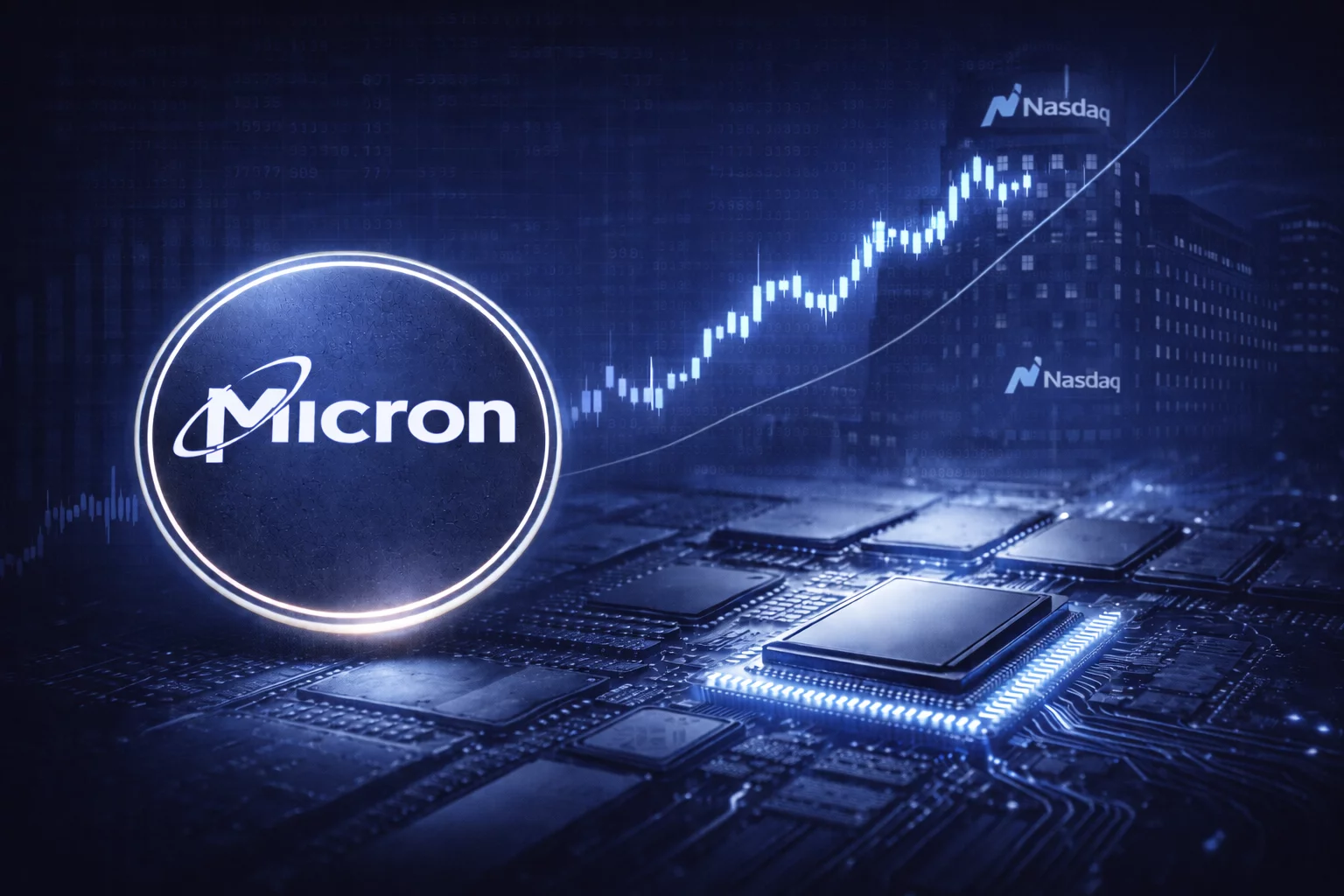
Micron Technology (NASDAQ: MU) achieved a historic milestone across public equity markets as its share price surged past the $1,000 threshold on substantial trading volume and broad-based institutional accumulation. The decisive catalyst driving this valuation expansion is the commercial release of
OpenAI next-generation frontier intelligence model, GPT-6 Astra. Diverging from previous architectures that prioritized raw parameter density, GPT-6 Astra incorporates a massive 1.05-million-token context window optimized specifically for autonomous computer use and complex agentic workflows. According to industry investigations from
Reuters and semiconductor supply chain data, this architectural evolution has shifted the primary infrastructure bottleneck from raw processor matrix computation to high-throughput data memory fabrics. Confronted with physical memory wall constraints across multi-turn reasoning workloads, institutional asset allocators are systematically repricing Micron from a cyclical commodity memory manufacturer into an indispensable enterprise utility, triggering a major revival of the artificial intelligence memory trade.
Key Takeaways
The thousand-dollar milestone establishes an unprecedented valuation benchmark, as Micron common stock crossed four digits amid dealer gamma short squeezes, options open interest repricing, and multi-billion-dollar institutional inflows.
GPT-6 Astra recalibrates compute and memory ratios, with OpenAI frontier agentic architecture deploying a 1.05-million-token context window that drives key-value cache memory footprints significantly higher during continuous autonomous task execution.
The memory wall emerges as the primary physical constraint on artificial intelligence scaling, forcing data center operators to prioritize memory bandwidth and low-latency storage fabrics to prevent expensive processor idle states.
Advanced manufacturing capacity commitments provide durable pricing power, as Micron's 1-beta DRAM node and advanced High Bandwidth Memory products remain fully committed through forward fiscal cycles under binding long-term agreements.
Institutional capital flows reflect a structural pivot toward inferencing infrastructure, demonstrating that enterprise capital expenditures are expanding from centralized training clusters toward distributed memory fabrics supporting high-concurrency autonomous agents.
Breaking the Thousand-Dollar Frontier: Institutional Capital Drives Historic Rerating
Trading across the
Nasdaq demonstrates that Micron's ascent past the $1,000 price point represents a structural shift in investor risk pricing and sector capital allocation.
Market analytics tracked by
Bloomberg confirm that heading into the $1,000 breakout, derivatives markets exhibited extreme call skew. Substantial institutional purchases of out-of-the-money call contracts forced option market makers to aggressively accumulate underlying common equity to maintain delta-neutral postures, generating a powerful self-reinforcing gamma squeeze. Simultaneously, algorithmic momentum models and macro hedge funds maintaining historical short positions based on legacy commodity cycles were forced into rapid capitulation, creating an air pocket of buying pressure that carried the equity to all-time highs.
This pricing dynamic is firmly anchored by fundamental upward revisions to corporate earnings projections. Consensus financial models compiled by the
Financial Times show equity analysts raising multi-year earnings-per-share estimates by more than thirty percent following the GPT-6 Astra deployment. Market participants are transitioning their valuation methodologies away from low-multiple cyclical trough accounting, valuing Micron's expanding cash flow visibility against premier hardware infrastructure platforms.
The GPT-6 Astra Paradigm Shift: Why Agentic Reasoning Demands Massive Memory Bandwidth
Evaluating the durability of the AI memory trade requires analyzing the computational physics introduced by OpenAI latest frontier release.
The Million-Token Context Window and Key-Value Cache Saturation
In conventional large language model deployments, context windows typically processed tens of thousands of tokens, allowing server memory pools to dedicate the majority of their dynamic capacity to core static model weights. According to technical documentation released by OpenAI, GPT-6 Astra features a native 1.05-million-token context window capable of ingesting extensive enterprise software repositories, multi-hour video feeds, and complex document archives in a single runtime session. Processing sequence lengths of this magnitude requires the execution engine to construct and continuously reference a massive key-value cache in dynamic memory. Because memory consumption for this cache expands linearly and quadratically with context length, physical memory saturation quickly exceeds model weight requirements, making high-density DRAM capacity the single most critical hardware parameter for enterprise deployment.
Systemic Transition from Pure Matrix Compute to Memory-Bound Workloads
Beyond raw storage volume, GPT-6 Astra represents a transition from conversational generation toward persistent agentic execution. When executing autonomous computer-use tasks, including cross-application data synthesis, live code compilation, and multi-step browser navigation, the underlying model performs hundreds of sequential, low-latency reasoning cycles. These workloads are inherently memory-bandwidth-bound rather than compute-bound. If the memory subsystem cannot deliver dynamic cache data to processing cores at multi-terabyte-per-second velocities, advanced computing processors enter prolonged idle states, driving hardware total cost of ownership upward. Overcoming this physical bottleneck necessitates incorporating dense, multi-layer high-bandwidth memory stacks directly adjacent to computing logic.
Supply-Demand Imbalance and Monopolistic Pricing Power: Micron 1-Beta Node and HBM Leadership
Within the competitive arena of advanced memory fabrication, Micron has established a defensible engineering position through its proprietary manufacturing node and packaging integration.
Advanced Node Energy Efficiency and Binding Forward Allocation
Rather than prematurely deploying high-cost extreme ultraviolet lithography across all initial layers, Micron optimized its proprietary 1-beta DRAM manufacturing process, delivering high die density and superior electrical efficiency. In power-constrained modern data centers where individual accelerated servers draw several kilowatts, Micron High Bandwidth Memory delivers roughly thirty percent lower power consumption compared to competitive alternatives of similar capacity. Mandatory regulatory disclosures filed with the
U.S. Securities and Exchange Commission confirm that Micron has entirely committed its advanced packaging capacity for upcoming fiscal quarters, securing binding multi-year purchase commitments from tier-one technology enterprises that guarantee minimum pricing baselines.
Architectural Alignment with Nvidia Accelerators and TSMC Packaging
Advanced hardware acceleration requires tightly integrated component ecosystems. Micron maintains engineering integration with global accelerator pioneer
Nvidia, pairing its high-speed memory architectures with flagship computing silicon. Concurrently, Micron collaborates within the open memory foundry network established by
TSMC, utilizing chip-on-wafer-on-substrate packaging technologies to ensure high interconnect yields between vertically stacked memory dies and core logic processors, consolidating its market position within the advanced computing supply chain.
Investors actively trading technology breakouts and managing volatility can utilize specialized derivatives tools on institutional platforms.
Concurrently, trading liquidity data from global digital asset platform
MEXC demonstrates sustained depth and cross-market turnover across major equities-linked digital assets during periods of accelerated technological deployment.
Financial Transformation: From Cyclical Commodity to Sovereign AI Infrastructure Utility
Surpassing the $1,000 milestone reflects an institutional reassessment of Micron corporate financial architecture and margin stability.
Structural Gross Margin Expansion Toward Software-Grade Profitability
Throughout historical capital cycles, memory producers were subjected to punishing price wars and severe margin compression during industrial downturns. However, as high-value, highly customized High Bandwidth Memory and enterprise solid-state storage expand past fifty percent of aggregate company turnover, historical cyclical volatility is diminishing. Because fabricating high-bandwidth memory requires complex cleanroom processing that consumes three times the standard wafer capacity of conventional commodity chips, open-market supply cannot easily be overbuilt. Consequently, Micron operating gross margins are expanding toward sixty percent, demonstrating cash flow resilience historically restricted to monopolistic software conglomerates.
Free Cash Flow Generation and Sustainable Multi-Billion-Dollar CapEx Cycles
Sustained cash flow visibility provides Micron with organic balance sheet strength. To finance fabrication complexes in Idaho and New York, the company is generating sufficient operational cash flow to fund multi-billion-dollar capital expenditure budgets without relying heavily on high-interest debt issuance or dilutive equity offerings. This capital recycling capability eliminates the historical equity discount typically applied to asset-intensive hardware fabricators.
Forward Risks and Critical Operational Variables to Monitor
While GPT-6 Astra establishes multi-year structural tailwinds for the memory ecosystem, market participants navigating elevated equity valuations must evaluate several fundamental variables:
Cloud hyperscaler capital allocation durability, tracking whether major infrastructure operators adjust forward hardware procurement schedules if enterprise software monetization experiences extended payback cycles.
Advanced packaging yield ramps and defect management, observing whether high-layer-count memory stacks sustain stable manufacturing yields during mass production to protect projected operating margins.
Competitive manufacturing responses from industry peers, monitoring the pace at which
SK Hynix and
Samsung Electronics bring new advanced fabrication lines online, guarding against medium-term regional oversupply conditions.
Exclusive View from James Mitchell
From a quantitative market structure and capital cycle perspective, Micron's breakout above the $1,000 level represents the definitive transition of the artificial intelligence economy from pure compute acceleration to memory interconnect optimization.
Market participants often mischaracterize this equity advance as late-stage speculative momentum, failing to recognize the thermodynamic and architectural realities of enterprise agentic software. When GPT-6 Astra executes multi-step workflows across million-token contexts, the operational constraint shifts entirely away from theoretical processor floating-point operations toward memory bus throughput. Micron's cross-asset multiple expansion reflects an institutional repricing of sovereign pricing power in a market where data access speed determines software viability. For professional derivatives traders and macro allocators, the conversion of $1,000 from historical resistance into structural support resets the volatility surface across the entire semiconductor sector. The critical forward indicator is not daily spot pricing fluctuations, but the verified delivery lead times of advanced liquid-cooled compute racks and the expanding percentage of high-bandwidth memory within total server hardware bills of materials.
FAQ
Why did Micron stock break above the $1,000 milestone?
Micron crossed the $1,000 mark following the public unveiling of OpenAI GPT-6 Astra model, which features a 1.05-million-token context window optimized for agentic workflows. The resulting demand for massive memory bandwidth and high-density storage prompted institutional investors to revalue Micron as a critical, high-margin infrastructure utility.
What makes GPT-6 Astra so demanding on semiconductor memory?
GPT-6 Astra operates as an autonomous agent executing long-horizon computer tasks, requiring real-time management of an enormous key-value cache across its 1.05-million-token window. This active data footprint places sustained demands on physical memory capacity and throughput, consuming significantly more dynamic memory than standard prompt-completion models.
What is the memory wall in modern computing architecture?
The memory wall refers to the performance disparity where raw processor computation speeds advance faster than the transfer rate of data moving between memory chips and compute cores. In high-throughput artificial intelligence inference, inadequate memory bandwidth forces processors to sit idle, severely limiting system efficiency.
What engineering advantages does Micron hold in advanced packaging?
Micron utilizes its proprietary 1-beta DRAM fabrication process to achieve exceptional energy efficiency, reducing operational power consumption by roughly thirty percent compared to competing memory nodes. Furthermore, Micron advanced products are deeply integrated with Nvidia compute platforms and TSMC packaging ecosystems.
Is Micron still vulnerable to traditional memory boom and bust cycles?
Micron exposure to commodity volatility is structurally reduced because specialized High Bandwidth Memory consumes significant wafer capacity and requires complex custom integration, preventing rapid supply gluts and securing higher, more predictable gross margins under long-term customer agreements.
What primary risks should investors consider at current valuation levels?
Key risks include potential fluctuations in cloud hyperscaler capital expenditures, manufacturing yield challenges associated with scaling higher-layer memory stacks, and competitive capacity additions from global fabricators like SK Hynix and Samsung Electronics.
Disclaimer
The information, analysis, and views contained in this article are provided for general educational and informational purposes only and do not constitute financial advice, investment advice, legal advice, tax advice, or a recommendation to buy or sell any security, digital asset, or financial derivative. Equity securities and financial instruments are subject to high market volatility and capital risk. Past operational performance, financial results, and quantitative indicators do not guarantee future market returns. Investors must conduct independent due diligence and evaluate their personal financial situation, risk tolerance, and investment goals before executing any trade. The MEXC Crypto Pulse team assumes no liability for any direct or indirect financial losses resulting from the use of or reliance upon the information published herein.
About the Author
James Mitchell specializes in technical analysis, market trends, and trading strategies for both Bitcoin and altcoins. Based in London, he has over 10 years of experience in financial markets. Before joining MEXC Learn, James worked as a senior analyst at a leading European investment firm, where he developed expertise in risk management and quantitative trading. His transition to cryptocurrency markets began in 2017, and he has since become recognized for his data-driven approach. He holds a Master's degree in Financial Economics from the London School of Economics. His analytical approach combines traditional technical analysis with on-chain metrics to provide readers with actionable insights. Areas of expertise encompass technical analysis, market trends and cycles, trading strategies, Bitcoin and altcoin analysis, and risk management.
Research References