Taiwan Semiconductor Manufacturing Company (NYSE: TSM) reported $46.72 billion in Q3 2026 revenue and NT$763.06 billion in net profit on October 15, with profit rising 68.7% year over year as demand for advanced semiconductor manufacturing remained strong.
Revenue exceeded TSMC's previous guidance, while the company forecast $52.3 billion–$54.3 billion in fourth-quarter revenue, signaling expectations for further growth. However, gross margin declined sequentially as the chipmaker expanded production of its latest 2-nanometer (2nm) technology.
The results highlight a key trade-off for TSMC: strong demand for advanced computing is supporting record earnings, but scaling next-generation manufacturing requires substantial investment and creates near-term margin pressure.
Key Takeaways
Q3 revenue reached $46.72 billion, up 41.2% year over year in U.S. dollar terms and above TSMC's previous guidance of $44.6 billion–$45.8 billion.
Net profit increased 68.7% to NT$763.06 billion, while diluted earnings per ADR reached $4.60.
Gross margin was 66.4%, within the company's previous guidance but down 1.3 percentage points from Q2, primarily due to the initial 2nm production ramp.
2nm technology contributed 8% of wafer revenue, up from 3% in Q2. Advanced technologies at 7nm and below accounted for 79%.
High-Performance Computing (HPC) represented 68% of total revenue, with HPC revenue increasing 22% sequentially.
Q4 2026 revenue guidance was $52.3 billion–$54.3 billion, with gross margin expected at 65%–67%.
Q3 capital expenditures totaled $13.84 billion, bringing spending for the first nine months of 2026 to $40.64 billion.
What Were TSMC's Q3 2026 Earnings Results?
Net profit attributable to shareholders reached NT$763.06 billion, compared with NT$452.30 billion a year earlier.
Key financial results included:
Revenue: $46.72 billion, up 41.2% year over year and 16.2% quarter over quarter in U.S. dollar terms.
Net profit: NT$763.06 billion, up 68.7% year over year and 8.0% sequentially.
Diluted EPS: NT$29.43 per ordinary share, equivalent to $4.60 per ADR.
Gross margin: 66.4%, compared with 67.7% in Q2 and 59.5% in Q3 2025.
Operating margin: 58.7%, compared with 60.3% in Q2 and 50.6% a year earlier.
Net profit margin: 51.1%, compared with 55.6% in Q2 and 45.7% a year earlier.
The results show that TSMC generated substantially higher revenue and profit than a year earlier, although profitability margins moderated from the previous quarter.
For investors, the distinction matters. Revenue growth demonstrates strong demand for advanced manufacturing capacity, while the margin trend reveals the costs associated with expanding newer semiconductor processes.
Did TSMC Beat Its Q3 Revenue and Profit Expectations?
TSMC exceeded its own third-quarter revenue guidance and delivered net profit above the market estimate reported before the earnings announcement.
The company previously forecast Q3 revenue of $44.6 billion–$45.8 billion. Actual revenue of $46.72 billion was approximately $920 million above the upper end of that range.
Operating margin also exceeded management's guidance, reaching 58.7% against a previously projected range of 56%–58%.
However, gross margin of 66.4% remained within the company's expected range of 65%–67%.
Separately, Reuters reported that analysts had expected approximately NT$746.3 billion in quarterly net profit, compared with the actual NT$763.06 billion.
That distinction is important: TSMC exceeded its own revenue guidance and analysts' net profit expectations, but its gross margin should not be described as a guidance beat.
The earnings surprise therefore reflected stronger operating performance alongside the expected cost of scaling advanced manufacturing technology.
Why Did TSMC's Gross Margin Decline Despite Higher Profit?
TSMC's gross margin decreased from 67.7% in Q2 to 66.4% in Q3, a decline of 1.3 percentage points.
In its
official Q3 management report, the company attributed the sequential decline primarily to margin dilution from the initial production ramp of its N2, or 2nm, technology.
New manufacturing processes require substantial investment in equipment, production qualification and manufacturing scale. The early stages of a technology ramp can carry higher costs before production becomes more efficient.
TSMC's challenge is therefore not simply to increase 2nm output, but to improve manufacturing economics as the process becomes a larger contributor to revenue.
The annual comparison presents a different picture.
Despite the sequential decline, Q3 gross margin remained 6.9 percentage points above the 59.5% recorded in Q3 2025.
This suggests that TSMC entered the latest technology transition with considerably stronger overall profitability than a year earlier, even as the initial 2nm ramp weighed on quarterly margins.
How Much Revenue Did TSMC's 2nm Technology Generate?
TSMC's 2nm technology accounted for 8% of total wafer revenue in Q3 2026, compared with 3% in Q2.
The increase shows that N2 production is becoming a more significant part of the company's advanced manufacturing business.
According to TSMC's quarterly technology breakdown:
2nm: 8% of wafer revenue, up from 3% in Q2.
3nm: 33%, compared with 30% in Q2.
5nm: 28%, compared with 33%.
7nm: 10%, compared with 11%.
Combined, processes at 7nm and below represented 79% of total wafer revenue.
These percentages measure wafer revenue by manufacturing technology, not the share of total company revenue or the percentage of physical wafer shipments.
The rapid increase in 2nm's contribution also helps explain the margin discussion.
While the technology is gaining commercial scale, the initial production ramp is temporarily weighing on profitability.
The key question for future quarters is whether higher utilization, manufacturing improvements and growing customer demand can help offset those costs.
What Does TSMC's Q4 2026 Guidance Show?
TSMC's updated fourth-quarter outlook points to continued revenue growth, although management expects gross margin to remain within a range similar to Q3.
Q4 2026 revenue: $52.3 billion–$54.3 billion.
Q4 gross margin: 65%–67%.
Q4 operating margin: 56.5%–58.5%.
Assumed exchange rate: NT$31.8 per U.S. dollar.
At the midpoint of $53.3 billion, the revenue outlook implies approximately 14.1% sequential growth from Q3's $46.72 billion.
The guidance indicates that TSMC expects demand and revenue momentum to remain strong into the final quarter of 2026.
At the same time, the projected 65%–67% gross margin suggests that higher revenue does not necessarily translate into an immediate improvement in manufacturing profitability.
That creates an important distinction between revenue growth and margin expansion as TSMC continues investing in advanced production technologies.
How Is AI Demand Affecting TSMC's Revenue Mix?
High-Performance Computing remained TSMC's largest revenue platform in Q3, contributing 68% of total revenue, compared with 66% in Q2 and 57% in Q3 2025.
HPC revenue increased 22% sequentially, according to the company's management report.
Other major platform contributions included:
The expanding HPC share reflects the importance of advanced computing workloads to TSMC's business.
AI accelerators and other high-performance processors require advanced semiconductor manufacturing, contributing to demand for leading-edge production capacity.
However, HPC revenue should not be interpreted as AI-only revenue. The category includes other computing applications, so the 68% contribution does not represent a separately disclosed AI revenue figure.
For companies such as NVIDIA (NVDA) and AMD (AMD), TSMC's results provide additional context for the strength of advanced semiconductor manufacturing demand.
Still, TSMC's HPC growth does not directly establish future orders or earnings for individual chip designers.
How Much Did TSMC Spend on Capital Expenditures in Q3 2026?
TSMC reported $13.84 billion in capital expenditures during Q3, compared with $15.70 billion in Q2 and $11.10 billion in Q1.
Total capital expenditures for the first nine months of 2026 reached $40.64 billion.
The company's Q3 management report also showed:
Operating cash flow: NT$919.77 billion.
Free cash flow: NT$476.56 billion.
Q2 free cash flow: NT$287.36 billion.
Quarterly free cash flow improved as operating cash generation increased and capital expenditures declined from the previous quarter.
These figures indicate that TSMC continued investing heavily in manufacturing capacity while generating substantial cash from operations.
The previously announced full-year 2026 CapEx outlook of $60 billion–$64 billion remains an important reference point, but that range was disclosed before the October 15 earnings announcement and should not be treated as a newly raised forecast.
For investors, the central question is whether sustained demand for advanced semiconductors will justify the substantial capital required for technology upgrades and production expansion.
TSMC Overnight Trading on MEXC: What Did TSMUSDT Show?
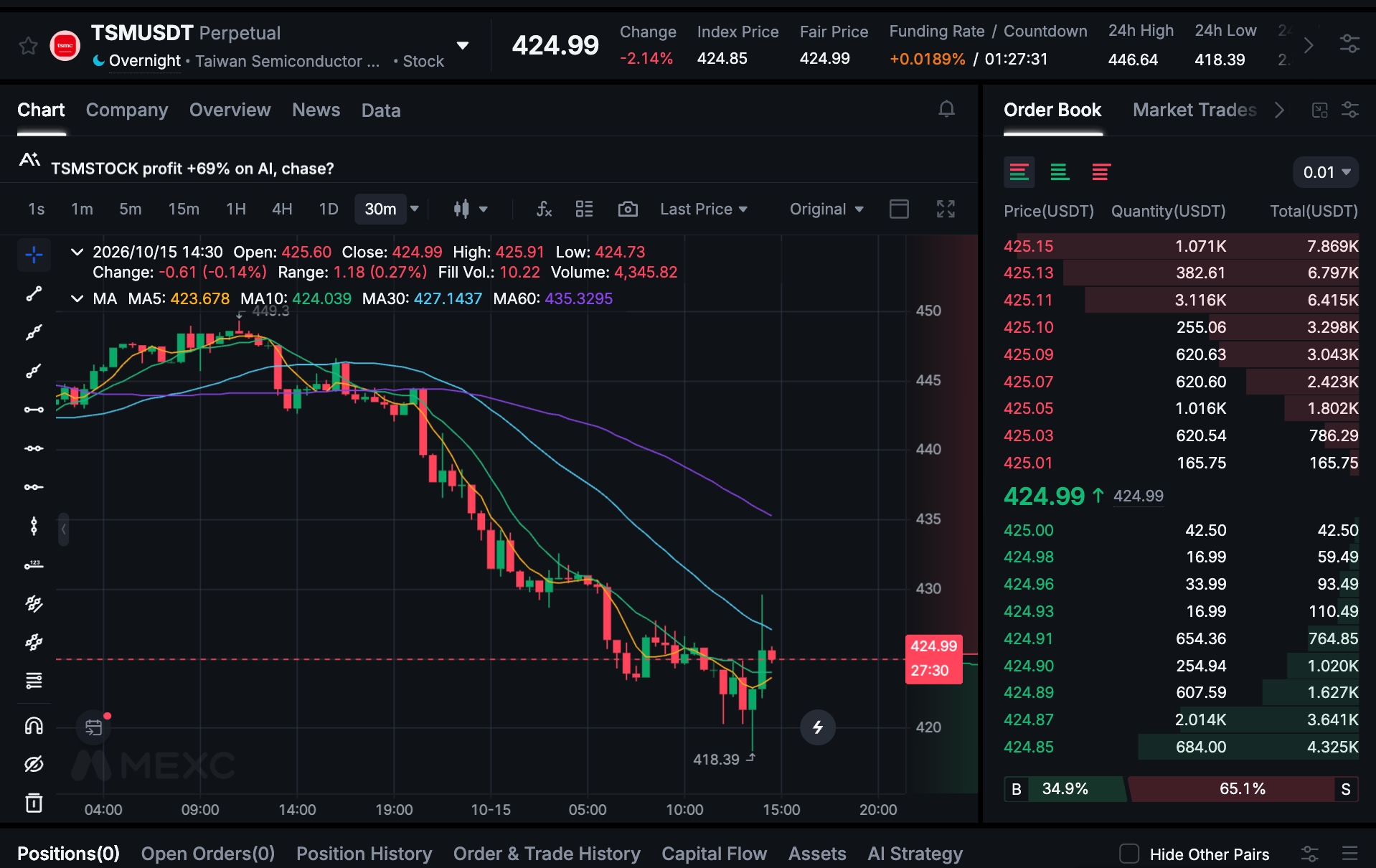
While TSMC reported nearly 69% year-over-year net profit growth, a trading snapshot of the
TSMUSDT perpetual contract on MEXC on October 15 showed a
displayed decline of 2.14%.
The contract was quoted at 424.99 USDT, with a 24-hour high of 446.64 USDT and a low of 418.39 USDT.
Other displayed contract indicators included:
The order-book figures describe displayed liquidity according to the platform's calculation. They do not establish that 65.1% of traders held short positions.
Similarly, a positive funding rate alone does not prove institutional buying or widespread short covering.
The snapshot provides a view of short-term derivatives trading conditions around the earnings period, but it does not establish that TSMC's financial results caused the displayed contract decline.
Importantly, TSMUSDT is a perpetual derivatives contract, not the Nasdaq-listed TSM American depositary receipt (ADR). Its price and percentage change should not be treated as TSM's official U.S. share-price performance.
MEXC also offers
Real U.S. Stocks on MEXC as a separate stock-trading product, subject to availability and eligibility. Stock ownership and perpetual derivatives exposure involve different product structures, trading conditions and rights.
What Do TSMC's Q3 Results Mean for the AI Semiconductor Industry?
TSMC's results provide further evidence that manufacturers are expanding the production infrastructure required for advanced computing.
For NVIDIA (NVDA), demand for AI accelerators is an indirect driver of advanced-node manufacturing activity, although TSMC's financial results do not directly forecast NVIDIA's revenue.
For AMD (AMD), the expansion of advanced computing capacity provides context for long-term demand for leading-edge processor manufacturing.
For ASML (ASML), higher production requirements support the broader semiconductor equipment investment cycle, although lithography equipment orders and recognized revenue follow their own delivery schedules.
The connection between these companies is important, but it should not be overstated.
TSMC's financial disclosures show strong manufacturing demand and rising HPC exposure. They do not separately establish the order growth, revenue contribution or profit outlook of every company participating in the AI semiconductor supply chain.
What Should Investors Watch After TSMC's Q3 Earnings?
Three factors will help determine whether TSMC can sustain its current earnings momentum.
The profitability of 2nm manufacturing. N2's wafer revenue contribution increased to 8%, but its initial ramp diluted gross margin. Future results will show whether expanding production scale improves manufacturing efficiency.
The sustainability of HPC demand. HPC represented 68% of quarterly revenue and grew 22% sequentially. Continued demand for advanced computing will remain important for TSMC's capacity utilization and revenue mix.
Q4 revenue growth and capital efficiency. TSMC's Q4 revenue guidance of $52.3 billion–$54.3 billion points to further growth, while gross margin guidance of 65%–67% indicates that manufacturing costs remain relevant. Capital expenditure and free cash flow will help investors assess the financial impact of continued expansion.
TSMC's Q3 2026 results demonstrate strong revenue growth, record profitability and rapid adoption of advanced manufacturing technologies.
The central trade-off is now clearer: 2nm production and HPC demand support long-term growth, but scaling the newest manufacturing processes can temporarily pressure margins even as overall earnings rise.
FAQ
What were TSMC's Q3 2026 earnings results?
TSMC reported revenue of $46.72 billion, net profit of NT$763.06 billion and diluted earnings of $4.60 per ADR. Net profit increased 68.7% year over year.
Did TSMC beat its Q3 2026 revenue guidance?
Yes. Actual revenue of $46.72 billion exceeded the upper end of TSMC's previous guidance of $44.6 billion–$45.8 billion.
What is TSMC's Q4 2026 revenue guidance?
TSMC expects Q4 revenue of $52.3 billion–$54.3 billion, with gross margin between 65% and 67% and operating margin between 56.5% and 58.5%.
Why did TSMC's gross margin decline in Q3?
Gross margin decreased from 67.7% in Q2 to 66.4% in Q3, primarily because of margin dilution associated with the initial ramp-up of 2nm manufacturing.
What percentage of TSMC's wafer revenue came from 2nm?
TSMC's 2nm technology contributed 8% of total wafer revenue in Q3 2026, up from 3% in Q2.
How much did TSMC spend on CapEx in Q3 2026?
TSMC reported $13.84 billion in Q3 capital expenditures, bringing total spending for the first nine months of 2026 to $40.64 billion.
Is TSMC's 68% HPC revenue share entirely AI revenue?
No. HPC includes AI-related applications and other high-performance computing products. The 68% share should not be interpreted as a separately reported AI-only revenue figure.