1. Today's Market: Change the Gauge and the Same Day Gives a Different Conclusion
Unit: %, absolute values of the single-day fall on October 16, each gauge computed from its own index close on the same day; all four bars are drawn from zero on one shared scale. The Dow reads 0.34, the S&P 500 1.09, the Nasdaq Composite 2.14 and the PHLX Semiconductor index 3.83.
The gradient is clean: the Dow fell just 0.34% and the semiconductor index 3.83%, about 11 times as far. What was sold on Friday was not US stocks in general but the AI line: the Nasdaq 100 lost 5.5% on the week, the semiconductor index is on its longest losing run since 2008, and Korean shares opened 3.17% lower in Asian hours today with Samsung Electronics and SK Hynix still under pressure.
When you see how far something fell, first ask which gauge it is. Four numbers from one session differ by a factor of 11, so how deep this week's drawdown feels is mostly a function of the semiconductor weight you hold; read it as "the market is falling" and you wait for a bounce when you should be changing the structure.
2. Stock in Focus: Apple +0.43%, the Only One of Six to Rise
Unit: %. Fewer than five US large caps fit the consumer electronics basis, so these six are picked by hand from the technology sector rather than an automatic peer list; the set spans positive and negative, so a zero line is drawn and all six share one scale. Apple sits at one end on +0.43% and AMD at the other on −5.95%, 6.38 points apart, with the six averaging −2.61%.
This was genuinely a move against the sector, and genuinely a move of its own. Consumer electronics averaged a 0.76% fall, so the negative sector average establishes the first; only Apple rose among the six while the other five all fell, which establishes the second. It ran 3.04 points ahead of the average of the six and 2.57 points ahead of the Nasdaq. What moved it is the company's own story: preorders for the first foldable iPhone, the iPhone Duo, opened the same day and pushed shipping estimates for every configuration to January 25, 2027, with the stock closing at $343.46 for a record close on volume 1.21 times its three-month average. Hold the other side of moving alone at the same time: this is a single-stock event, not a sector move, semiconductors and technology fell as a group that day so the gain cannot be read as the theme turning, and the launch date is October 23, with first-batch shipments and the model mix undisclosed until after launch and the quarterly results.
Five Dimensions: Peer Rank a Full 100, Valuation Heat Only 3
Unit: 0 to 100, against peers and its own one-year history, measured over a one-year window rather than the single session. Peer rank scores the full 100, trend position reads 96, volatility 77 and relative strength 56 (measured against the consumer electronics sector average of −0.76%), while the weakest, valuation heat, reads only 3.
Four corners reach high and one sits almost on the centre. Peer rank at 100 measures where it stands among its peers, while valuation heat at 3 measures how expensive the sector is right now: different reference sets, so both hold at once. The multiple confirms it, with the consumer electronics price-to-earnings ratio in the 97th percentile of its past year. Being the strongest among peers and being cheap to buy are two questions to ask separately; read together carelessly, "the best of the group" becomes "a good price today".
3. What to Watch Tonight: The First Session of the Chip Repricing
13:30|The US market opens The first session since the PHLX Semiconductor index fell 3.83% on Friday, with no technology results tonight
14:00|October NAHB housing market index (32 last time) 🔴 This lands half an hour after the open, so it is not a pre-market release
Pre-open results|FITB Fifth Third; STLD and CCK after the close, with technology results only on Wednesday
No inflation or employment data this week The Fed is also in its blackout from October 17 to 29, so until the October 27 and 28 decision the market prices on nothing but price and earnings
What tonight really is The first open at which the US market reprices whether AI capital spending earns its return, and the only price signal before Wednesday's results
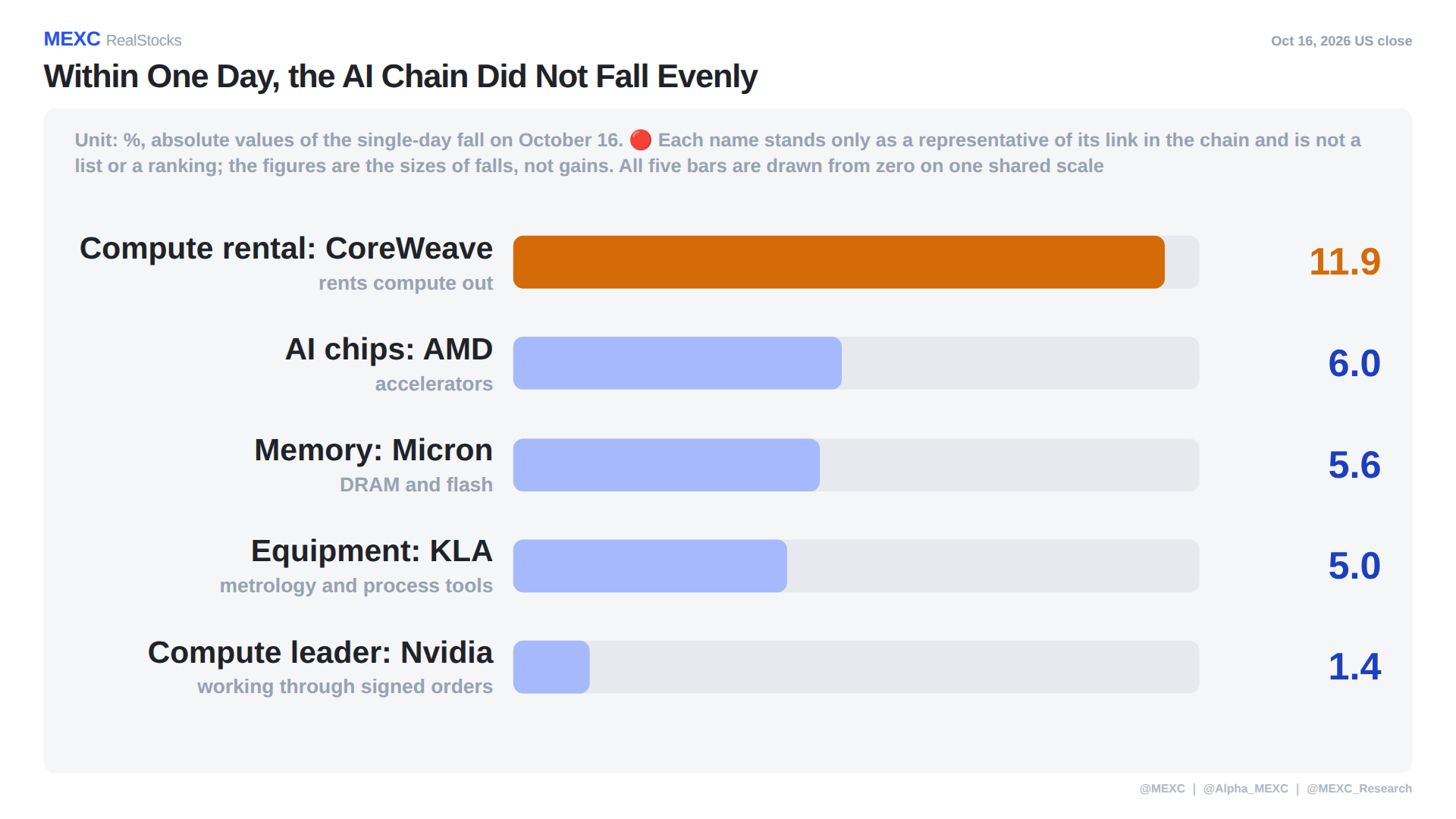
Unit: %, absolute values of the single-day fall on October 16. ⚠️ Each name stands only as a representative of its link in the chain and is not a list or a ranking. CoreWeave in compute rental reads 11.9, AMD in AI chips 6.0, Micron in memory 5.6, KLA in equipment 5.0 and Nvidia, the compute leader, 1.4.
One session, a spread of about 8 times Nvidia fell only 1.4%, the equipment and memory names about 5%, and CoreWeave, which rents compute out, fell 11.9%
The mechanism is not complicated The closer to either end of the chain, the more revenue depends on whether others keep paying to build data centres, while the leader is working through orders already signed; so what was repriced is the funding and return on AI capital spending, not demand for AI chips
Two boxes to watch tonight Whether memory and equipment can hold: two Korean memory makers fell 17.8% and 24.3% last week, their largest weekly falls since 2008, and remain under pressure in Asian hours today, which makes them the epicentre
The real answer comes Wednesday Lam Research, Texas Instruments, Meta and Tesla all report after the close, and only then are there figures to settle the argument about capital spending
4. Frequently Asked Questions
Q: Apple rose 0.43%. Was that a move against the sector?
A: Yes, and unusually it was a move of its own as well. Moving against the sector needs a negative sector average, and consumer electronics fell 0.76%; moving alone needs no second name in the set rising, and only Apple rose while the other five all fell. It ran 3.04 points ahead of the average of the six and 2.57 points ahead of the Nasdaq. The other side of moving alone is that this is a single-stock event, not a sector move.
Q: Peer rank is a full 100 but valuation heat is only 3. Is that a contradiction?
A: No, the reference sets differ. Peer rank measures where it stands among its peers; valuation heat measures how expensive the sector is right now, with the consumer electronics price-to-earnings ratio in the 97th percentile of its past year. Being the strongest among peers and being cheap to buy can fail to hold at the same time.
Q: What exactly was repriced in Friday's fall?
A: The funding and return on AI capital spending, rather than demand for AI chips. The evidence is in how unevenly it fell: on the same day Nvidia lost 1.4%, equipment and memory about 5%, and CoreWeave, which rents compute out, 11.9%, a spread of about 8 times. The closer to either end of the chain, the more revenue depends on whether others keep building data centres, while the leader is working through orders already signed. Tonight the question is whether that spread narrows or widens.
Disclaimer: This article is compiled and written by the MEXC RealStocks team. The data in this article is based on the closing of the US stock market on October 16, 2026. The content is a compilation of public market information, and individual stocks are publicly discussed targets, which do not represent the recommendation or opinion of MEXC and do not constitute any investment advice. More US stock content: @MEXC | @Alpha_MEXC | @MEXC_Research